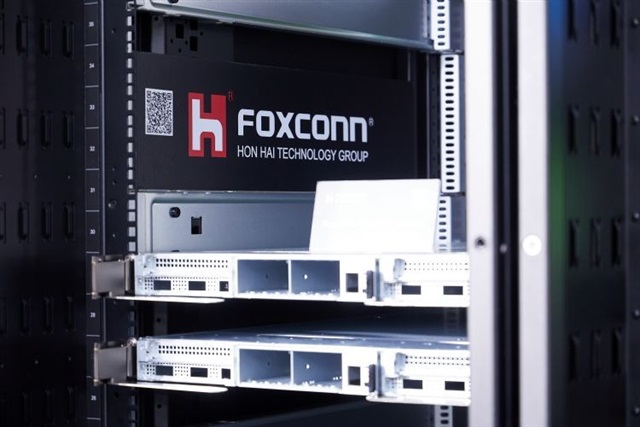
And just like that, the revenue numbers dropped. Foxconn Industrial Internet (FII), the hulking industrial arm of Hon Hai Precision Industry, just posted first-quarter 2026 results that made Wall Street’s eyes water. Net profit? Up a cool 102%. Revenue? Absolutely blew past expectations. What’s the magic elixir? AI. Specifically, the hungry maw of artificial intelligence computing power demand that just can’t seem to get enough AI GPUs and custom ASICs.
It’s almost too neat, isn’t it? A company literally built on making the stuff the world needs to plug into silicon minds, suddenly finding itself swimming in cash because everyone else wants to build silicon minds. For twenty years I’ve watched these cycles, the hype trains that pull into the station with all the fanfare of a coronation, only to find the real money is being made by the guys building the tracks, not necessarily the ones riding the fancy new locomotive. FII, in this narrative, are the track builders. They assemble. They manufacture. They provide the industrial backbone for this AI gold rush.
The AI Gold Rush: Who’s Selling the Shovels?
This isn’t Foxconn’s first rodeo, obviously. They’ve been the silent, gargantuan engine behind more consumer electronics than most people have owned in a lifetime. But this AI surge feels different. It’s less about a single product, like a new iPhone, and more about a fundamental shift in computing. Demand for the specialized chips that power AI models – GPUs from Nvidia, AMD, and those bespoke ASICs dreamt up by cloud giants – has created a bottleneck. And who’s best placed to alleviate that bottleneck? The outfit with acres of factory floor and decades of experience in scaling complex manufacturing. FII.
Look, the PR speak is always about innovation and growth. And sure, FII is growing. But let’s be real: their primary function is to execute at scale. They are the supreme logistical wizards of the electronics world. When Nvidia designs a new monster GPU, who’s going to be churning out millions of them? When Google or Amazon needs a custom chip for their data centers, who’s going to be pumping those out? It’s FII. Their profit growth isn’t a proof to some revolutionary new manufacturing technique (though I’m sure they’ve optimized everything to hell). It’s a direct reflection of the sheer, unadulterated demand for the output of the AI revolution.
“Benefiting from the continued expansion of artificial intelligence (AI) computing power demand, Foxconn Industrial Internet (FII), a subsidiary of Hon Hai Precision Industry (Foxconn), reported first-quarter 2026 revenue that far exceeded market expectations…”
This quote, buried in the original report, is the crux of it. ‘Benefiting from’. That’s the key. FII isn’t driving the AI revolution in terms of innovation, they are profiting from its expansion. And that’s not a criticism; it’s a business model. And frankly, a brilliant one if you’re in their shoes. While chip designers are locked in a costly R&D arms race, and AI model builders are burning through VC cash on training runs, FII is quietly, efficiently, making the physical components.
Why Does This Matter for Developers?
For developers, this surge means one thing: more hardware to play with. More GPUs available, potentially at more competitive prices (though I wouldn’t hold my breath for deep discounts just yet). It means that the ambitious AI projects that were previously constrained by hardware scarcity might now see the green light. Think larger language models, more complex computer vision systems, and real-time AI applications that were once confined to theoretical papers. FII’s success is a signal that the infrastructure to run AI is rapidly expanding. And where there’s more infrastructure, there’s more opportunity to build applications on top of it.
However, it also underscores the concentration of power. The companies that can afford to commission these high-volume, custom ASIC runs are typically the tech behemoths. This further entrenches their advantage. While open-source AI models are flourishing, the hardware on which they run is becoming increasingly specialized and controlled by a few massive players and their manufacturing partners like FII. It’s a double-edged sword: more power available, but potentially less diversity in the hardware landscape.
The Cost of Doing Business (for Everyone Else)
The numbers are undeniably impressive. FII’s Q1 2026 performance is a flashing beacon for investors and industry watchers alike. It’s a strong indicator that the AI hardware market isn’t just surviving; it’s thriving, growing, and demanding more. More production capacity, more advanced manufacturing processes, and, for FII, more profit. But it also highlights the immense capital expenditure required to even participate in this hardware arms race. Designing these chips is astronomically expensive, and manufacturing them at scale requires an industrial ecosystem that few can replicate. This isn’t a startup playing field; it’s a domain for established giants and their indispensable manufacturing partners.
So, while the headlines will focus on the dazzling profit growth – and they should, it’s a huge number – remember where the real value is being created. It’s in the circuits, yes, but also in the sheer, unglamorous, and profoundly important act of building them. FII isn’t just building phones or laptops anymore; they are building the engines of the next technological epoch. And they’re getting handsomely paid for it.
🧬 Related Insights
- Read more: Synopsys Nails HBM4 Silicon Link-Up — But Who’s Cashing In First?
- Read more: NVIDIA GTC 2026: Vera Rubin, Feynman, and Cosmic Overreach
Frequently Asked Questions
What does Foxconn Industrial Internet (FII) actually do? FII is a subsidiary of Hon Hai Precision Industry (Foxconn) that focuses on providing smart manufacturing solutions, cloud computing services, and network equipment, with a significant role in producing components and systems for the AI industry.
Is the demand for AI GPUs sustainable? The sustained high demand for AI GPUs, as evidenced by FII’s profit growth, suggests a strong, ongoing trend driven by the expanding applications of AI across various sectors, from data centers to consumer devices.
Will this profit growth mean cheaper AI hardware? While increased production capacity and competition can theoretically lead to lower prices, the current demand, coupled with the high R&D and manufacturing costs for advanced AI chips, suggests that significant price reductions are unlikely in the short term. The profits are currently being reinvested into further expansion and innovation.