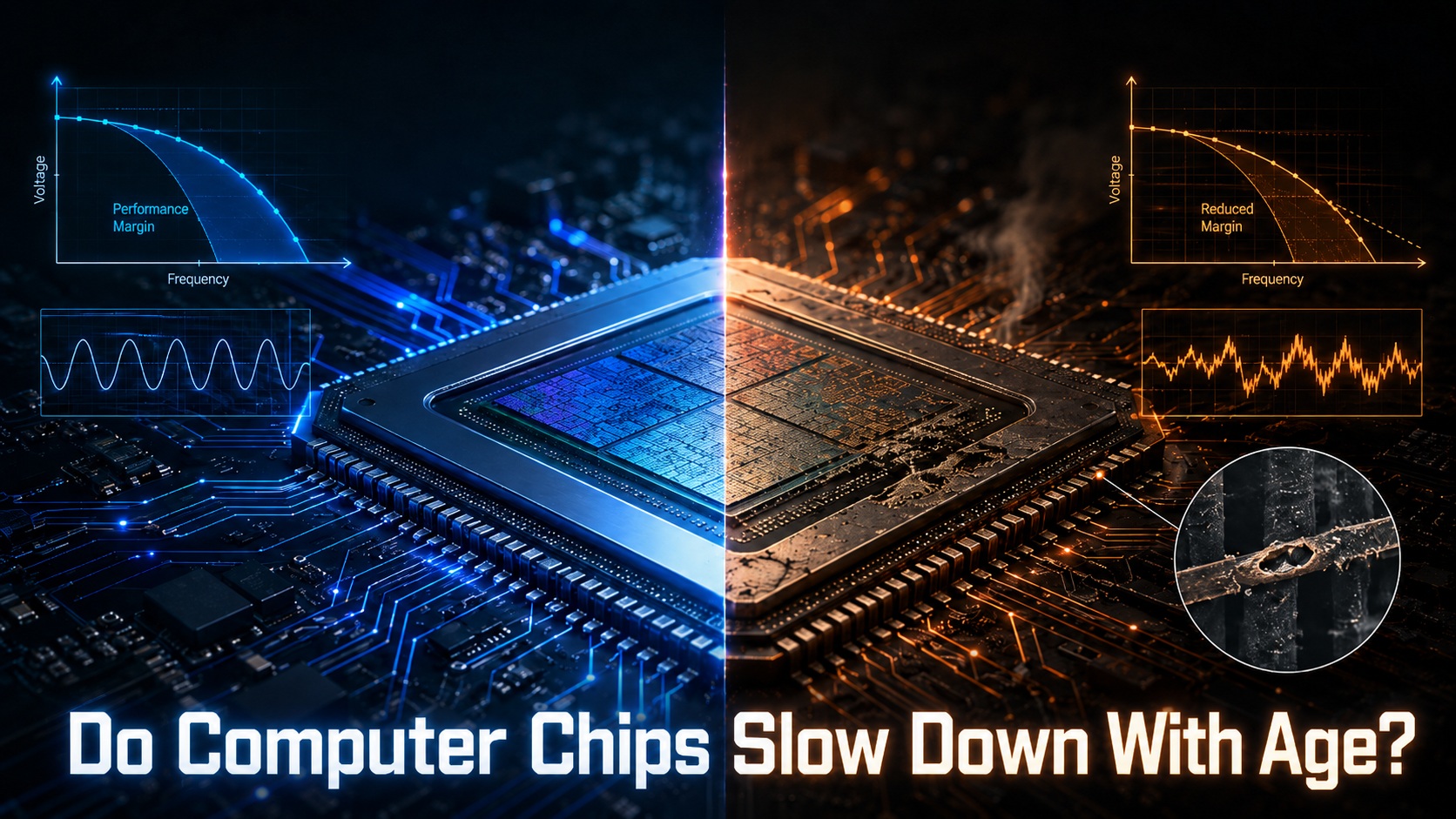
So, the million-dollar question that gets trotted out every few years in tech circles: Do computer chips, you know, actually get slower as they age? It’s the kind of query that sounds simple enough, right? Like asking if your car tires wear out. But, as is often the case with anything silicon-based, the answer is a lot less black and white and a whole lot more… nuanced. Everyone expects a straightforward ‘yes’ or ‘no,’ but reality, as usual, has other plans.
Look, your CPU or GPU isn’t going to wake up one morning and decide to clock itself down 10% just because it’s seen five years of your questionable browsing history. For most of us, if our trusty PC starts feeling sluggish, it’s probably not the silicon’s fault. Think accumulated dust bunnies forming insulating blankets, thermal paste dried out like ancient jerky, background apps staging a silent coup, the OS deciding to stage a bloatware convention, security patches that hog resources, or simply newer, hungrier games demanding more than your old rig can chew. Oh, and don’t forget our own ever-increasing expectations. We expect things to fly, even when the hardware hasn’t changed.
But here’s the kicker: that doesn’t mean the whole ‘silicon aging’ thing is just some mythical beast cooked up by over-caffeinated engineers. Nope. At a fundamental, physical level, chips absolutely do age. Those tiny transistors, the complex interconnects, the delicate insulating layers, even the pathways that deliver power – they all operate under a constant barrage of electrical and thermal stress. And over enough time, that relentless pressure can slowly, insidiously, eat away at the precious voltage and frequency ‘headroom’ that allowed the chip to hum along reliably in the first place.
I’ve seen this firsthand more times than I care to admit, especially with GPUs. You’d get a graphics card dialed in, nail an overclock that was rock-solid stable, only to have it start hiccuping months later running the exact same clocks, voltages, and at similar temperatures. It wasn’t like the card suddenly developed a limp. Instead, it felt like the little bit of extra wiggle room, the safety margin that made that aggressive tuning possible, had just… shrunk. That’s the real story of silicon aging for the enthusiast crowd: not a chip getting tired and wheezing like a vintage engine, but a chip gradually losing the buffer that once allowed for wild overclocking.
The Illusion of a Fixed Speed
Modern CPUs and GPUs aren’t just static, fixed-speed beasts. They’re constantly playing a game of digital Tetris, adjusting their frequencies on the fly based on a dizzying array of factors: power budgets, voltage levels, current draw, thermal readings, what the workload is actually doing, the arcane rules embedded in the BIOS/UEFI, and any little tweaks the user might have thrown in. Intel’s Turbo Boost, for instance, is already a tightly regulated dance limited by power, current, thermal caps, how many cores are active, and the silicon’s maximum clock potential. In other words, boost clocks are already conditional even before aging enters the conversation. This is where the crucial distinction lies: ‘the chip has aged’ is a world away from ‘the chip is now slower.’
A brand-new CPU might be validated by the manufacturer to hit a scorching 5.5 GHz within a specific voltage range, all with a healthy dollop of reliability margin baked in. Years down the line, that same chip might still chug along at its stock settings without breaking a sweat, because Intel, AMD, or NVIDIA didn’t ship it with a razor-thin safety net. But if you were the kind of person who ran manual overclocks, experimented with aggressive undervolting, or simply pushed your chip to run at consistently high voltages and temperatures, then that diminished margin? Yeah, that’s where it starts to bite.
Aging, in essence, shifts the chip’s stability curve. The frequency that once worked perfectly fine at a given voltage may eventually demand a slightly higher voltage. Or, if you keep the voltage the same, then the chip might just start requiring slightly lower clock speeds to maintain stability. It’s a subtle recalibration, not a sudden breakdown.
What’s Actually Wearing Down? The Dirt on Chip Components
Digging deeper, silicon aging isn’t some monolithic event. It’s actually a constellation of wear-and-tear mechanisms that chip designers and their engineering teams have to meticulously account for right from the drawing board when they’re designing and validating these complex pieces of silicon. It’s a constant battle to stay ahead of the curve.
For us PC enthusiasts, the main culprits to keep an eye on are a quartet of technical terrors: negative-bias temperature instability (NBTI), hot-carrier injection (HCI), time-dependent dielectric breakdown (TDDB), and electromigration. A pretty hefty 2025 review of IC reliability practically shouts from the rooftops that NBTI, HCI, TDDB, electromigration, and other aging-induced variations are becoming major reliability threats as chips continue their relentless march toward ever-higher frequencies and voltages.
Negative-bias temperature instability (NBTI) is a big one. In layman’s terms, the combination of voltage and temperature stress can gradually, but surely, alter how a transistor behaves. This can lead to a shift in the threshold voltage, meaning a transistor might need slightly different electrical conditions to reliably switch on and off as it once did. NBTI is widely acknowledged as a core MOSFET reliability issue, often linked to an increase in threshold voltage and a reduction in transistor drive strength – essentially, how well it performs its switching or amplification duties.
Hot-carrier injection (HCI) is another aging mechanism that sounds like it belongs in a sci-fi flick. Under extremely high electric fields, these energetic carriers – basically tiny, electrically charged particles, usually electrons – can inflict damage on specific parts of a transistor over time. You can visualize it as the transistor being electrically ‘roughed up’ by years of operating under intense pressure, like a boxer taking round after round.
Then there’s time-dependent dielectric breakdown (TDDB). This one is less about a graceful performance dip and more about the insulating layers within the chip slowly wearing thin. This isn’t typically the cause of a subtle 5% performance loss. Instead, it’s a long-term reliability mechanism that can, eventually, contribute to outright failure. Think of it like insulation on a wire finally giving out.
Finally, electromigration. This is essentially the aging of the chip’s internal wiring, stressed by constant current flow. CPUs and GPUs are packed with incredibly tiny metal interconnects that act as highways for current, shuttling electricity between transistors. Over time, high current densities can cause these metal atoms to gradually move, creating voids and bumps within these microscopic pathways. This can lead to increased resistance or, in the worst-case scenario, open circuits.
So, does your chip get slower? Not in the way you’re probably imagining. It loses its headroom, its stability margin, its ability to push those boundary-pushing clock speeds without throwing a tantrum. It’s a slow erosion of the perfection that was engineered into it, not a sudden death sentence.