Did Xi Jinping just hand us the geopolitical blueprint for the next decade, using a 2,400-year-old historical framework to warn us about what’s coming? When Xi Jinping stood with Donald Trump in Beijing in May 2024 and invoked the Thucydides Trap — that unsettling historical observation that a rising power and an entrenched hegemon are, if not destined, then at least structurally prone to conflict — it wasn’t just academic musing. It was a statement of intent, with Taiwan and its indispensable semiconductor industry immediately becoming the focal point.
The chip industry, so often discussed in terms of nanometers and market share, is now irrevocably tied to the grand chessboard of global power dynamics. And at the heart of this tangled web lies TSMC’s CoWoS, or Chip on Wafer, a sophisticated advanced packaging technology. This isn’t just about making chips smaller or faster; it’s about securing them, about controlling the very foundations of modern technological dominance.
Xi’s mention of the Thucydides Trap, a concept derived from the Peloponnesian War, is a stark reminder that historical patterns, however ancient, can cast long shadows. The rising power (China) and the established hegemon (the U.S.) are locked in a dance that grows increasingly tense. Taiwan, sitting smack-dab in the middle, isn’t just an island; it’s the world’s premier chip foundry, churning out the silicon that powers everything from your smartphone to advanced military hardware. It’s the ultimate prize, and the ultimate vulnerability.
The Geopolitical Significance of Advanced Packaging
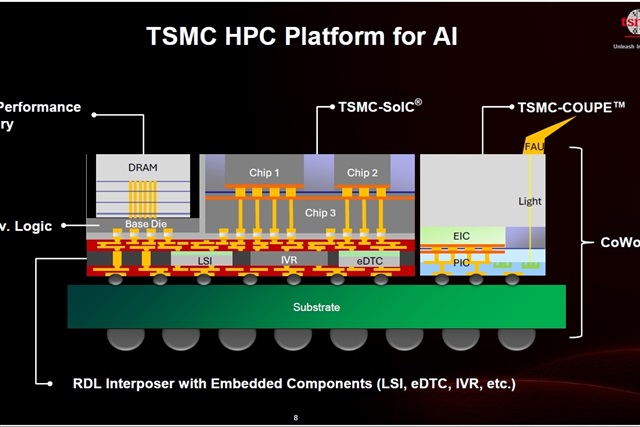
This is where TSMC’s COUPE (Chip on Wafer) initiative, and more broadly its CoWoS advanced packaging capabilities, enters the fray not just as a technological advancement but as a strategic imperative. For years, the narrative has been about leading-edge process nodes – 5nm, 3nm, and beyond. But the real magic, increasingly, is happening after the silicon wafer has been fabbed. Advanced packaging allows for the integration of multiple chips, or chiplets, into a single, powerful unit. It’s a way to boost performance, reduce power consumption, and, crucially, to customize solutions for specific, high-value applications like AI accelerators and high-performance computing.
However, it also represents a critical choke point. The concentration of this advanced packaging capacity in Taiwan, primarily with TSMC, makes it an irresistible target in any geopolitical showdown. The ability to manufacture these complex, integrated chips is a superpower in itself. Losing access to TSMC’s advanced packaging would cripple the global tech industry and severely hobble both the U.S. and China’s ambitions. The U.S. understands this intimately, which is why its CHIPS Act includes significant funding not just for domestic chip fabrication but also for R&D in advanced packaging.
“The real battle is no longer just about who can fabricate the smallest transistor, but who can orchestrate and integrate those transistors most effectively into functional systems.” (Paraphrased from industry sentiment)
Here’s the thing: The Thucydides Trap isn’t just about military might. It’s about economic dominance, technological supremacy, and control over critical supply chains. China’s rapid ascent means it views the existing global order as inherently stacked against it, and the U.S. sees China’s rise as an existential threat to its own dominance. Taiwan, with its unparalleled chip manufacturing prowess, finds itself in the unenviable position of being the fulcrum.
Why Does TSMC’s COUPE Matter So Much?
Xi’s explicit mention of the Thucydides Trap, followed by discussions on Taiwan, isn’t subtle. It’s a declaration that the status quo is untenable. For TSMC, and specifically its COUPE and CoWoS technologies, this translates into immense pressure. The company is being asked to perform a geopolitical tightrope walk. It needs to serve its global customer base – including U.S. entities heavily reliant on its advanced packaging for AI dominance – while navigating the demands and threats from Beijing, which views technological self-sufficiency as paramount and Taiwan as a breakaway province.
This isn’t just about market forces at play. It’s about national security. The U.S. Department of Defense, for instance, has long expressed concerns about over-reliance on Taiwan for advanced chip packaging. The fear is that a blockade or conflict would sever access to these critical components, with catastrophic consequences for U.S. defense capabilities and its entire high-tech economy.
So, when Xi speaks of the Thucydides Trap and Taiwan, he’s not just talking about territorial claims. He’s talking about denying the established hegemon the very technological tools it uses to maintain its position. And TSMC’s advanced packaging is high on that list. It’s a stark reminder that the future of semiconductors isn’t just about innovation; it’s about power, control, and the ever-present specter of conflict.
The Geopolitical Tightrope
TSMC’s COUPE isn’t a standalone technological marvel; it’s a critical piece of infrastructure in a global power struggle. The company’s ability to continue innovating and manufacturing at the cutting edge, while simultaneously managing the escalating geopolitical tensions between its two largest potential patrons (the U.S. and China), is perhaps the most complex challenge facing any corporation today. The success of its COUPE initiative, and its broader advanced packaging capabilities, will therefore be measured not just by yield rates and revenue growth, but by its resilience in the face of Xi’s chilling invocation of historical conflict. The stakes have never been higher.
Is China Capable of Replicating TSMC’s Advanced Packaging?
While China has made significant strides in semiconductor manufacturing, particularly in mature process nodes, replicating TSMC’s cutting-edge advanced packaging capabilities like CoWoS remains a formidable challenge. The complexity of the multi-chip integration, the precision required, and the proprietary intellectual property involved create substantial barriers. Despite substantial investment and a determined drive for self-sufficiency, the gap in advanced packaging technology is considered significant, making it a critical bottleneck in China’s semiconductor ambitions and a key reason why Taiwan’s semiconductor industry remains so strategically vital.