Are your most advanced tools actually making your chip designs more likely to fail? It’s a question that feels like a sci-fi paradox, but it’s rapidly becoming the most pressing issue in the semiconductor world, and it’s not about raw compute power anymore.
We’re talking about governed convergence. Think of it like this: for years, we’ve been perfecting individual instruments in an orchestra – the world’s most powerful simulators, the sharpest verification suites. Each one plays a beautiful, complex solo. But now, as these systems get mind-bogglingly complex, especially at nodes like 5nm and below and in the dizzying world of chiplets, the challenge isn’t making a single instrument sound better. It’s getting the whole dang orchestra to play in harmony without a conductor who understands every single instrument’s nuance.
Siemens’ Calibre Connectivity Interface is a great example of the industry finally waking up. By making verification output a data foundation for other tools, they’re pushing us from isolated silos toward connected engineering ecosystems. Big step! But here’s the kicker: interoperability is just the first handshake. It’s the equivalent of making sure all the musicians can read the same sheet music. It doesn’t guarantee they won’t play a cacophony.
The Entropy Wall: Where Complexity Breaks Everything
This is where things get really interesting. As systems get more tightly woven together – silicon, package, thermal, mechanical, signal integrity, you name it – the number of interactions explodes. It’s like a digital Jenga tower; pull out one piece incorrectly, and the whole thing might wobble. The original article calls this the “Entropy Wall,” and it’s a doozy. It’s that point where coordinating across all these specialized domains becomes harder than the original engineering task itself. Historically, our limits were transistors or clock speeds. Now, it’s our ability to make sense of the sheer interconnectedness.
The illusion of progress: each domain looks fine, but the system is failing.
And here’s the punchline that’ll make you raise an eyebrow: many folks are betting heavily on AI to fix this. But uncontrolled AI, fed on a diet of already fragmented data and conflicting assumptions, might just be a super-powered amplifier for chaos. Imagine training an AI on a symphony where every musician is playing a different tune; it’ll learn to play all those tunes, but it won’t create harmony. It could speed up local optimizations while actually worsening the global system stability. Intelligence isn’t convergence. Prediction isn’t governance. Automation isn’t authority.
Is AI the Answer, or Part of the Problem?
This is the core of the governed convergence problem. We’ve got the tools, the AI models, the compute. What we’re critically short on is the ability to knit it all together, to ensure that evidence from different domains can be normalized, understood in context, and used for rock-solid, system-wide decisions. This is the difference between a really smart assistant who can give you a great answer on one topic and a master strategist who can coordinate an entire military campaign.
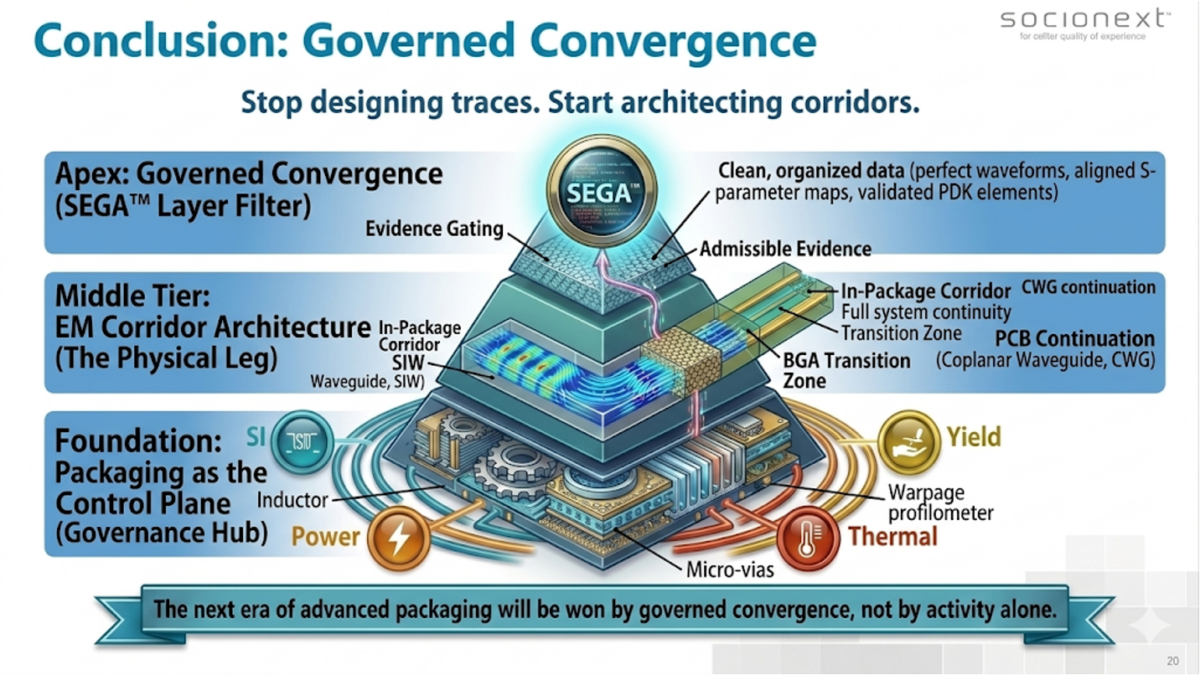
Look at chiplets, advanced packaging, AI accelerators – these aren’t just slightly more complex chips; they’re entire ecosystems where the package itself is no longer just a passive holder. It’s becoming an active control plane, dictating power, thermal, and signal behavior for the whole system. The old ways of thinking about packaging as “just the box” are long gone.
Historically, packaging has been treated primarily as a physical integration layer. That assumption is rapidly changing. At multi-terabit bandwidths and in highly coupled heterogeneous systems, packaging increasingly functions as an active control plane through which power integrity, thermal behavior, signal integrity, manufacturability, and system stability must converge simultaneously.
This is fundamentally an orchestration challenge. It’s the conductor problem, writ large across the entire semiconductor industry. We need systems that can manage the messy, human, and increasingly distributed decision-making processes at a scale we’ve never encountered before.
The Next Frontier: Orchestrating Chaos
We’re heading into an era where the ability to govern complexity, not just to simulate or predict it, will be the ultimate competitive advantage. It’s a massive shift from tool-centric design to system-convergence design. And frankly, it’s exhilarating to think about the new architectures and engineering paradigms that will emerge when we finally crack this. It’s less about faster clocks and more about cohesive, reliable, and intelligently coordinated systems.
What we’re seeing now is the semiconductor industry’s version of humanity figuring out how to build cities instead of just villages. The old rules don’t apply, and the tools of yesterday are insufficient. The future of chip design isn’t just about silicon; it’s about the complex, governed dance of everything that makes a complex system sing.
🧬 Related Insights
- Read more: BenQ Materials Ships CMP Rollers to Fabs – Taiwan’s Latest Semi Gamble?
- Read more: AI Predicts River Temps: Energy Sector Rejoices
Frequently Asked Questions
What is governed convergence in chip design? Governed convergence refers to the ability to coordinate and harmonize highly specialized engineering domains (like silicon, packaging, thermal, power) to achieve a coherent, manufacturable, and reliable system-level design, ensuring deterministic decision-making across the entire engineering stack.
Will AI solve the convergence problem? While AI can optimize individual domains, it risks amplifying existing fragmentation if not integrated within a governed convergence framework. True convergence requires more than just prediction; it demands normalized evidence and deterministic decision-making capabilities that AI alone doesn’t inherently provide.
Why is packaging becoming more important in chip design? In advanced heterogeneous systems with high bandwidths, packaging is evolving from a passive integration layer to an active control plane that significantly influences power integrity, thermal behavior, signal integrity, and overall system stability, making it crucial for convergence.