Does Your OS Really Know How Fast Your CPU Can Go?
It’s a question most users never consider, buried beneath layers of abstraction and proprietary silicon wizardry. Yet, for years, operating systems like Windows and Linux have been largely fumbling in the dark when it comes to understanding the peak performance potential of AMD Ryzen processors. They’ve relied on estimations, interpolations, and guesswork to figure out just how fast a specific core can burst. But this is all about to change.
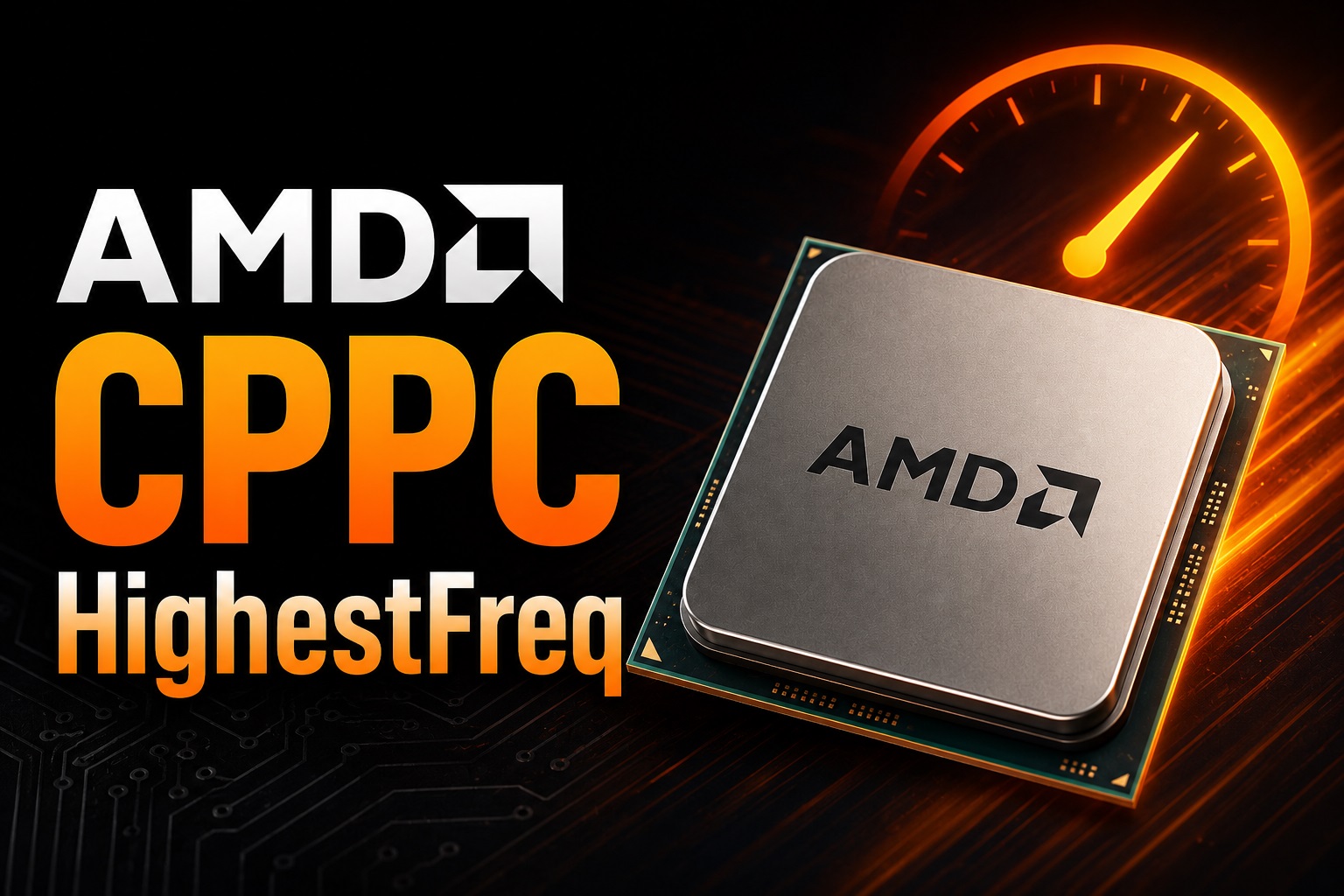
AMD’s forthcoming CPPC HighestFreq initiative, slated for integration into the ACPI 6.7 specification and appearing in Linux AMD P-State drivers, aims to fundamentally alter this dynamic. Instead of abstract performance metrics or educated guesses, CPUs will soon be able to directly report their actual maximum boost frequencies to the operating system via firmware. This isn’t just a technical tweak; it’s a potential paradigm shift for CPU scheduling and, by extension, system responsiveness.
The Guesswork Game
Modern AMD Ryzen chips are sophisticated beasts, heavily utilizing Collaborative Processor Performance Control (CPPC). The problem? Current CPPC implementations don’t expose the raw, maximum frequency information to the OS. This forces Windows and Linux to employ indirect methods—often involving abstract performance numbers and interpolation—to estimate how a given core will behave under load. This approach, while functional, is increasingly problematic as Ryzen’s boosting algorithms become more nuanced and asymmetrical across cores.
The CPPC does not expose actual frequency information to the OS. Therefore, Windows and Linux rely on abstract performance numbers and interpolation methods to estimate the boost behavior.
Think about it. If the OS scheduler incorrectly assumes a core’s capabilities, a demanding task like a AAA game might not land on the absolute fastest core available. The performance hit might not be catastrophic in every instance, but it’s a subtle inefficiency, a missed opportunity for peak responsiveness. This is particularly vexing given that Ryzen processors already designate “preferred cores” and exhibit varying boost behaviors across their silicon. Knowing the exact boost clock provides the scheduler with precise intelligence, enabling it to make truly optimal decisions.
Why This Matters for Peak Performance
This is where CPPC HighestFreq becomes more than just a technical footnote. For high-performance computing, especially gaming and other latency-sensitive applications, granular control is paramount. The ability for the OS to directly query a core’s maximum sustained boost frequency means schedulers can move beyond guesswork and make informed assignments. Instead of treating cores as roughly equivalent performers within a performance tier, the OS will be able to dynamically prioritize threads for the actual best-performing cores at any given moment.
This is not about the absolute theoretical maximum frequency of the chip, but rather the highest frequency a specific core can sustain under current thermal and power conditions, as reported by the CPU itself. It’s the difference between a general directive and a precise instruction, and in the hyper-competitive world of silicon performance, that distinction matters.
A Historical Parallel in CPU Management
This feels remarkably similar to the early days of multi-core processing, where operating systems initially struggled to efficiently distribute workloads. The evolution from basic round-robin scheduling to more sophisticated affinity-aware techniques was driven by the need to use the growing complexity of CPU architectures. CPPC HighestFreq represents the next logical step in that evolution for frequency management. It’s about equipping the OS with the intelligence needed to fully exploit the sophisticated boosting mechanisms AMD has engineered into its processors.
The implications extend beyond just raw speed; improved scheduling accuracy can lead to more consistent frame rates in games, quicker rendering times in professional applications, and a generally snappier user experience. It’s a move towards a more direct, less abstracted relationship between the hardware’s true capabilities and the software that orchestrates its execution.
What’s Next?
As this feature makes its way into upcoming ACPI specifications and drivers, expect to see the direct benefits trickle down to end-users. While the underlying hardware is already capable of these advanced boosts, the operating system’s improved visibility will unlock its full potential. It’s a quiet but significant development, a proof to the ongoing, often unseen, work required to make our silicon perform at its absolute best.