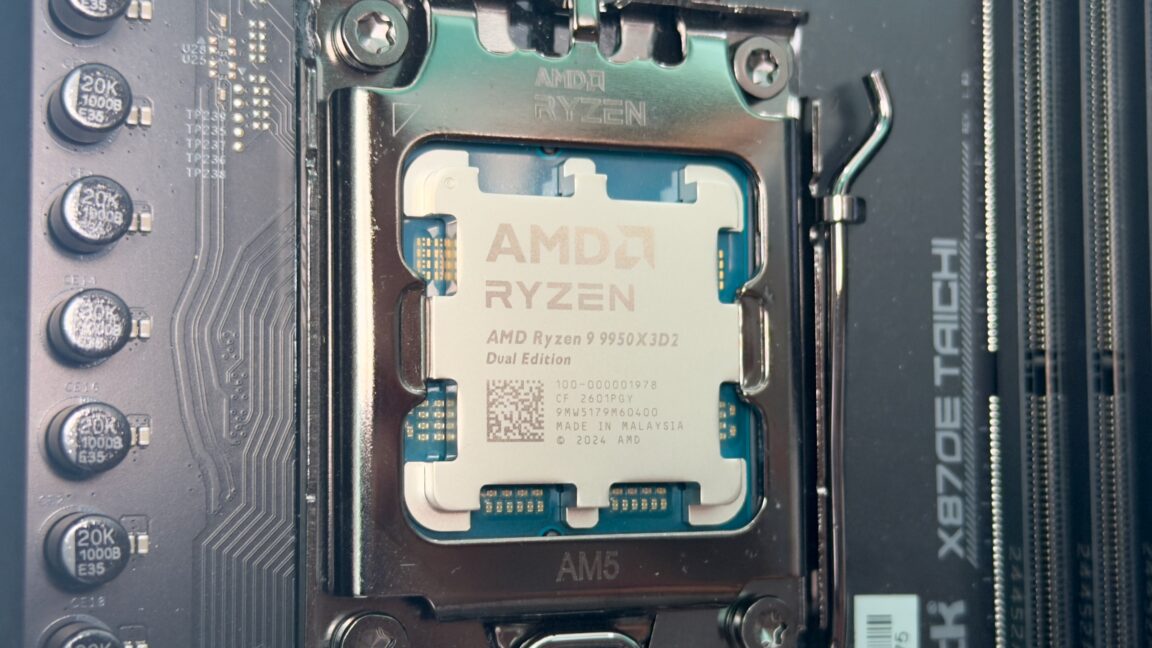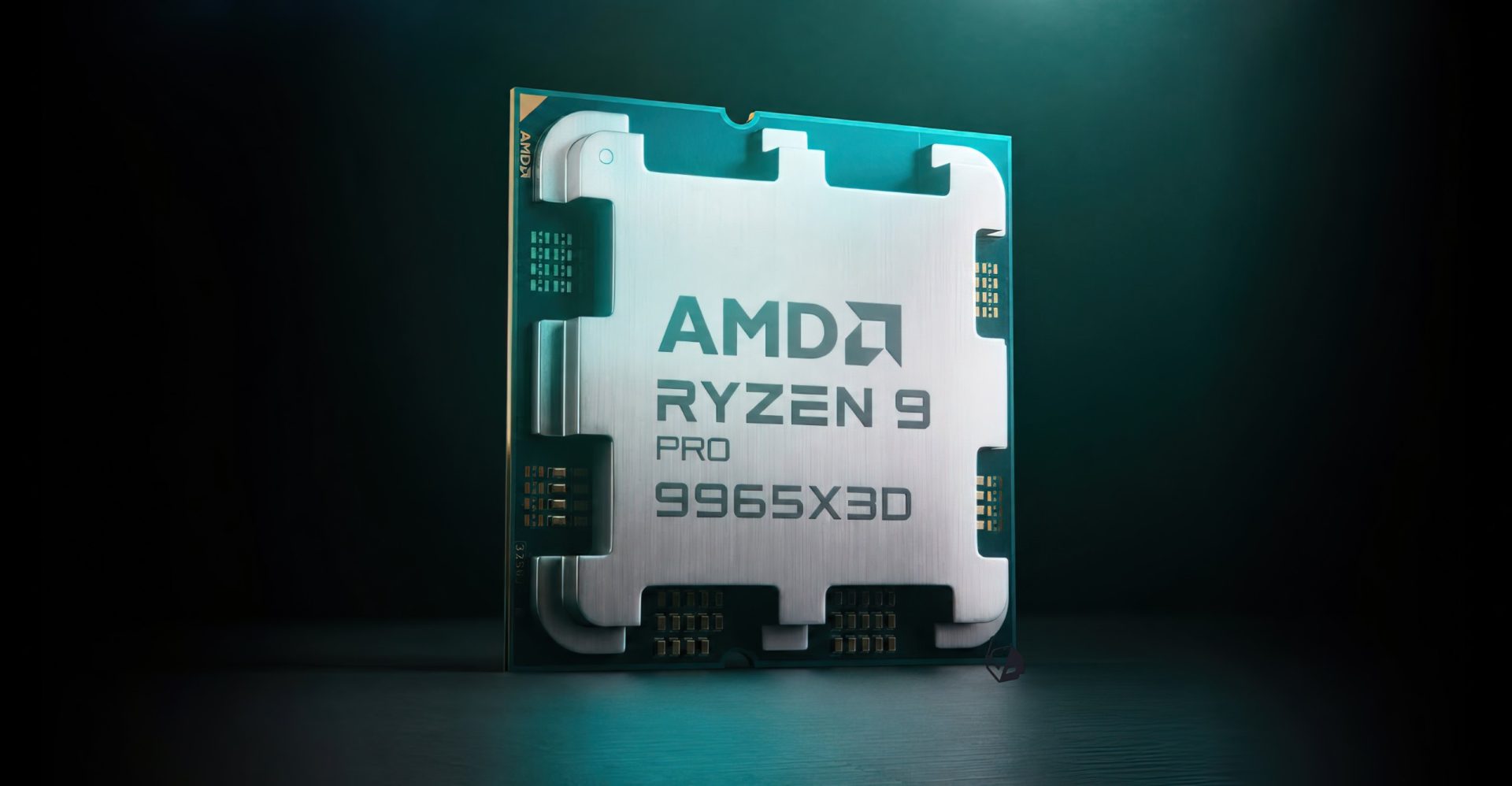
And just like that, the ground beneath the professional workstation market shifts. Forget incremental updates; we’re talking about a seismic event, a tectonic plate of processing power grinding its way to our desks. The rumor mill, usually a whisper network for tech journalists, is practically screaming about the AMD Ryzen 9 PRO 9965X3D. This isn’t just another chip; it’s the herald of a new era for AMD’s PRO lineup, a signal flare fired into the future.
For years, AMD’s Ryzen PRO CPUs have been the silent workhorses for professionals – the ones who demand stability, manageability, and raw power without the flashy bells and whistles of consumer-grade silicon. They’ve been the dependable workhorses, the tried-and-true steeds for content creators, data scientists, and anyone who needs their machine to just work. But in this landscape, “just work” is starting to mean something far more advanced, and AMD’s PRO line has maxed out at 12 cores. Until now. This new 16-core beast, based on the much-anticipated Zen 5 architecture, is set to blow that ceiling clean off.
What’s truly exhilarating here, beyond the core count, is the rumored inclusion of 3D V-Cache. Think of 3D V-Cache as a massive, ultra-fast express lane built directly onto the CPU. It dramatically speeds up tasks that constantly access large amounts of data – precisely what professional applications and demanding AI workloads thrive on. It’s like upgrading from a bustling highway to a private, bullet-train network for your data. This isn’t just about crunching numbers faster; it’s about the fluidity and responsiveness that can transform a workday from a slog into a sprint.
But here’s where the skepticism—and my own professional duty—kicks in. The initial leak, surfacing on PassMark, is, to put it mildly, a bit fuzzy. Specs are vague, and the reported cache numbers seem… optimistic, or perhaps just misunderstood by the benchmark tool itself. It lists a L3 cache of 32 MB, a far cry from the 128 MB we’d expect with 3D V-Cache on a chip this size. This is the classic game of telephone played out in silicon leaks: by the time it reaches us, the details are often garbled.
The performance figures are also peculiar. A reported 7.3% drop in multi-threading and 2.7% in single-threading performance compared to what? The non-PRO 9950X3D? This is where the PRO designation itself comes into play. These chips are engineered with different priorities. The PRO line traditionally sports a lower Thermal Design Power (TDP), often hovering around 65W, a far cry from the 170W or even 200W beasts found in enthusiast or high-end workstation chips. This lower power envelope is what contributes to the perceived performance dip. It’s a trade-off for efficiency and thermal stability, crucial for business environments.
This duality is fascinating. Is AMD positioning this as a power-sipping productivity powerhouse, or is the leak pointing to a more strong TDP in practice? Previous whispers suggested a 170W TDP, which would align more closely with performance expectations for a 16-core, 3D V-Cache-equipped chip. The promise of a highly efficient, yet incredibly potent, CPU for professionals—and even discerning gamers looking for an edge without a deafening fan chorus—is undeniably compelling. It suggests AMD isn’t just chasing raw clocks but a smarter, more nuanced approach to performance.
This Ryzen 9 PRO 9965X3D, if it pans out with its full potential, represents a fundamental platform shift. We’re not just seeing more cores; we’re seeing intelligent design choices like 3D V-Cache extending into the professional sphere. It’s about making the most complex, data-intensive tasks feel effortless. It’s about democratizing bleeding-edge performance, not just for the enthusiast who fine-tunes every last setting, but for the creator who needs their tools to be as innovative as their ideas.
My own unique insight here? This isn’t just about competing with Intel’s Xeon or workstation-grade offerings anymore. This is AMD planting its flag firmly in the high-performance professional computing space, not just with raw power, but with the smart kind of power that 3D V-Cache provides. It’s a bold statement, and if the rumors hold true, it’s one that could reshape the entire market for professional desktops.
The CPU is the first 16-core chip for the “PRO” segment, based on the Zen 5 core architecture.
What this leak underscores is AMD’s relentless innovation cycle. They aren’t content to rest on their laurels. They’re constantly pushing the boundaries, not just in raw compute but in how that compute is delivered and utilized. The professional market, often seen as a slower-moving segment, is about to get a jolt of pure, unadulterated future. Get ready.
Why Does This Matter for AI Workloads?
AI is the ultimate data hog. Training complex models, processing vast datasets, and running inference all demand immense computational resources and, critically, rapid access to that data. 3D V-Cache acts like a turbocharger for these data-intensive operations. It dramatically reduces the time the CPU spends waiting for data to travel from slower memory. For AI researchers and developers, this means faster experimentation, quicker model iteration, and the ability to tackle larger, more ambitious projects. It’s not just about having more cores; it’s about making those cores work smarter and faster, especially when drowning in data.
What’s the Deal with 3D V-Cache?
Imagine your CPU as a chef and its data as ingredients. Normally, the chef has to walk to the pantry (RAM) to get ingredients, which takes time. 3D V-Cache is like having a special, super-organized prep station right next to the chef’s cutting board, packed with frequently used ingredients. This drastically cuts down on travel time, allowing the chef to prepare dishes (process data) much faster. It’s an ingenious way to boost performance by increasing the amount of high-speed cache memory readily available to the CPU cores.
🧬 Related Insights
- Read more: UK Chip Founders: Swing for $1 Billion or Swing Home
- Read more: NVIDIA’s GB200 NVL72 Racks: Scheduling Nightmares No More?
Frequently Asked Questions
Will this new AMD PRO CPU replace my job?
No, a CPU is a tool. While more powerful CPUs like the rumored Ryzen 9 PRO 9965X3D can significantly speed up your workflow and enable more complex tasks, they don’t replace human creativity, problem-solving, or strategic thinking. They empower you to do your job more efficiently.
What is 3D V-Cache, and why is it important for professionals?
3D V-Cache is a technology that stacks extra L3 cache memory directly on top of the CPU, creating a much larger and faster cache. For professionals, this is crucial because many demanding applications (like video editing, 3D rendering, CAD, and AI workloads) frequently access large datasets. The faster cache means these applications run significantly smoother and quicker.
Is the Ryzen 9 PRO 9965X3D better than the regular Ryzen 9 9950X3D?
The exact comparison depends on the final specifications and TDP, but PRO CPUs are optimized for stability, security, and manageability in professional environments, often with a lower TDP for efficiency. The 9965X3D is likely designed for slightly different use cases than the consumer-focused 9950X3D, even with similar core counts and cache.