Are your games about to look so much more detailed that your eyeballs might melt?
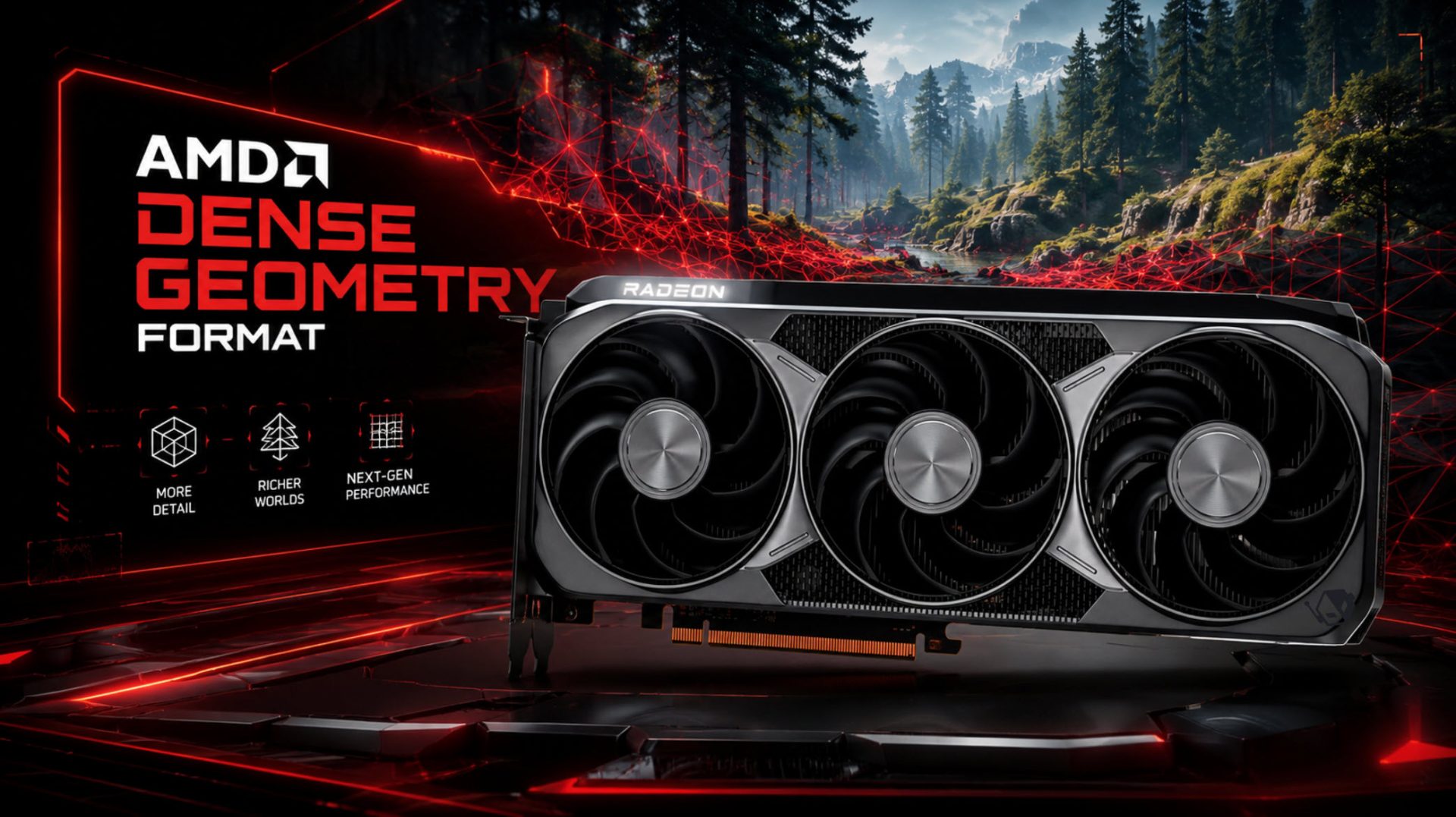
It’s a question nobody asked, but AMD apparently feels compelled to answer. Their latest salvo in the geometry wars, Dense Geometry Format (DGF), aims to cram more polygons into games than ever before. Think of it as extreme Tetris for 3D models, but instead of blocks, you’re dealing with millions of triangles. This isn’t just an incremental upgrade; AMD’s touting it as vital for the future of ray-traced rendering, content creation, and pretty much anything that involves making things look pretty in real-time.
Geometry Got a Problem
Look, the relentless march of progress means games are getting more complex. Nanite in Unreal Engine set a new standard for detail, but that complexity throws a wrench into the works for ray tracing. Current methods struggle. They’re big, they’re inefficient, and they’re frankly a bit of a mess when it comes to handling the sheer volume of triangles we’re about to throw at them. AMD’s pointing out the limitations of current ray tracing APIs: pre-allocating memory for the worst-case scenario, needing to store exact triangle order (which eats space), and the overhead of converting data into hardware formats. It’s a Rube Goldberg machine of inefficiencies.
Super Compression to the Rescue?
So, AMD cooked up DGF SuperCompression. It’s designed to squeeze DGF data even further, aiming for up to a 30% reduction in storage. They claim this works on older RDNA GPUs too, which is nice, but the real juice is reserved for future RDNA cards, like the RDNA 5, promising even heftier gains. Essentially, they’re making triangles smaller so you can fit more of them onto your graphics card’s digital real estate. It’s a clever play, but the devil, as always, is in the implementation.
Geometry encoded with DGFS is no longer directly consumable by hardware, but can be made considerably smaller. DGFS is able to exactly reconstruct a given set of input DGF blocks, and also supports efficient decode to a conventional vertex and index buffer, which enables DGFS content to run on non-DGF hardware.
This quote is the crux of it, really. It’s smaller, yes, but you still have to decode it. That’s where latency and performance hitches can creep in. AMD’s charts show savings, but they also show decode times. While those times look minuscule in their controlled test environment—barely registering on a stopwatch—the real world is rarely so kind.
The Geometry Data Deluge
Let’s look at the numbers they’re throwing around. On current-gen cards, DGF SuperCompression (DGFS) can shave off a respectable chunk of data. For the ‘Dragon’ model, they claim a 31.09% saving. That’s not insignificant. But then they show a second set of tables, and suddenly the ‘DGF Size’ numbers are smaller even before DGFS is applied. It’s a bit confusing, frankly. It looks like they’re comparing different configurations or perhaps different stages of DGF implementation. AMD says the decode times on their test rig are fractions of a second, which is great. But can the actual silicon keep up under the sustained, chaotic load of a demanding game? That’s the million-dollar question.
This whole DGF play feels like AMD trying to get ahead of the curve. NVIDIA’s got its own version, RTX Mega Geometry, and the whole industry is scrambling to figure out how to make these incredibly detailed worlds actually run. It’s a necessary evil, really. If games are going to push boundaries with geometry, something has to give. And that ‘something’ is often efficiency and clever compression.
A Tale of Two Architectures (Eventually)
The real story here isn’t just the compression; it’s about future-proofing. AMD is betting big on DGF for RDNA 5 and beyond. This isn’t a feature they can just bolt onto current hardware without significant effort. It requires a fundamental shift in how geometry data is handled at the silicon level. For now, it’s a software solution with hardware support layered on top. But the real gains, the massive increases in geometry detail AMD is hinting at, will likely need dedicated hardware to truly shine. Until then, we’re stuck with clever software tricks that might introduce their own set of performance quirks.
It’s a familiar dance. New technologies emerge, promising utopia, but the path from theory to buttery-smooth framerates is paved with compromise and careful engineering. AMD’s DGF is another step on that path. Whether it’s a giant leap forward or just another incremental hop remains to be seen. But one thing’s for sure: games are about to get a whole lot more geometrically ambitious. Whether your GPU can handle it is another story entirely.