The faint hum of servers, the flicker of LEDs indicating healthy network traffic – these are the quiet signals of a technology revolution that hit a significant milestone this week. On March 12th, a plaque was dedicated at the former Xilinx headquarters in San Jose, California, marking the IEEE Milestone for the first Field-Programmable Gate Array (FPGA). And let me tell you, this isn’t just some dusty bit of Silicon Valley history; this is the bedrock of the flexible, adaptive computing future we’re living in.
Think of it this way: before FPGAs, building a custom chip was like commissioning a Michelangelo sculpture. You poured massive resources, time, and money into creating a singular masterpiece, and once it was carved in silicon, that was it. No changes. Want to tweak a feature? Back to the drawing board – and the immense expense – you went. FPGAs, however, changed the game entirely. They’re more like a hyper-advanced Lego set, where the instructions aren’t baked into the plastic but can be downloaded and changed on the fly. This ability to reconfigure hardware after manufacturing is nothing short of an epochal shift.
The Flexibility-Performance Tightrope Walk
For ages, computing faced this fundamental trade-off: speed versus flexibility. Microprocessors, bless their sequential hearts, are like a brilliant academic reading a book aloud, word by word. They can talk about anything, adapt their discourse, but if you need them to perform a million calculations simultaneously? You’re going to be waiting a while. On the other end of the spectrum, Application-Specific Integrated Circuits (ASICs) are like hyper-specialized Olympic athletes. They can do one thing, and do it with breathtaking speed and efficiency, but ask them to run a marathon if they’re built for sprinting, and you’re out of luck. And the cost to train those athletes – designing and fabricating an ASIC – is astronomical.
“ASICs can deliver the best performance, but the development cycle is long and the nonrecurring engineering cost can be very high. FPGAs provide a sweet spot between processors and custom silicon.”
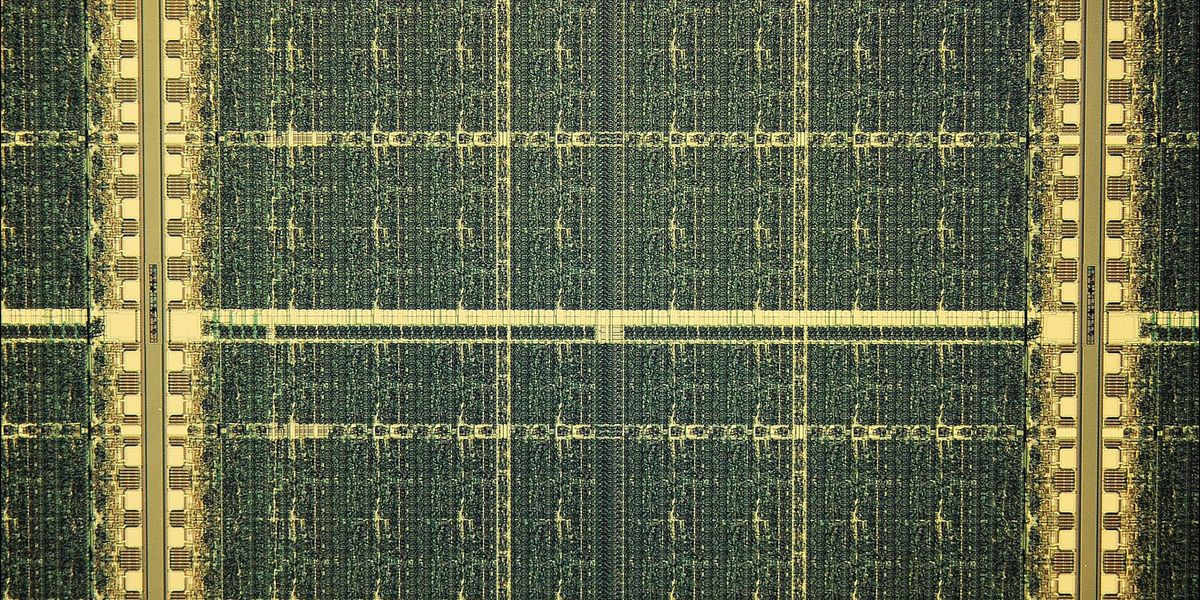
This is where the FPGA, birthed from the ingenious mind of Ross Freeman at Xilinx in the mid-80s, stepped in. Freeman, realizing that transistor counts were about to explode thanks to Moore’s Law, saw an opportunity. Instead of squeezing every last drop of efficiency out of a fixed design, why not build a chip with programmable logic blocks and routing channels – essentially, a blank canvas of computational power waiting to be defined? It was a radical idea: shifting the power to define hardware from the chip fabrication plant directly to the engineer using the chip. It’s akin to handing the keys to the orchestra’s conductor instead of dictating every note to the instrument maker.
The Dawn of the Software-Defined Chip
The first commercially available FPGA, the Xilinx XC2064 in 1985, was a humble beast by today’s standards, featuring a mere 64 configurable logic blocks. But it represented a monumental leap. Suddenly, engineers could iterate on hardware designs in days or weeks, not months or years. This dramatically slashed development risk and accelerated innovation, especially at a time when the cost of traditional chip manufacturing was soaring. It was the dawn of the software-defined chip, a concept that now permeates so much of our digital existence.
And this isn’t just ancient history. Look at the landscape today: AI accelerators? Often built on FPGA principles or drawing heavily from their adaptability. High-performance networking? FPGAs are the unsung heroes ensuring data flows smoothly. Medical imaging, scientific computing, even cutting-edge defense systems – they all benefit from the FPGA’s unique blend of speed and reconfigurability. The technology enabled by the FPGA is, in many ways, the engine that’s making the AI revolution not just possible, but practical. Without that initial spark of flexibility, the complex AI models we see today would be prohibitively expensive and slow to deploy on fixed-function hardware.
Why does this matter for us, the mere mortals who use these devices? Because the FPGA is the silent enabler of progress. It’s the reason your internet connection is getting faster, why medical diagnostics are becoming more precise, and why the next generation of AI applications might just blow your socks off. It’s a proof to a future where hardware isn’t a static object but a dynamic, evolving platform, much like software has always been.
🧬 Related Insights
- Read more: Silverstone IceMyst Pro 360 Pro: The AIO That Tames DDR5 Overclock Hell
- Read more: NVIDIA’s Proteina-Complexa Cracks Protein Binder Design Wide Open
Frequently Asked Questions
What does FPGA stand for?
FPGA stands for Field-Programmable Gate Array. It’s a type of semiconductor device whose logic circuit can be reprogrammed after manufacturing.
How is an FPGA different from a CPU?
CPUs (Central Processing Units) execute instructions sequentially from software, offering high flexibility but limited parallel processing. FPGAs, on the other hand, implement custom digital circuits, allowing for massive parallel operations and hardware-level performance tailored to specific tasks, all while remaining reconfigurable.
Will FPGAs replace CPUs or ASICs?
No, FPGAs are not typically designed to replace CPUs or ASICs entirely. Instead, they occupy a unique ‘sweet spot,’ complementing them. FPGAs are ideal for applications requiring high performance and low latency with a need for rapid design iteration or adaptability, often working alongside CPUs and ASICs in complex systems.