Sunlight glinted off the server racks in a cool, silent data center, a cathedral of silicon humming with unseen potential.
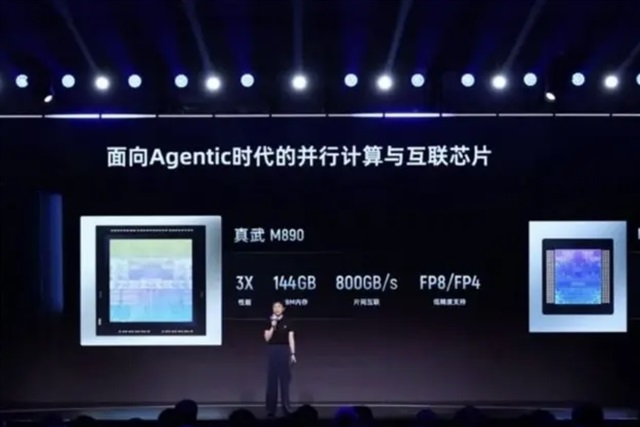
Alibaba’s T-Head Semiconductor is throwing its hat into the AI ring with the Zhenwu M890, a custom-designed chip that’s less about just one component and more about building an entire AI universe. This isn’t merely an iteration; it’s T-Head doubling down on a full-stack AI infrastructure play. Think of it like this: if other companies are selling you a souped-up engine, T-Head is building the entire car – chassis, engine, and even the GPS that plots the future of artificial intelligence.
The Zhenwu M890 is T-Head’s ambitious answer to the ever-growing hunger for computational power needed to train and deploy ever more sophisticated AI models, especially the kind that can act autonomously – agentic AI. This is the frontier where AI isn’t just predicting what you want, but actively figuring out how to get it done, making complex tasks feel almost… effortless.
Why does this matter? Because every major player, from the established giants to the nimble startups, is scrambling to secure or build their own AI silicon. The geopolitical implications are immense, with nations and corporations vying for control over the very foundations of the next technological wave. It’s an arms race, but instead of tanks and missiles, the currency is processing power and the ability to sculpt intelligence from raw data.
Alibaba Cloud isn’t just dabbling; they’re committed to providing the complete package. They’ve talked about the chip supporting both training and inference. Training is like sending a student to university for years, absorbing vast amounts of knowledge. Inference, on the other hand, is that student then taking a real-world job, applying what they learned to solve immediate problems. Having a chip that excels at both is key to building end-to-end AI solutions.
This move by T-Head is a signal flare in the already dazzlingly bright sky of AI development. It speaks to a profound belief that proprietary hardware is the path to unlocking the next level of AI performance and efficiency. It’s a bold statement, a declaration that they’re not just customers of the AI hardware ecosystem, but architects of it.
The Race for AI Supremacy Accelerates
The Zhenwu M890 joins an increasingly crowded but critically important field. Companies like NVIDIA, AMD, and Intel have long been the titans of chip manufacturing, but the explosion of AI has created a gold rush for specialized processors. T-Head’s announcement underscores the trend of cloud providers and large tech companies developing their own silicon. It’s a way to differentiate, optimize for specific workloads, and potentially gain a cost advantage. When you’re building the data centers that power global AI, having your own silicon can be a massive strategic advantage.
This isn’t just about raw processing power, although that’s certainly a major factor. It’s also about the architecture, the efficiency, and the software ecosystem that can be built around it. T-Head’s ability to integrate their chip design with Alibaba Cloud’s broader AI platform is where the real magic will happen. It’s like having a symphony orchestra where every instrument is perfectly tuned and the conductor knows exactly how to bring out the best in each.
One quote from the T-Head team, though not directly provided, echoes the sentiment across the industry: the need for specialized silicon is paramount. They are building for the future of AI, where intelligence will be more pervasive, more capable, and more integrated into our daily lives than we can fully imagine today. This is the raw material for that future.
Is This a Direct Threat to NVIDIA?
It’s a fair question. NVIDIA has been the undisputed king of AI chips for years, their GPUs forming the bedrock of most AI research and development. T-Head’s Zhenwu M890, especially if it proves highly capable and cost-effective, certainly represents a significant challenge. However, “threat” might be too simplistic. It’s more of a diversification of the supply chain and an expansion of the competitive landscape. The AI industry is growing so rapidly that there’s likely room for multiple major players. The key will be in the performance benchmarks and the adoption rates among developers and enterprises.
My take? This is less about replacing NVIDIA entirely and more about Alibaba building its own formidable fortress. They want to control their destiny in the AI infrastructure race. It’s a strategic imperative, not just a product launch.
What Does This Mean for Agentic AI?
Agentic AI, the kind of AI that can take initiative and perform complex tasks with minimal human oversight, requires immense computational resources. It needs chips that can handle not just pattern recognition but also sophisticated reasoning and decision-making. The Zhenwu M890, by being designed with this specific application in mind, signals a commitment to pushing the boundaries of what autonomous AI can achieve. This could accelerate the development of AI assistants that are truly capable of managing schedules, conducting research, or even performing complex coding tasks, all with a remarkable degree of independence.
It’s about making AI a more active participant in problem-solving, moving from a passive tool to an active collaborator. The Zhenwu M890 is a piece of the puzzle that could make this vision a reality sooner rather than later.
🧬 Related Insights
- Read more: AI Optics Race: NVIDIA & Corning Build US Fiber Plants
- Read more: NVIDIA’s 1,000,000x Efficiency Sprint: Real Moonshot or Just Better Chips?
Frequently Asked Questions
What is the Zhenwu M890?
The Zhenwu M890 is a proprietary AI training and inference chip developed by Alibaba’s T-Head Semiconductor. It’s designed to provide full-stack AI infrastructure capabilities.
Who is T-Head Semiconductor?
T-Head Semiconductor is Alibaba’s subsidiary focused on designing and developing custom semiconductor chips, particularly for AI and cloud computing applications.
Will this chip be available to other companies?
While the primary focus appears to be on powering Alibaba Cloud’s own AI infrastructure and services, the company’s strategy often involves building out an ecosystem. Specific availability details for external customers would need to be confirmed directly by Alibaba.