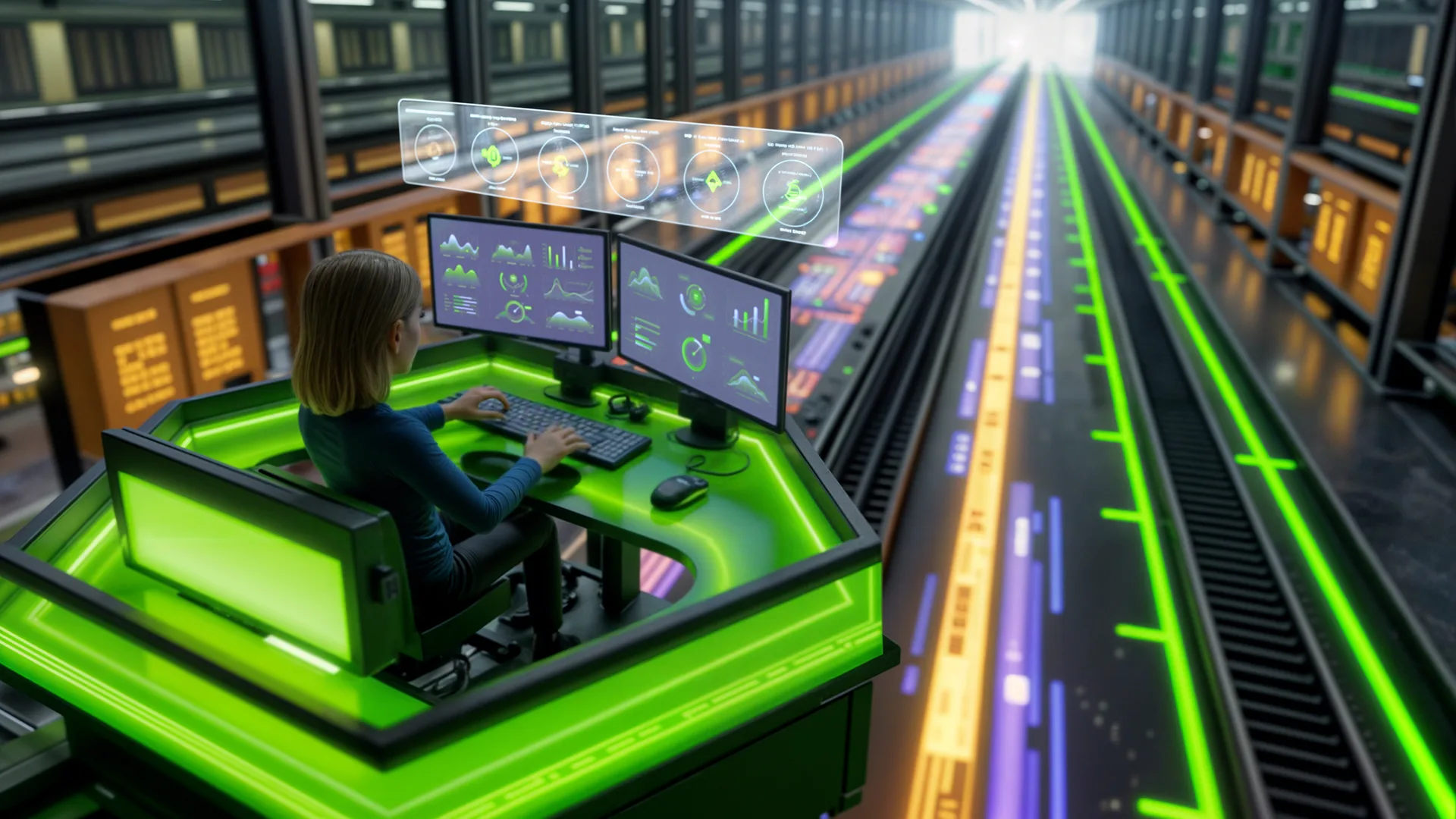
What if the real bottleneck in your billion-dollar AI factory isn’t GPUs, but the sloppy orchestration turning prime silicon into idle waste?
NVIDIA Mission Control 3.0 hits that nerve dead-on, rearchitecting AI factories from rigid monoliths into flexible, token-hungry machines. It’s not hype — it’s a layered, API-driven stack that swaps synchronized release hell for modular bliss. And here’s the kicker: in a world where 1% GPU downtime equals millions of lost tokens hourly, this could be the shift operators didn’t know they craved.
A 1% drop in usable GPU time can mean millions of tokens lost per hour.
That’s straight from NVIDIA’s playbook, and it stings because it’s true. Factories scaling to thousands of GPUs drown in congestion, long-tail latency, power squeezes. Old stacks? Tightly coupled nightmares demanding hardware-sync’d updates. Mission Control 3.0 flips the script — modular services like automated network management and domain power orchestration plug into a unified plane, letting OEMs and ISVs remix without NVIDIA’s babysitting.
But.
Look, NVIDIA’s selling flexibility, yet it’s their reference architectures at the core. Smart move — codifies best practices while opening doors (slightly). My unique take? This echoes the early days of OpenStack, when cloud vendors promised open control planes but built moats around their iron. Prediction: Mission Control locks NVIDIA deeper into AI ops, turning factories into their ecosystem fiefdoms by 2026.
Why Does Multi-Org Isolation Suddenly Matter in AI Factories?
Shared infra was fine for PhD tinkering. Now? Production-grade war rooms demand tenant walls.
Mission Control virtualizes the stack — services on KVM VMs, compute racks per org, but switches shared via Spectrum-X VXLAN or Quantum InfiniBand PKeys. Physical footprint shrinks; TCO plummets as you cram multiple orgs onto one cluster without bleed.
It’s software-defined isolation at scale. No more siloed clusters eating capex. Operators get self-service portals, hard boundaries. Skeptical? Test it against Kubernetes multi-tenancy hacks — this feels tighter, battle-tested on NVIDIA metal.
Power, though. That’s the silent killer.
Facilities cap at fixed watts — grids don’t scale like Moore’s Law. GPUs guzzle more per gen, racks densify, yet utilities laugh. Past Mission Control reacted: schedule jobs, then cap power. Reactive. Wasteful.
Version 3.0? Power as a scheduling primitive. Domain power service slots into Slurm or Run:ai-orchestrated K8s, steering workloads rack-aware with MAX-P/MAX-Q profiles. Predict anomalies via AIOps. Token production climbs without breaching envelopes.
Can NVIDIA’s Power Orchestration Actually Deliver More Tokens Per Watt?
Short answer: probably, if you’re all-in on their stack.
Imagine air traffic control for data centers — not just routing planes, but throttling thrust based on fuel quotas and wind shear. That’s domain power service: real-time, topology-aware reservations. Mixed workloads? Covered. But here’s the rub — it’s NVIDIA-first. Run:ai integration shines, but what about your rogue schedulers? Ports exist, yet expect friction.
And visibility. Dashboards were table stakes; now predictive AIOps flags rack oversubscription before it strands power. Economic? Existential, as NVIDIA says.
Operators crave this foresight. Congestion cascades from minutes to hours; Mission Control’s unified plane nips it.
Yet, call out the spin: “unified control plane” sounds benevolent, but it’s ecosystem glue. ISVs integrate? Great — on NVIDIA terms. Enterprises gain choice, sure, but the modular facade hides reference arch dependency. Bold call — this accelerates AI factories short-term, but mid-term, it stratifies the market: NVIDIA haves vs. have-nots.
Historical parallel? Think Cisco’s data center pivot in the 2010s — ACI promised fabric unification, delivered dominance. Mission Control 3.0 does the same for AI hyperscalers.
Flexibility sells. New API layers mean rapid hardware support — Blackwell drops, Mission Control adapts sans full-stack rewrites. Multi-org onboarding? Automation zips it.
Downsides? Still maturing. Validation across OEMs takes time; early adopters report teething on shared fabric isolation. Power smarts? Killer for inference farms, less proven at exascale training.
How Does This Reshape AI Factory Economics?
Token-per-watt jumps. Capex drops via shared infra. Ops teams sleep better with anomaly prediction.
But the why: architectural shift from coupled to composable. It’s Kubernetes for AI factories — or close enough.
NVIDIA’s not just shipping silicon; they’re wiring the nervous system. Critique their PR? “Maximize token production” — check. But existential? Only if you’re betting the farm on Grace-Hopper-Blackwell lineages.
Unique insight time: this isn’t evolution; it’s the control plane pivot mirroring cloud’s SDN era. OpenStack faltered on fragmentation; Mission Control, backed by CUDA moat, won’t. Expect forks from hyperscalers, but NVIDIA owns the ref impl.
Operators, test it. Flexibility’s real — modular services mean your ISV stack plugs in. Power orchestration? Game-on for regulated DCs.
Skeptics (me included) watch for true multi-vendor escape hatches. So far, promising.
🧬 Related Insights
- Read more: NVIDIA’s Slurm-Kubernetes Hack Powers 8,000-GPU AI Beasts
- Read more: Intel’s Innovation Engine Roars Back to Life
Frequently Asked Questions
What is NVIDIA Mission Control 3.0?
It’s a modular software stack for managing AI factories, adding power orchestration, multi-org isolation, and predictive ops to boost token output.
How does Mission Control 3.0 handle power limits in AI factories?
Domain power service makes power a scheduling primitive, optimizing Slurm/K8s workloads with real-time steering and profiles like MAX-P/MAX-Q.
Will NVIDIA Mission Control work with non-NVIDIA hardware?
Modular design supports OEM integrations, but it’s optimized for NVIDIA reference architectures — expect best results there.