Nvidia’s Blackwell GPUs suck down 1,000 watts each. Now imagine cramming 50 times more compute into a chip that sips power like it’s on a diet.
That’s the audacious pitch from optical metamaterials invading AI data centers. Two startups, Lumotive and Neurophos, aren’t peddling invisibility cloaks anymore. They’re warping light to fix the bandwidth chokepoints strangling today’s hyperscalers.
Look. Twenty years back, labs birthed metamaterials — tiny structures that bend light like nothing in nature. Cloaks? Cool demo. Market? Zilch, as Neurophos CEO Patrick Bowen puts it bluntly.
But data centers? They’re starving for this wizardry. Electronic switches convert light to electrons, back and forth, guzzling energy and capping speeds. Optical alternatives promise pure photonics flow. Problem is, silicon photonics wastes power; MEMS flop on reliability.
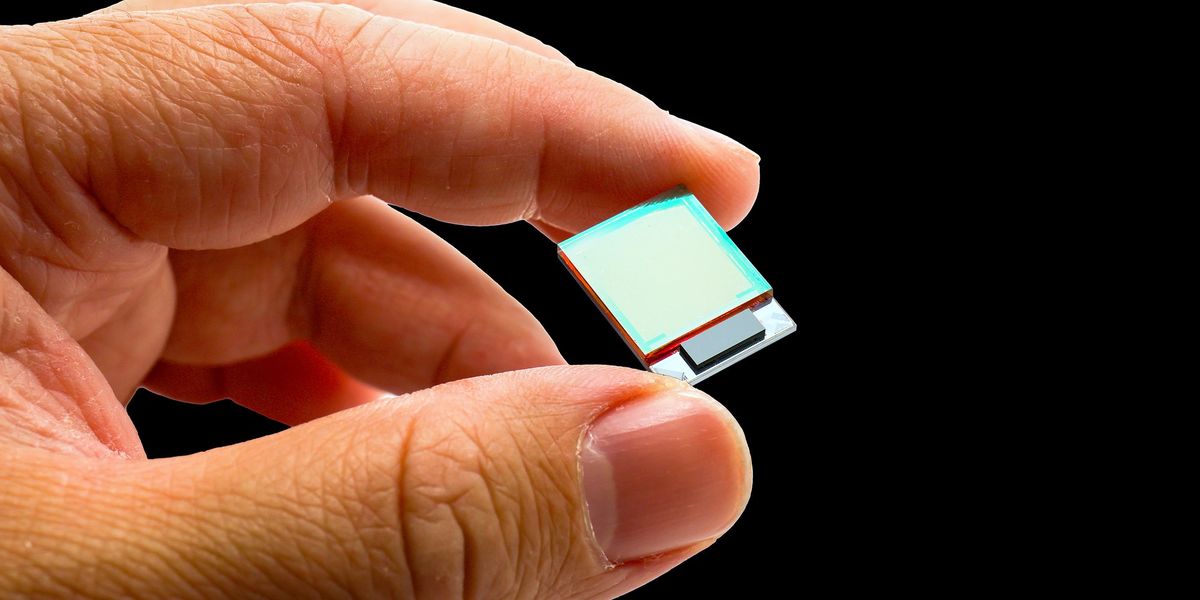
Enter Lumotive’s microchip, unveiled March 19. Copper nanostructures laced with programmable liquid crystals — think LCD tech, but for beam steering. No moving parts. Steers, lenses, splits light in real time.
Why Are Data Centers Betting Big on Optical Switches?
Sam Heidari, Lumotive’s CEO, nails it:
“Having no moving parts significantly improves reliability.”
They tuned this at foundries for cost and durability — no small feat. Scales from 256x256 ports to a wild 10,000x10,000. Game-changer for AI’s data deluge? Heidari thinks so. First switches: end of 2026.
Here’s the thing. AI training runs chew terabits per second across racks. Conventional nets bottleneck at electro-optic handoffs. Metamaterials sidestep that, reflecting beams with phase tweaks. It’s like a mirror array gone smart, programmable via voltage.
Neurophos takes it further — into optical computing. AI on electrons? Power hog. Light? Efficient, parallel. But today’s optical processors sprawl like ’80s mainframes.
Bowen: Their modulators — light’s transistors — shrink 10,000-fold via CMOS. No exotics. A 1,000x1,000 array fits a 5x5 mm chip. Silicon photonics equivalent? One square meter.
Claims: 50x density, 50x efficiency over Blackwell. Hyperscalers test proofs this year; production mid-2028.
Skeptical? Sure. Bold numbers scream hype. But peek under the hood — metamaterials exploit sub-wavelength patterning, evading diffraction limits that plague bulk optics. It’s architectural: from discrete lenses to flat, dense metasurfaces.
Can Metamaterials Really Crush Nvidia in AI Compute?
And — plot twist — this echoes fiber optics’ arc. ’70s lab toy for telecom trunk lines. By ’90s, internet backbone. Metamaterials? Same vibe. From cloak gimmicks to datacenter ducts.
Lumotive fixes switching fabrics. Neurophos attacks the matrix multiplies at AI’s heart. Together? Reshape the stack. But timelines lag: 2026-2028 means Nvidia iterates first.
Critique the spin. “Game-changing,” Heidari says. Bowen touts hyperscaler evals. PR gloss, but R&D grind at foundries hints legitimacy — CMOS compatibility seals it for scale.
Deeper why: Power walls. Data centers hit 2% global electricity now; AI pushes 8-10% by 2030. Photonics slashes that via lower conversion losses. Metamaterials amp density, fitting more in racks without meltdown.
How? Liquid crystals in Lumotive phase-shift reflections, beamforming like 5G arrays but optical. Neurophos modulates phase/amplitude per element, encoding ops on laser pulses. Vector-matrix math — AI bread-and-butter — maps neatly to wavefronts.
Risks? Thermal drift in crystals. Fabrication tolerances at nanoscale. Yield ramps. Yet IEEE Spectrum’s metasurface coverage (flat lenses, zero-index) shows momentum.
Prediction: If Neurophos hits 50x, it won’t kill GPUs — hybrids rule. But optical accelerators carve niches in inference, where parallelism shines.
Lumotive’s port scaling? Disrupts all-optical fabrics, echoing Ciena’s wave swaps but metasurface-flat.
One short para: Barriers fall.
This shift — photonics-native data centers — brews quietly. Startups lead; incumbents watch.
What Happens If These Chips Actually Ship?
Evals this year validate. If hyperscalers bite, funding floods. Neurophos, Lumotive bootstrap viability.
Bowen again:
“We basically fit a 1,000- by-1,000 array of optical modulators on a tiny 5-by-5-millimeter area on a chip.”
Physics checks out. Metasurfaces compress functions; programmability adds flex.
My insight: Like CRISPR for genomes, these flatten optical design — from 3D etalons to 2D chips. Architectural pivot, not increment.
But hype check — cloaks flopped on polychromatic light. These? Tunable, broadband claims. Prove it in volume.
Four sentences here. Dense unpack. Light’s speed (c) vs electrons’ drift — inherent edge. Metamaterials unlock it at scale.
🧬 Related Insights
- Read more: Truck-Sized AI Data Centers: GPUs Delivered in Months, Not Years
- Read more: NVIDIA RTX PRO 6000 Blackwell Workstation: Desk-Side AI Power or Overhyped Desk Filler?
Frequently Asked Questions
What are optical metamaterials used for in data centers?
They’re steering light for switches and modulators, boosting bandwidth and cutting power in AI racks — no moving parts, massive port counts.
Will Neurophos chips beat Nvidia GPUs?
They claim 50x density/efficiency for specific AI tasks via photonics; hybrids likely, shipping 2028.
When do Lumotive’s optical switches launch?
End of 2026, scaling to 10k x 10k ports for all-optical nets.