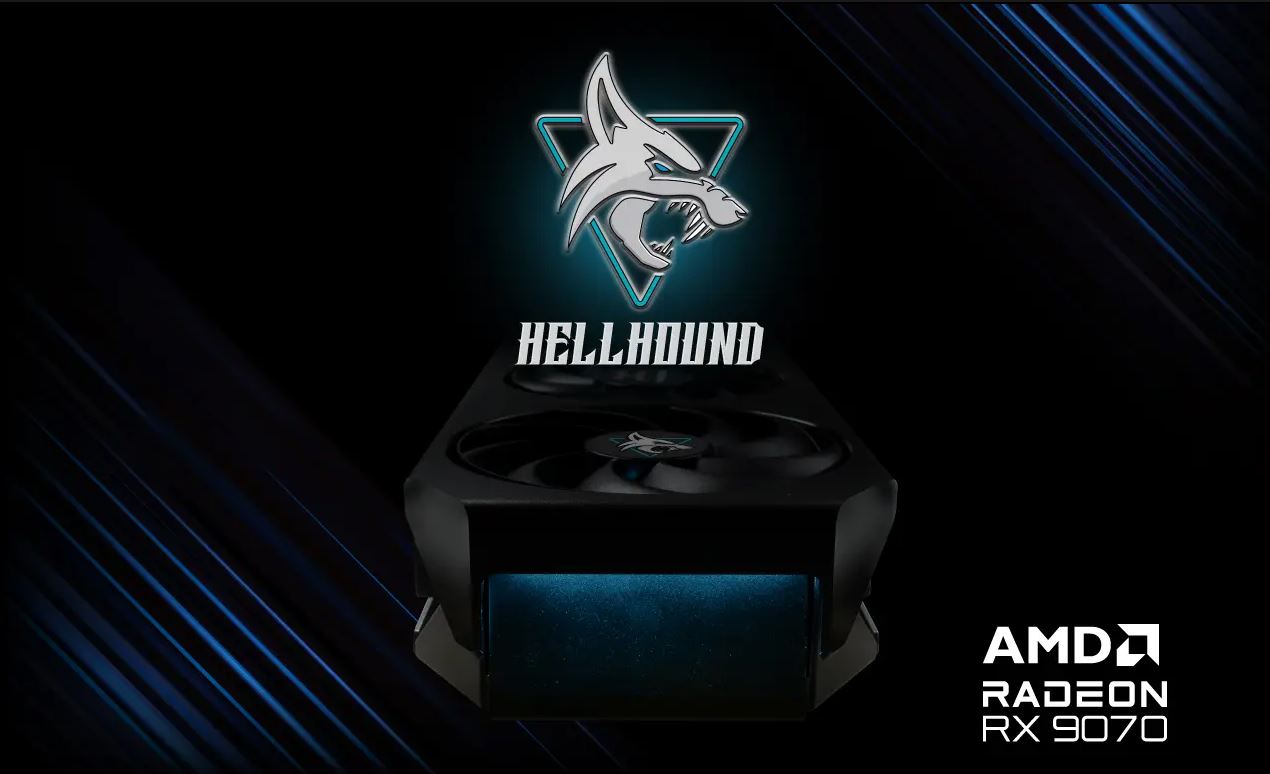
This is wild. The PowerColor Hellhound RX 9070 is currently sitting at an astonishing $586 on Amazon. Let that sink in. In a year where graphics cards have been steadily climbing, often by 20-30% or more, this is less an anomaly and more a digital supernova. We’re talking about a card that consistently hovered in the $600-$650 range, sometimes nudging $700, now breaking that psychological barrier. It’s a signal flare in a sky of inflated silicon.
The RAMpocalypse Effect — Or Is It?
Now, the official MSRP for the RX 9070 is a tidy $549. But MSRP has become more of a nostalgic whisper than a market reality for most of 2024. The industry’s been battered by what’s being dubbed the “RAMpocalypse” – a perfect storm of supply chain woes and a resurgence in demand, all conspiring to push prices skyward. Yet, here we are, with a powerful 16GB card actually dipping below that $600 mark. It’s like finding a perfectly ripe avocado at a farmer’s market during peak season – something you didn’t think was possible anymore.
The RX 9070, while not the absolute king of the hill compared to its XT sibling, is a seriously capable card. For 1080p and 1440p gaming, it absolutely crushes it. That 16GB of VRAM? It’s a fortress against memory bottlenecks, letting you crank up those textures and graphical settings without the stuttering dread that plagues lesser cards. The larger shader count just means it’s more efficient at rendering those frames, giving you smoother gameplay. It’s the kind of performance that makes you wonder if you even need to spend another $100-$200 on the XT version, especially when the RX 9070 XT is still routinely clearing $700.
A Smarter Buy Than Ever
Let’s be brutally honest: the GeForce RTX 5070, often in the same sub-$600 ballpark (when it’s even available at MSRP!), is looking increasingly like a less appealing proposition. You’re getting 4GB less VRAM for what often amounts to a similar or even higher price point. The RX 9070, especially at this discounted $586 figure, isn’t just a good deal; it’s practically a steal. It’s the kind of purchase that feels like you outsmarted the market, a rare victory in today’s tech landscape.
Think of it this way: computing is undergoing a fundamental platform shift. We’re moving from discrete tasks and apps towards intelligent agents and pervasive AI. Graphics cards, once the domain of hardcore gamers, are now the bedrock of this new computational paradigm. They’re the muscle behind AI inference, the engine for AI model training. And when you’re building out infrastructure, whether for personal use or for a business, efficiency and raw power-to-price ratio become paramount. The RX 9070, at this price, delivers exactly that.
While the Radeon RX 9070 XT continues to sell for over $700 in most regions, the RX 9070 can be found for around $600-$650. Of course, some editions sell for nearly $700, but it’s hard to find an RX 9070 for less than $600.
This quote, from the original reporting, highlights just how unusual this sub-$600 dip is. It’s not just a small price cut; it’s a significant deviation from the norm. And the fact that it’s the PowerColor Hellhound edition – a model that usually commands a premium for its aesthetics and cooling – makes it even more remarkable. This isn’t some bare-bones reference design; this is a well-built card that’s now more accessible than ever.
Of course, no GPU is an island. To truly unleash the beast, you’ll need a capable power supply to keep it fed and a mid-range CPU that can keep up, preventing any frame-rate bottlenecks. But these are manageable considerations, far less daunting than the prospect of paying inflated prices for less VRAM. This price point makes the RX 9070 a compelling option for anyone looking to upgrade their gaming rig or even dip their toes into more compute-intensive tasks without breaking the bank. The AI revolution needs powerful, accessible hardware, and right now, this GPU is waving a big, red flag of opportunity.
Is this the start of a GPU price correction?
It’s far too early to say. While this RX 9070 price drop is a welcome anomaly, the broader market forces (like demand for AI acceleration and ongoing supply chain dynamics) are still in play. However, extreme price drops like this often signal a manufacturer or retailer looking to clear inventory, potentially ahead of new releases or to combat oversupply in specific segments. It could be a temporary blip, or it could be the first ripple of a larger trend. We’ll be watching closely.
What does 16GB of VRAM actually mean for me?
Think of VRAM (Video RAM) as your graphics card’s short-term memory. For gaming, 16GB means you can load higher-resolution textures, use more complex graphical effects, and play games at higher resolutions (like 1440p or even 4K) without the GPU running out of space and causing stuttering or performance drops. For AI tasks, more VRAM allows you to work with larger datasets and more complex AI models, accelerating your progress.
Will this price drop last?
Probably not indefinitely. Graphics card prices are notoriously volatile, influenced by manufacturing costs, supply, demand, and new product cycles. The current sub-$600 price for the PowerColor Hellhound RX 9070 is likely a promotional offer or an attempt to move inventory. It’s wise to act if you’re interested, as these deals often disappear as quickly as they appear. Keep an eye on pricing trends, but don’t bet on this specific price holding for long.