For years, the narrative around Europe and tech innovation felt… well, a bit like watching paint dry. There was a pervasive sense that the EU’s primary contribution to progress was a well-intentioned but often stifling regulatory hand. We were all expecting more of the same: a continent expertly navigating the labyrinth of compliance, perhaps, but lagging in the raw, messy, exhilarating business of building the future.
And then, quietly at first, something shifted. It’s not just a subtle change of tune; it’s a fundamental platform shift unfolding across the continent, signaling a powerful pivot from a purely regulatory posture to a genuine embrace of innovation, particularly in the crucial realm of ASIC design.
The Great European Pivot
Think of it like this: for a long time, Europe was the meticulous architect, drawing up blueprints for every possible scenario. Now, it’s picking up a sledgehammer and a welding torch, ready to build skyscrapers at lightning speed. The Nordic model, exemplified by countries like Sweden, is leaning into a blend of capitalism and socialism, smartly dialing back high taxes and scaling back overly broad social safety nets to foster a more pro-innovation environment. But the real seismic tremors are happening closer to our domain: the European Union is actively, aggressively, and I’d argue, brilliantly, encouraging innovation in ASIC startups. This isn’t just about accelerated growth; it’s about strategic self-reliance, a vital move to reduce dependency on the US for critical semiconductor technology. The policymakers finally recognize that to remain relevant on the global stage, they have to be part of this AI-powered chip revolution.
ASIC Ascendance: Beyond the Giants
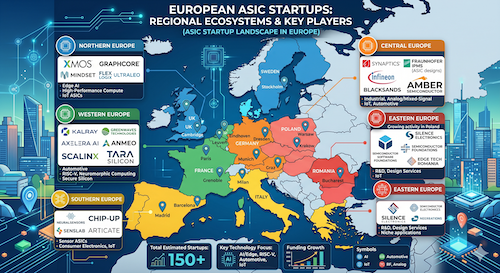
Sure, the established titans like NXP, Infineon, and STMicroelectronics are still growing and pushing boundaries – NXP, for instance, is now offering strong hardware and software for agentic systems at the edge. But my focus here, the truly electrifying part, is the burgeoning ASIC startup ecosystem that’s bursting onto the scene. These aren’t minor players; they’re at the absolute leading edge of innovation, fueled by a potent cocktail of ambitious vision and substantial funding.
Why now? Personal perspective is key. Europe has undeniably been losing the economic growth race in tech for years. But a powerful catalyst has emerged: the stark realization that the continent can no longer depend solely on the US for defense or trade. This has ignited a fierce drive towards self-reliance, a mandate to build its own technological fortresses. We’re seeing it in action with companies like the UK’s Fractile, which has secured a massive $220 million raise to construct a new generation of inference engines. Axelera has pulled in $250 million, while France’s Arago is laser-focused on accelerating datacenter inference, and Vertical Compute is tackling the critical challenge of reducing memory loads in AI systems. It’s a breathtaking pace!
And the collaboration! Quintaris in Germany, a powerhouse consortium of Bosch, Infineon, NXP, Nordic Semi, and Qualcomm, is targeting application processors for automotive, with an eye on IoT and datacenters down the line. Spain’s Semidynamics is already lauded for its ultra-customizable RISC-V systems, brilliantly coupled with AI accelerators. We’re witnessing ventures exploring photonic and neuromorphic tech, like the UK’s Optalysys, alongside novel AI approaches from Innatera in the Netherlands and Cortical.io in Austria. It’s a renaissance of silicon ingenuity.
The Chips Act: A Policy Power-Up
This burgeoning activity isn’t happening in a vacuum. The European Chips Act, adopted in late 2023, is acting as a potent accelerant. Through sovereign guarantees and substantial funds designed to match venture capital investment, it’s pouring rocket fuel onto this nascent industry. Their goal? To capture 20% of the global chip market share by 2030. That’s an audacious target, and frankly, I love to see it. It’s precisely the kind of ambitious vision needed to disrupt the status quo.
Now, the cynics will inevitably point to potential bureaucratic hurdles, predicting that policy makers might just stumble over their own feet and stifle this promising initiative. But the signs are overwhelmingly positive. The revitalized Nordic economic model and Germany’s renewed commitment to defense spending, specifically supporting home-grown tech, are high-profile examples of this shift. Defense, in particular, is a compelling priority, one that is powerful enough to override entrenched bureaucratic resistance.
European Chips Design Platform: Democratizing Innovation
Policy makers, as we know, have a fondness for acronyms and committees. The European Chips Act has spawned the Chips Joint Undertaking (Chips JU), a vehicle designed to sponsor public-private partnerships and, crucially, the Chips JU European Chips Design Platform (EuroCDP). This initiative is a game-changer. It provides startups, small companies, and academic institutions with access to the same high-end tools and technologies that major ASIC enterprises use, all at predefined, accessible pricing. This democratization of advanced EDA tools is absolutely critical for accelerating European innovation. And naturally, Siemens, a European tech behemoth, is playing a key role by providing access to their sophisticated EDA tools through this program. It’s a virtuous cycle of support and advancement.
This push isn’t just about catching up; it’s about forging a new path, one where European ingenuity can truly shine on the global semiconductor stage. The era of regulatory dominance is over for Europe; the age of silicon ambition has truly begun.
Why is Europe suddenly focusing on ASIC innovation?
Europe is shifting its focus from being primarily a regulator of technology to becoming a major innovator and producer of advanced semiconductor technology, particularly ASICs. This is driven by a strategic desire for greater technological self-reliance, especially in light of geopolitical shifts and a recognition of the economic growth potential in the AI hardware sector. The European Chips Act provides significant financial and policy support to encourage domestic design and manufacturing capabilities.
What is the European Chips Design Platform (EuroCDP)?
The EuroCDP is a key initiative under the European Chips Act, managed by the Chips Joint Undertaking. It aims to lower the barrier to entry for European startups, small businesses, and academic institutions by providing subsidized access to sophisticated Electronic Design Automation (EDA) tools and design technologies that are typically used by large semiconductor corporations. This democratizes access to critical design resources, fostering a more vibrant and competitive ASIC design landscape within Europe.
Will this impact global chip supply chains?
Potentially, yes. Europe’s increased investment and focus on domestic ASIC innovation, particularly in areas like AI inference engines, could diversify the global supply chain. By fostering new design houses and potentially encouraging more local manufacturing, Europe could reduce its reliance on existing dominant players and provide alternative sources for cutting-edge chip technology. This could lead to greater resilience and competition within the global semiconductor market over the long term.