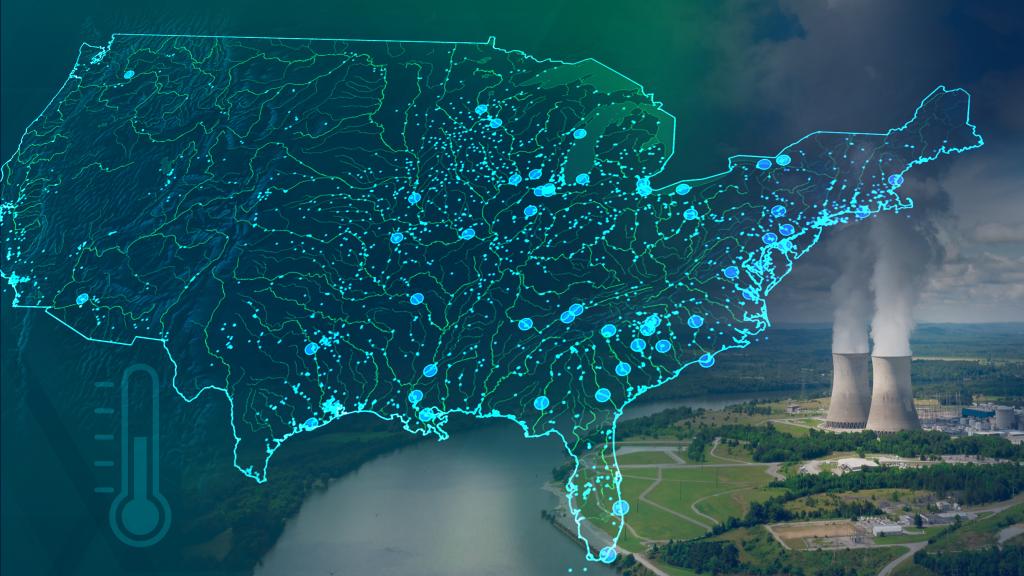
Is the era of guessing river temperatures over?
Probably not. But Oak Ridge National Laboratory (ORNL) has certainly thrown a wet blanket on the idea that we need to guess. They’ve cooked up an AI model, bless its digital heart, that churns out river temperature predictions with impressive accuracy, even for those lonely stretches of water with zero monitoring equipment. Think hydropower utilities, dam operators, and nuclear power plants — all those folks who suddenly get twitchy when water gets too warm. This isn’t just about avoiding fines; it’s about keeping the lights on and the fish from staging a mass exodus.
Let’s be clear: over 70% of U.S. electricity hums from thermoelectric plants that guzzle water for cooling. Nuclear, gas, coal — they all need a chilly beverage. But a lot of U.S. waterways are, shall we say, unmeasured. Like a chef trying to bake a cake with only half the ingredients listed. Now, ORNL’s Long Short-Term Memory network (fancy AI name, sounds like a bad prog-rock band) steps in. It’s been taught to sniff out patterns, linking weather and landscape to how a river behaves over days, weeks, and years. It’s less about the immediate splash and more about the long, slow warming.
Who Cares About River Temps Anyway?
Turns out, a lot of people do. Sean Turner, a senior engineer at ORNL, practically gushes about it. He says the model could reshape how we think about existing nuclear plants and where we stick new ones. Bold words, but the numbers back him up. An average error of just 1.1 degrees Celsius. That’s pretty darn close. For comparison, those old-school models? They take ages and a small fortune to build and maintain. This AI stuff is apparently more efficient. Who knew.
And it’s not just a one-trick pony. This RiTHyMs (River Temperature Time Series for Hydrothermal Modeling and Analysis — ORNL, you really need to work on your acronyms) model consistently nailed seasonal swings. It even held its own during heatwaves, the times when grid reliability goes right out the window. Plus, focusing on relevant upstream areas gave it a cleaner signal downstream. Apparently, pollution affects temperature. Who knew.
The kicker? The model was trained on data that’s available for every river in the continental U.S. That means, theoretically, it can spit out daily temperature estimates for any waterway. Anywhere. No sensors required. This is the part that makes the corporate PR folks at ORNL practically vibrate with excitement. “We wanted a system that could be applied anywhere in the nation,” Turner chirped, “and that means we needed to train it with data that’s available for every waterway.” Translation: they built it to be ridiculously scalable.
A New Era of Water Management?
Oak Ridge isn’t just sitting on its laurels. They’re already applying RiTHyMs to the Tennessee Valley Authority’s operations. And they’re tinkering with it for mountainous regions, specifically those glacial runoff zones out west. Utilities are apparently lining up for these water temperature projections. It’s almost as if knowing what’s happening with your cooling water is… important.
This whole endeavor leans heavily on ORNL’s supercomputing power. Think massive datasets across hundreds of river basins. It’s the kind of crunching power that makes old-school computation look like a hamster wheel. The names involved are a who’s who of ORNL’s hydrology department, plus a few folks who have since moved on to greener pastures (or perhaps just less-data-intensive ones).
The real insight here isn’t just the AI itself, but its applicability. For decades, we’ve built data infrastructure for a fraction of our waterways. This model is a philosophical shift: assuming we can know, and then building the tool to prove it. It’s the digital equivalent of mapping the entire ocean, not just the shallows. We’ve spent a fortune placing sensors, and while those are valuable, they’re inherently limited. This AI approach, trained on readily available data, essentially democratizes environmental monitoring for a crucial resource. It’s like the difference between a single lighthouse and a satellite map of every coastal hazard.
🧬 Related Insights
- Read more: Ajinomoto’s ABF Shortage Could Delay NVIDIA’s Next AI Chip Wave by Months
- Read more: China’s Memory Makers Soar: AI Fuels Price Surge
Frequently Asked Questions
What does the RiTHyMs model actually do?
It uses AI to predict river temperatures with high accuracy, even in areas without water sensors. This helps power plants, utilities, and environmental managers.
Is this AI model better than older methods?
ORNL claims its AI model produces comparable or better results than traditional, data-intensive models, but in less time and with fewer resources.
Will this AI replace human hydrologists?
Highly unlikely. AI models are tools. They enhance human capabilities, providing insights and predictions that hydrologists can then use to make informed decisions, conduct further research, and manage complex systems.