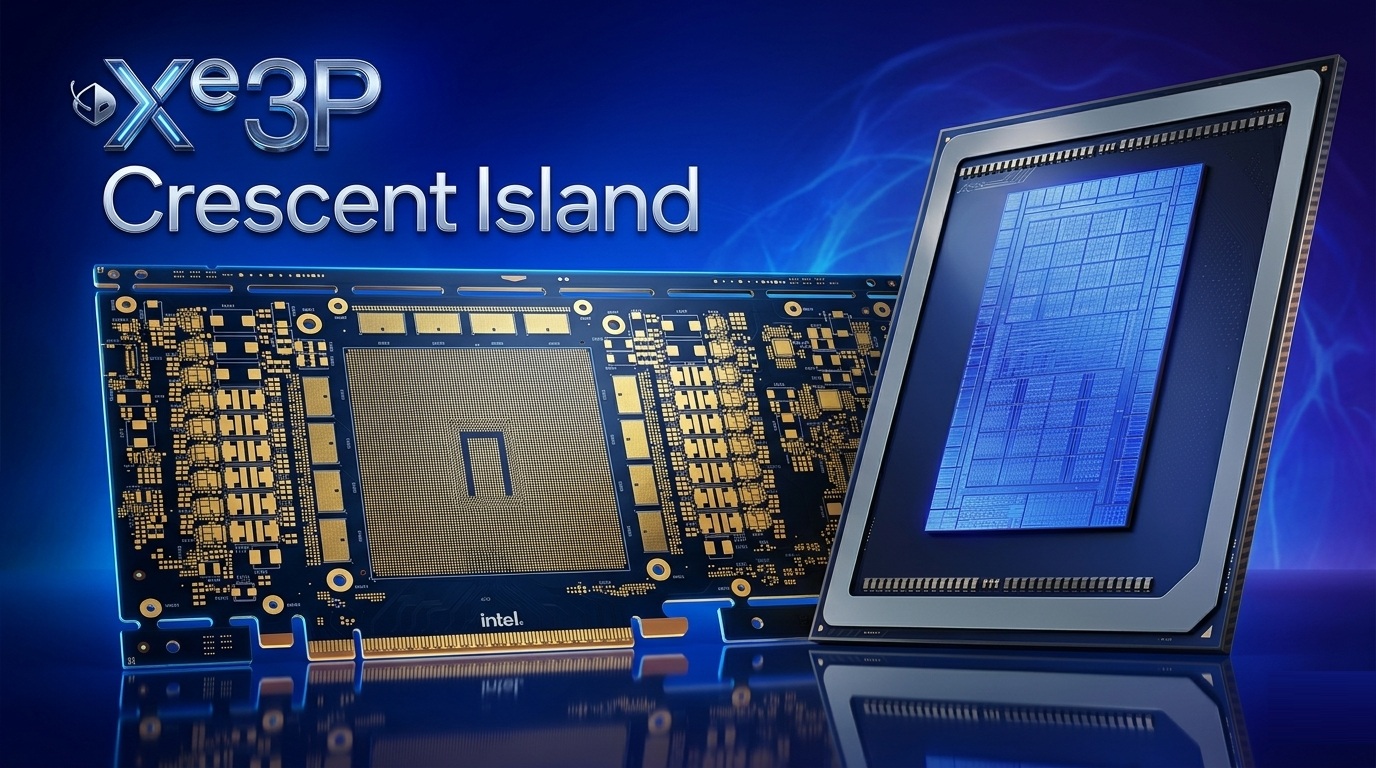
The hum of servers, the whir of fans… and then, BAM! A PCB leak, not just any PCB, but one that screams ‘future’. This isn’t just a peek behind the curtain; it’s like finding the blueprints for a new kind of engine, humming with the potential of what’s next. We’re talking about Intel’s Crescent Island, and if these leaks hold water, it’s a bold statement in the AI accelerator game.
It’s easy to get lost in the dazzling spectacle of top-tier HBM memory, the stuff of flagship GPUs that cost more than a decent used car. NVIDIA and AMD are locked in their HBM arms race, pushing the envelope with HBM3E and whispering about HBM4. But here’s the thing: HBM, for all its glory, is becoming a bottleneck, not just for supply but for price. And Intel? They seem to be doing a magnificent sidestep.
The Astonishing 160GB Memory Blob
Picture this: a GPU chip so massive it looks like it’s swallowed a small planet. That’s the Xe3P, the heart of Crescent Island, according to the leaked PCB shots. It dwarfs Intel’s current top-tier BMG-G31. But the real jaw-dropper isn’t just the silicon itself; it’s the memory surrounding it. Twenty, count ‘em, TWENTY LPDDR5X modules. This translates to a staggering 160GB of capacity. For AI inference, that’s not just a lot; that’s a whole new playground.
Why LPDDR5X? It’s the cost-effective, power-efficient cousin to the high-bandwidth memory (HBM) that dominates the high-end AI card market. While HBM offers insane bandwidth, its complexity, cost, and current supply chain crunch make it a tough nut to crack for many. Intel, by embracing LPDDR5X, is carving out a potentially massive niche. Think of it like building a colossal library with incredibly sturdy, affordable shelves (LPDDR5X) instead of trying to cram everything into a few ridiculously over-engineered, gold-plated vaults (HBM).
This strategy isn’t just about saving a few bucks; it’s about accessibility. Making large memory capacities more affordable opens the floodgates for a wider range of AI applications, especially for those “tokens-as-a-service” providers and inference workloads that Intel is clearly targeting. It’s democratizing the super-sized AI memory.
Powering the Future, One Port at a Time
The PCB itself looks like a high-performance beast, with a serious VRM setup hinting at strong power delivery. And get this—it’s rocking that single 16-pin connector. This is the new standard, the power lifeline for these hungry beasts, and it’s good to see Intel aligning with it. There’s even a little USB Type-C port tucked away, which seems to be for testing, a common practice in the bleeding-edge development world. It’s a tiny detail, but it speaks to the seriousness of the engineering at play.
The Xe3P architecture itself is an evolution, building on Intel’s current Xe3 lineage. It’s designed to be scalable, fitting everything from integrated graphics in your laptop to these absolute monsters in the data center. This unified approach is key; it means the software optimizations and developer tools Intel is building can span across a vast array of hardware, smoothing the path for AI development.
Intel Crescent Island will be both power- and cost-optimized. It will be targeted at air-cooled data center solutions and will be aimed at AI inference workloads.
This quote, right here, is the mission statement. Air-cooled. Cost-optimized. Inference. These aren’t buzzwords; they are the pillars of a practical, potent AI future. While NVIDIA might be building hypercars for the AI track, Intel is building a fleet of incredibly capable, workhorse trucks that can carry massive loads (data) efficiently and affordably. And let’s be honest, for a huge chunk of the AI economy, the truck is what gets the job done.
Why This Matters for the AI Arms Race
This isn’t just about Intel catching up; it’s about them potentially leapfrogging in specific, crucial segments. By sidestepping the HBM bottleneck with a smart LPDDR5X implementation, Intel is positioning Crescent Island as a serious contender for inference tasks. Inference—the actual deployment and use of AI models—is where the rubber meets the road for most businesses. This is where the trillions of dollars in AI value will be realized, and having cost-effective, high-capacity hardware is paramount.
My take? Intel’s gamble on LPDDR5X for a high-end inference card is a masterstroke of pragmatic futurism. It’s a calculated move that acknowledges the current hardware realities while boldly projecting a vision for AI accessibility. It’s the kind of disruptive thinking that shifts entire industries. This isn’t just another GPU; it’s a signal that the definition of ‘high-end AI hardware’ is about to get a whole lot more interesting, and perhaps, a lot more affordable.
We’re still looking at a target of customer sampling in the second half of 2026, so there’s time for more revelations. But based on this leak, the future of AI processing is looking not only faster but also much, much bigger – and potentially within reach for more players than ever before.
🧬 Related Insights
- Read more: AMD Ryzen 7700X3D: Cheaper 3D V-Cache Arrives
- Read more: NVIDIA Car AI [Architecture Shift] Changes Your Ride
Frequently Asked Questions
What is Intel Crescent Island?
Intel Crescent Island is a next-generation PCIe accelerator designed for AI inference workloads, featuring the new Xe3P GPU architecture and a massive 160GB of LPDDR5X memory.
Why is Intel using LPDDR5X memory instead of HBM?
Intel is using LPDDR5X memory for Crescent Island to offer a more cost-effective and power-optimized solution compared to the expensive and supply-constrained HBM memory used by competitors, making it ideal for inference tasks.
When will Intel Crescent Island be available?
Intel is currently targeting customer sampling for the Crescent Island GPU for the second half of 2026.