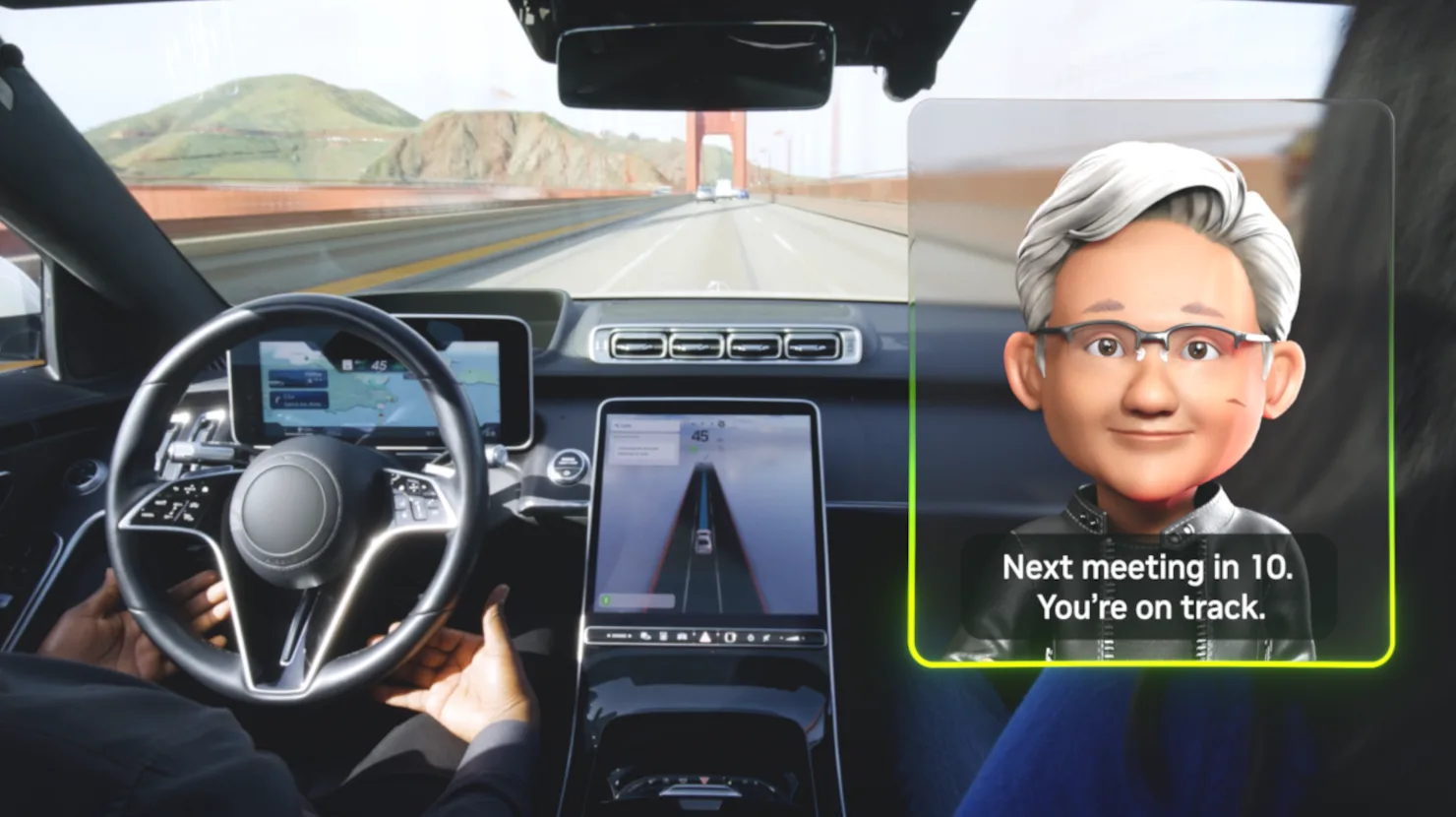
This isn’t about voice assistants that listen anymore. It’s about AI that understands and acts. The shift from rigid, command-and-response car interfaces to truly agentic, multimodal AI systems means your next ride might just anticipate your needs before you even articulate them. Think about it: your car could know your calendar, adjust the cabin for your elderly parent without a word, or explain precisely why the adaptive cruise control is behaving in a certain way. This isn’t science fiction; it’s the architecture NVIDIA is actively building for the automotive future, a future where your car is less a machine and more a deeply integrated, intelligent co-pilot.
The change from what we have now — fixed commands for navigation or music — to something that can reason, plan, and react to a dynamic environment is a colossal leap. Current in-vehicle assistants, good as they might be for turning up the heat or finding the nearest gas station, are fundamentally limited. They rely on interpreting a phrase, triggering a pre-programmed action, and then essentially hitting reset. That’s a rigid box that doesn’t accommodate the nuances of human interaction or the complexities of real-world driving.
But the advent of Large Language Models (LLMs), Vision-Language Models (VLMs), and advanced speech processing changes the game. This technology allows for conversational AI with memory, the ability to reason through multi-step tasks, and a context-awareness that adapts as your journey unfolds. It’s about moving from a system that merely reacts to explicit requests to one that can anticipate needs, making the entire in-vehicle experience feel more natural and less like operating a glorified remote control.
Beyond Basic Commands: What Does This Mean for You?
This architectural evolution unlocks a cascade of user-facing benefits. Intelligent routines become fluid: your car might greet you based on your calendar appointments, or smoothly integrate with your smart home devices as you pull into the driveway. For drivers, real-time, contextual explanations of surrounding traffic and ADAS (Advanced Driver-Assistance Systems) behavior are no longer a distant dream. This transparency builds trust, a critical element as vehicles become more autonomous. Imagine understanding why your car is braking, rather than just experiencing it. Even diagnostics can be transformed, enabling predictive maintenance through natural language queries, no technical jargon required. And personalized comfort modes – say, for children or elderly passengers – become intuitive and easy to implement, moving from complex settings to simple, context-aware adjustments.
The On-Device Imperative: Latency, Privacy, and Compute
Delivering these sophisticated AI experiences directly within the vehicle presents a significant systems engineering challenge. Strict requirements for low latency, paramount safety, and ironclad data privacy mean that much of this processing must happen locally, on the edge, rather than relying solely on the cloud. An in-vehicle AI assistant can’t afford to wait for a round trip to a data center; it needs to react in milliseconds.
Running large models — 7 billion parameters or more — locally, processing multimodal inputs (audio, cameras, vehicle telemetry), maintaining sub-500-millisecond response times, and sustaining high decode throughput (over 30 tokens per second) demand substantial on-device compute. NVIDIA’s DRIVE AGX platforms are engineered precisely for this. They’re designed to augment the more limited inference capabilities found in traditional infotainment SoCs, enabling the scalable deployment of these advanced LLMs and VLMs right where the action is.
The strategy here is an “AI box”—a modular, add-on compute solution that integrates with existing infotainment systems. This approach avoids the need for automakers to rip out and replace core vehicle electronics or undertake massive redesigns of their infotainment stacks. It’s about augmenting rather than replacing, allowing manufacturers to upgrade vehicles with basic systems into modern AI platforms via a hardware add-on that communicates via standard interfaces like Ethernet.
Running LLMs and VLMs locally, the AI box processes inputs from the cockpit system and returns intelligent outputs that power advanced AI assistants and rich in-vehicle experiences.
This decoupled compute platform, purpose-built for in-vehicle AI, offers significant advantages over trying to shoehorn these workloads onto general-purpose infotainment chips. We’re talking about higher AI compute capacity for larger models, dedicated memory bandwidth with guaranteed quality of service (meaning your AI assistant won’t stutter because the navigation system is updating), and deterministic, high-throughput inference performance. Crucially for automakers looking to move quickly, these are production-ready platforms, accelerating time to market. The promise: significantly higher AI compute capacity, stronger workload isolation, and a faster path to deploying these sophisticated AI assistants.
This represents a fundamental architectural shift, moving AI processing closer to the sensor and the user, a trend we’re seeing across many computing domains. The implications for the automotive industry are profound, potentially redefining the in-car experience from a mere mode of transport to an intelligent, adaptive environment.
🧬 Related Insights
- Read more: What is RISC-V?
- Read more: NVIDIA’s Blackwell Dominates MLPerf—But at What Real Cost?