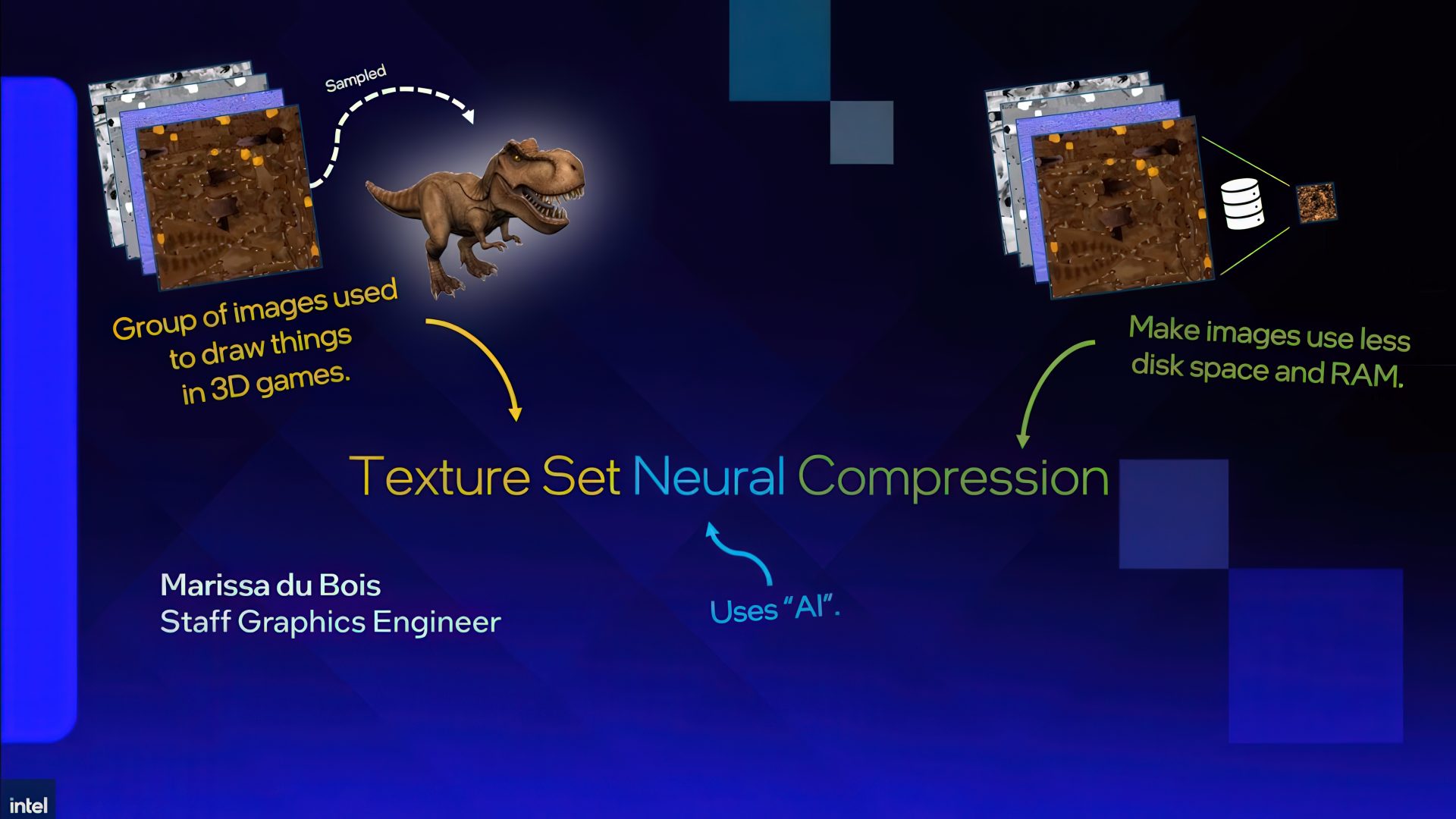
Marissa du Bois hits the GDC 2026 stage, flashing slides of shrunken textures. Intel’s Texture Set Neural Compression SDK—TSNC for short—promises up to 18x smaller files for your game’s PBR maps.
And here’s the kicker: it’s not some vaporware demo. This is productized, ready for devs to grab later this year. Zoom out a bit. Intel’s chasing NVIDIA’s NTC coattails, but with their own deterministic twist—no randomness to screw up your builds.
But wait. 18x? That’s Variant B’s aggressive mode, cascading latents down to 1/8 resolution. Sounds like a dream for bloated AAA titles gasping on SSD space. Reality check: quality dips. Block artifacts creep into normals and roughness. Intel admits it’s ‘enough to be noticeable to a viewer.’
Variant B is, therefore, probably best suited for distant or secondary materials where quality loss is less likely to be scrutinized.
Straight from du Bois’s mouth—or close enough. Perceptual error via FLIP? 6-7%. Minor for backgrounds, sure. But slap it on a hero asset? Players notice.
How Does Intel’s TSNC Actually Work?
TSNC trains a wee neural net on your texture set—diffuse, normal, roughness, the whole PBR gang. Stochastic gradient descent learns the redundancies across channels. Boom: compact latent space. A tiny MLP reconstructs it at runtime.
Feature pyramids are the secret sauce. Four BC1 latents at varying resolutions. Variant A: two 4K, two 2K for 4K inputs. 26.8 MB vs. 256 MB raw. 9x squeeze, beating BC7’s 4.8x. FLIP error at 5%—mostly normal map fuzz.
They rewrote the compressor in Slang shaders. Decompressor plays nice with Unreal, custom engines, even CPU. GPU side? DirectX 12 Cooperative Vectors on Arc’s XMX cores. FMA fallback for the rest. Smart.
No ecosystem lock-in—yet.
But.
This smells like 2000s megatexture flashbacks. Id Software hyped infinite worlds with on-demand streaming. Runtime decompression tanked perf on weaker rigs. TSNC’s ‘at sample time’ mode—per-pixel shader decode—could do the same. Constant inference overhead. Viable on Panther Lake iGPU? Barely. 0.194 ns/pixel on XMX. Still, multiply by 1080p frames? Adds up.
Is TSNC a Real Threat to NVIDIA’s NTC?
NVIDIA got here first. Intel’s playing catch-up—shocker. Both deterministic, both neural. But Intel’s SDK is standalone, backend-agnostic. No GeForce lock. That’s the jab.
Benchmarks look solid. 3.4x speedup on hardware accel. Discrete GPUs? Even snappier. Deployment options galore: install-time unpack for bandwidth wins; load-time for VRAM diet; stream-time for open worlds; sample-time for masochists.
Pick your poison. Most? Load or stream. Sample-time’s a VRAM miracle (half the footprint) but perf tax. Devs weigh that against 18x disk savings.
Unique angle: remember BCn formats? Locked in since DirectX 9 because universal. TSNC needs engine buy-in. Vulkan? DX? Good luck porting. NVIDIA’s NTC thrives in their UE5 plugin garden. Intel’s open-ish pitch might fizzle without adoption. Bold call: by 2028, TSNC powers 10% of PC indies, zero AAA. Too niche, too fiddly.
Dry humor time. Intel touts ‘smarter than BC7.’ Duh—neural nets lap fixed math. But PR spin ignores the train-once-per-set hassle. Auto-compress pipelines? Coming, maybe. Right now, manual per-material grind.
Four strategies dissected by du Bois. Install-time: fat downloads, slim installs. Load-time: compressed disk, VRAM burst on load. Stream-time: goldilocks for streaming engines. Sample-time: VRAM anorexic, shader hog.
Panther Lake test: FMA at 0.661 ns/pixel. XMX slashes to 0.194. Integrated graphics holding 1080p compute? Impressive. Discrete Arc or Battlemage? Laughably fast.
Alpha SDK drops later 2026. Beta, public—whenever.
Skepticism meter: high. Compression wars echo JPEG vs. JPEG2000. Fancy lost to simple. TSNC’s neural edge? Cool for labs. Games demand zero-hitch. If inference spikes stutter—game over.
Still, props. Intel’s Arc push needs wins. TSNC fits: Arc-first, but portable. Forces NVIDIA to iterate. Competition? Healthy.
Why Should Game Devs Care About TSNC Right Now?
Disk bloat kills. 200GB installs? Players rage-quit. 18x hits download sizes hard. Streaming engines salivate.
But test it. Alpha incoming. Train times? Unknown. Quality tweaks? DIY.
Historical parallel: like S3TC birth. Hardware forced compression. Now neural forces smarter. But adoption lags hardware. Arc marketshare? Tiny. XMX? Rarer. FMA fallback saves it.
Prediction: TSNC shines in asset pipelines first. Runtime? Mobile Arc experiments. PC? Wait for DXR-level mandates. None coming.
Intel’s not sleeping on GPUs. TSNC screams ‘we’re serious.’ Burn that into your brain.
🧬 Related Insights
- Read more: Memory Chip Shortage: AI’s Feast Means Your Famine for Years
- Read more: Broadcom’s Quantum-Safe Fibre Channel Trick: Encryption Without the Pain?
Frequently Asked Questions
What is Intel TSNC SDK?
Intel’s Texture Set Neural Compression SDK compresses PBR texture sets up to 18x using per-set neural nets, decoding via tiny MLPs on GPU or CPU.
How does TSNC compare to NVIDIA NTC?
Both deterministic neural compression; TSNC is backend-agnostic with Slang shaders, supports Arc XMX accel, offers 9-18x ratios vs. NTC’s similar but ecosystem-tied approach.
When will Intel TSNC SDK be available?
Alpha later 2026, beta and public release TBD—don’t hold your breath for tomorrow.