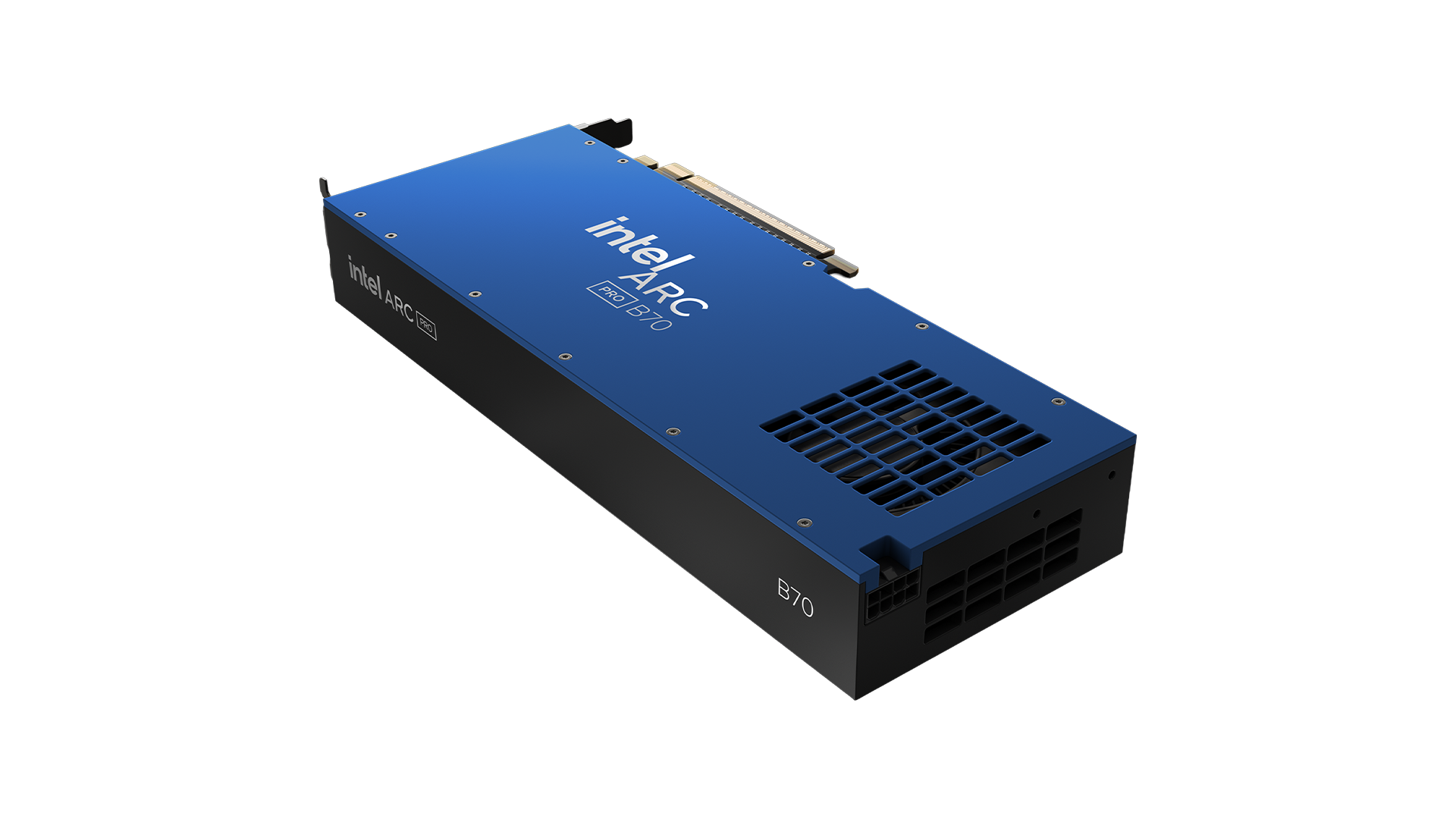
Smoke curls from a workstation in a dimly lit lab, as Intel’s Arc Pro B70 GPUs churn through 120B-parameter models like they’re yesterday’s crossword.
MLPerf Inference v6.0 dropped today, and Intel’s waving its Xeon 6 CPUs and Arc Pro B-Series GPUs like a victory flag. Four-GPU setups pack 128GB VRAM, handling massive concurrency without breaking a sweat. The B70? It smokes the older B601 by 1.8x in inference performance. Software tweaks in an open, containerized stack scale from solo nodes to multi-GPU beasts—up to 1.18x better on the same B60 hardware versus last round.
Intel’s Bold Claim in Quotes
“The combination of Intel Xeon 6 and Intel’s Arc Pro B-Series GPUs represent our investment to expand customer choice and value, offering real-world solutions that address both LLM models as well as traditional machine learning workloads, with leading performance and incredible value for graphics professionals and AI developers worldwide.”
— Anil Nanduri, Intel VP, AI Products and GTM
That’s the corporate line. Smooth. But let’s cut the ribbon: Intel’s pitching this as democratized AI, free from NVIDIA’s subscription traps and privacy pitfalls. Fair point—demand for inference is exploding, and pros want power without the bill.
Arc Pro B70 and B65 aren’t just spec bumps. Enhanced memory lets them swallow larger models and context windows—1.6x more KV cache than rivals in multi-GPU configs. PCIe P2P transfers, ECC reliability, SR-IOV, telemetry, remote updates. It’s an all-in-one Linux container for edge, workstations, datacenters. CPU matters too; Xeon 6 handles orchestration, security, the unglamorous grind that defines total cost.
Intel’s the lone ranger submitting pure CPU results. Over half of MLPerf 6.0 subs run on Xeon. P-cores deliver 1.9x generational leaps, AMX and AVX512 accelerating LLMs sans extra silicon.
Why Does Intel’s MLPerf Win Matter for Edge AI?
Edge inference isn’t glamorous. It’s low-latency grinds in factories, clinics, cars—places where Nvidia’s data-center kings falter on power draw or cost. Intel’s stack scales cleanly, containerized for devs who hate vendor lock. But here’s the acerbic truth: these benchmarks are controlled labs. Real-world? Traffic jams of variables—power spikes, heat, software glitches. Intel’s 1.8x sounds snappy, yet Nvidia’s H100s lurk in the shadows, hoarding the trillion-parameter crowns.
Strip the spin. Intel’s unique edge? They’re the open-source darlings in a walled-garden world. Remember 2010s, when Intel clung to x86 while ARM nibbled? This feels like that pivot—historical parallel—betting on ubiquitous CPUs plus affordable GPUs to erode GPU monopolies. Bold prediction: by 2027, workstation AI shifts 20% from Nvidia as Arc matures. PR calls it ‘incredible value.’ Translation: cheaper than CUDA cults.
Short version.
It scales.
Is Intel Finally Catching Nvidia in AI Inference?
No. Not yet. Arc Pro B70 handles 120B models with concurrency, sure—four cards, Xeon 698X, DDR5 blitz. But Nvidia’s submissions? Black-box beasts optimized for their ecosystem. Intel’s open stack shines for tinkerers, multi-GPU PCIe magic avoiding NVLink premiums. B70’s 1.6x KV cache edge powers bigger contexts, critical for agentic AI where memory starves first.
CPU inference leadership? Undeniable. Standalone Xeon results prove it—others bundle accelerators to hide host weakness. Intel owns the host brain, powering 50%+ of MLPerf rigs. Generational 1.9x on P-cores, baked-in AI accel. No accelerators needed for fine-tuning or classics. That’s ecosystem glue.
Yet skepticism bites. Benchmarks scream ‘performance varies by config’—disclaimers galore. February 2026 dates? Future-proofing or slippage? Costs vary, security never absolute. Intel’s rallying cry against proprietary models rings true as subscriptions balloon, but will devs switch? Arc’s driver drama lingers like a bad hangover.
Dig deeper.
Four-GPU B70: Intel Xeon 698X, 8x 16GB DDR5-6400, crushing v6.0 tasks. B60 comparisons? 1.18x software lift on identical iron. Enterprise features—telemetry, firmware OTA—target IT admins weary of bespoke hacks.
The Skeptic’s Ledger: Gains vs. Gaps
Pros: Open, scalable, value-packed. 128GB VRAM for LLMs. CPU-GPU synergy without proprietary chains. Edge-ready low-latency.
Cons: Still playing catch-up. Nvidia’s throughput kings for hyperscale. Arc’s maturity? Questionable outside labs. Power efficiency? Unproven at scale.
Unique insight: This mirrors Intel’s 3D XPoint bet—high-risk push for inference independence. If Arc B70 hits shelves with promised multi-GPU P2P, it disrupts workstation AI rentals. Corporate hype? ‘Leading performance’—dial it back to ‘competitive.’ Dry humor: Intel’s finally got GPUs that don’t melt under load. Progress.
Inference demand surges.
Intel positions center.
Game on.
🧬 Related Insights
- Read more: NVIDIA’s Isaac Gambit: 90% Synthetic Data by 2030, But Robots Still Stumble in the Real World
- Read more: Semiconductor Startup Ecosystem: How New Chip Companies Get Built
Frequently Asked Questions
What are MLPerf Inference v6.0 results for Intel Arc Pro B70?
Four-GPU setups with Xeon 6 deliver 1.8x higher performance than B601, scaling to 128GB VRAM for 120B models with high concurrency.
Does Intel Arc Pro beat Nvidia in AI inference benchmarks?
Not outright—Intel excels in open scalability and CPU integration, but Nvidia leads raw throughput; Arc shines for cost-sensitive edge and workstations.
Why choose Intel for AI workstations over GPUs alone?
Xeon 6 provides orchestration, security, and standalone inference leadership, cutting total ownership costs without accelerator dependency.