Synthetic data makes up a measly 20% of AI training for those tricky edge scenarios in robotics right now.
But Gartner — yeah, those prognosticators — figures it’ll balloon to over 90% by 2030.
That’s the hook NVIDIA’s dangling with their Isaac platform, promising to whisk robots from cozy simulations straight into factories. I’ve covered this Valley song-and-dance for two decades; generalist-specialists that learn broad skills then specialize? Sounds like the ultimate jack-of-all-trades robot. Except, who’s actually banking the big bucks here? Spoiler: it’s the GPU kingpin.
NVIDIA Isaac: Open Tools or Clever Lock-In?
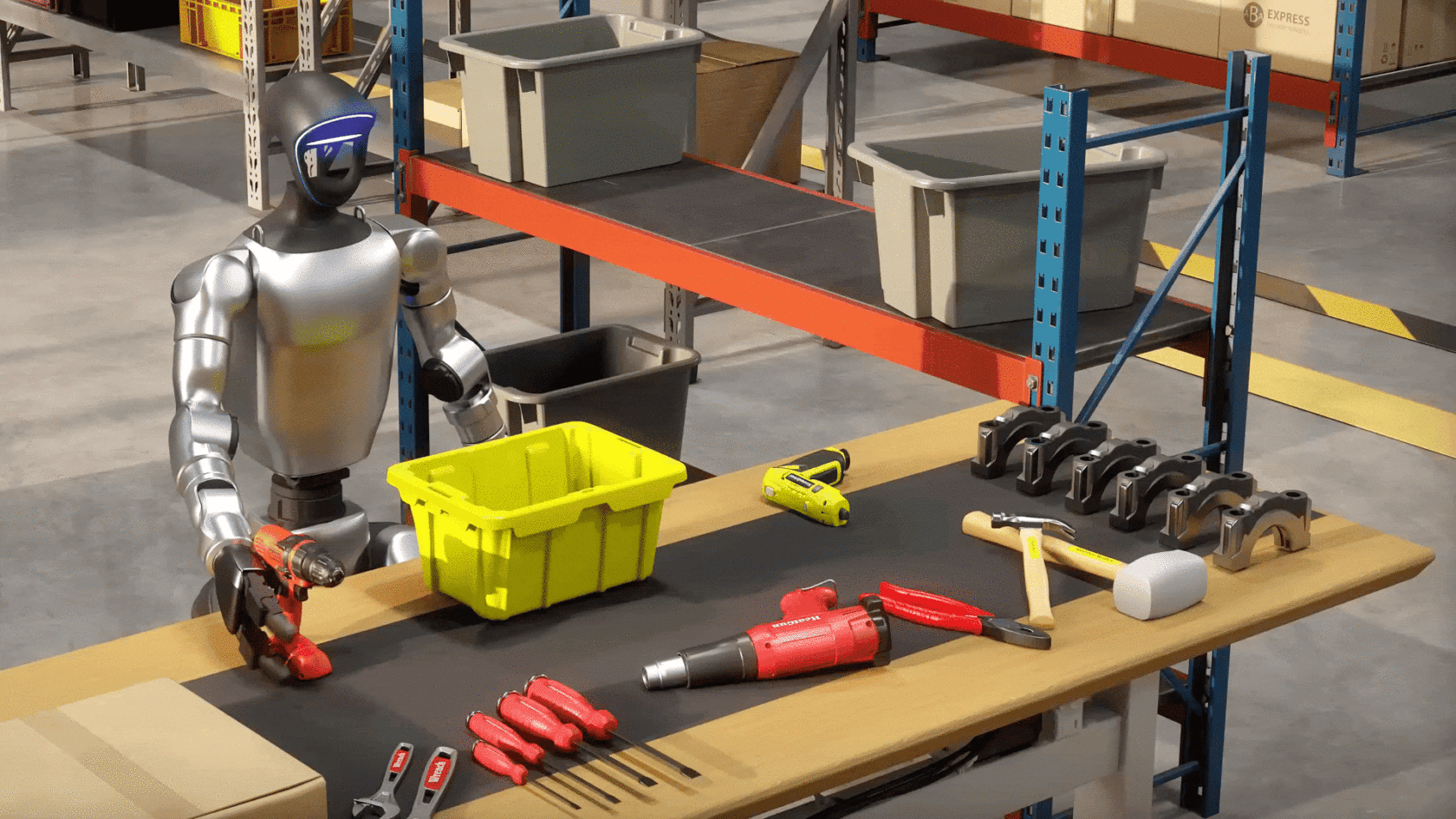
NVIDIA’s pitching their open Isaac platform as the full-stack savior — models, data pipelines, sim frameworks, runtime libs, all tied to their three-computer setup. They even toss in GR00T N, a vision-language-action model to bootstrap your bot’s brain. Run it in the cloud or on edge, now jazzed with long-running agents like OpenClaw.
These workflows are open and composable, so developers can mix and match components, bring their own tools and data, and accelerate their pipeline from prototype to real-world deployment.
Nice quote from the press release, right? Open and composable — buzzwords that scream ‘use our stuff freely!’ But here’s my cynical take after years of this: it’s NVIDIA’s ecosystem. You mix and match, sure, but you’re rendering in OpenUSD, simulating in Isaac Sim, training on their Cosmos models. It’s like offering a free toolbox that’s magnetized to your hardware. Agility Robotics swears by it for sim-to-reality jumps. FieldAI too. Coincidence?
Data’s the real grindstone.
Back in the day — couple years ago — you’d slave over manual collection: sensor logs, teleop demos, praying your bot doesn’t face-plant on unseen corners.
NVIDIA flips that with synthetic magic. Blend real signals with sim-generated hordes, courtesy of Omniverse NuRec’s 3D Gaussian splatting. Scan the world, recreate it in Isaac Sim, test edge cases that’d be suicidal or impossible in meatspace. Teleop via XR headsets and gloves feeds Isaac Teleop, amps up with Physical AI Data Factory Blueprint — powered by Cosmos and OSMO orchestrator.
One real scenario? Boom, endless variants in minutes.
But wait.
Can Synthetic Data Fool Robots in the Wild?
Physically accurate sims sound peachy. Rig your humanoid, AMR, or arm in Isaac Sim, tweak with PTC Onshape integration. All OpenUSD, smoothly interactions.
Yet I’ve seen this movie. Remember the 2010s self-driving hype? Billions poured into sims, DARPA challenges won in virtual worlds, then Waymo’s cars creep at 25mph in Phoenix suburbs. Reality’s friction, lighting quirks, human idiots — sims miss ‘em. NVIDIA’s propelling the shift, sure, but that Gartner 90%? It’s their compute factory churning. Who pays for the Omniverse render farms? You, scaling to production.
My unique gut-check: this mirrors the CUDA lock-in from early deep learning. NVIDIA gave devs ‘free’ tools then, hooked ‘em on proprietary stacks. Robotics? Same play. Bold prediction — by 2027, Isaac GR00T fine-tunes will power 70% of commercial bots, but deployment fails will hit 80% without hybrid real-synth loops. History rhymes: Tesla’s Dojo sim dreams crashed on highways.
And the generalist-specialist dream? VLA models perceiving, reasoning, acting across tasks. GR00T N as foundation. Cloud-to-robot workflows for safe deploys.
Skeptical me asks: where’s the money trail? NVIDIA’s GTC announcements — edge AI systems, agent-friendly models — scream GPU sales. Robots don’t buy A100s; startups do, burning VC cash on sim cycles. Winners? Jensen Huang’s yacht fund.
Look, it’s not all spin. Tools like Isaac Lab for training, NuRec in GA — devs save months on data drudgery. FieldAI deploys for industrial clients effortlessly, they claim.
But after 20 years, I’ve learned: platforms win before products do.
Why Does NVIDIA Dominate Robot Sims Now?
Three-computer solution: cloud for training, sim for eval, edge for run. Integrates teleop, augments datasets. Physical AI Data Factory? Scalable beast.
Edge cases — rare crashes, weird grips — sims nail ‘em safely. No more waiting weeks for physical trials.
Still, production’s the graveyard. Agility’s Digit humanoid? Impressive walks, but pick bins at Amazon scale? Not yet. NVIDIA frameworks accelerate, but hardware (motors, sensors) lags AI brains.
Cynical aside — it’s PR gold. ‘Open’ lures OSS fans, but proprietary models like GR00T N bootstrap you right back.
Devs, mix your tools. But compute bills arrive.
Who Profits from Robot AI Hype Cycles?
Short answer: NVIDIA, obviously.
Long one: the sim-to-production pipe greases VC pipelines. Startups prototype fast, pitch ‘generalist bots,’ raise rounds on Isaac demos. End-users? Factories wait for reliability.
I’ve grilled execs on this. ‘Scale data!’ they chant. But real-world variance — dust, wear, sabotage — laughs at sims.
Historical parallel: 1990s factory automation. Hype on vision systems, billions sunk, most bots idle. AI amps it, but physics wins.
NVIDIA’s not wrong — synth data’s essential. Just don’t drink the full Kool-Aid.
🧬 Related Insights
- Read more: Intel’s Arc Pro GPUs Claw Back Ground in MLPerf v6.0 — Still Nvidia’s Shadow?
- Read more: GM’s Large Physics Models Slash Car Design Weeks to Minutes
Frequently Asked Questions
What is NVIDIA Isaac platform?
It’s an open suite for robot devs: sims (Isaac Sim/Lab), models (GR00T N), data tools (NuRec, Teleop), pipelines to deploy from cloud to edge.
How does synthetic data help build robots?
Generates massive edge-case scenarios impossible to collect physically, blending with real data for training strong VLA models — aiming for that 90% by 2030.
Will NVIDIA Isaac replace physical robot testing?
Not fully — sims accelerate, but real-world validation’s mandatory. It’s a force-multiplier, not a sim-only utopia.