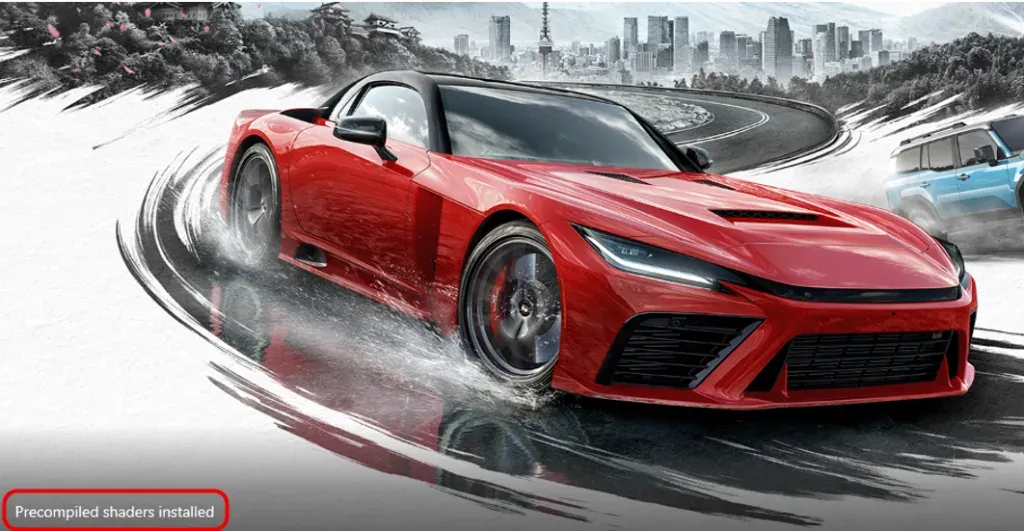
Ninety seconds. That’s how long Forza Horizon 6 used to crawl to life on a PC. Now? Four seconds. Yes, you read that right. A staggering 95% reduction. And before you start weeping tears of joy into your RGB-laden keyboard, understand this isn’t magic. It’s Microsoft’s Advanced Shader Delivery (ASD) finally making its way beyond niche handhelds and into the wider PC gaming world, with AMD GPUs now getting their turn in the sun.
What’s the big deal? It’s simple, really. Every game update, every driver tweak, used to force your PC to recompile shaders. Think of it as a digital dentist having to re-examine every single tooth on every single player every time the game sneezed. This was the bottleneck, the glacial pace of progress that even the fastest SSDs couldn’t outrun. Microsoft’s solution is to shove all those pre-compiled shaders into the cloud, sorted by your specific hardware configuration. Download the game, and bam – the right shaders are already waiting. It’s a concept consoles have lived with for ages, and Valve tinkered with for the Steam Deck, but Windows has been stuck in the slow lane.
Why Does This Matter for Developers (and Gamers)?
This is the sort of thing that separates a premium gaming experience from just… playing games. Waiting for a game to load is dead time. In an industry obsessed with immersion and instant gratification, those 80-second gaps are an eternity. Developers have been wrestling with this, and Microsoft’s ASD offers a concrete answer. It’s not just about Forza. Thirty-four other games already supported this when it first landed on the Xbox ROG Ally. Now, with broader GPU support, that number should only climb.
Of course, it wouldn’t be a Microsoft rollout without a few asterisks. First, you need the Microsoft Store or Xbox PC app version of the game. No Steam? Tough luck, for now. Second, this is currently preview territory. You need to be in the Xbox Insiders program to even enable it. And the AMD love? That’s reserved for RDNA 3, 3.5, and 4 GPUs. Anything older is out of luck.
But here’s the kicker — the one thing that makes me raise a skeptical eyebrow. Microsoft claims this is a “universal solution for all GPUs on Windows 11 going forward.” Yet, here we are, with exclusive hardware requirements. It smacks of the usual corporate dance: initial exclusivity deals followed by gradual rollout. We’ve seen it before. AMD gets its turn now, and one can only assume Nvidia and Intel (who already have their own flavour of this tech) will see further integration. Intel’s “Precompiled Shader Distribution” is already using its own cloud database. Nvidia’s “Auto Shader Compilation” in the Nvidia app is similarly functional. The standardization here is good, but the staggered access feels… familiar.
“Consoles have done this forever, which makes sense considering they don’t have to worry about different hardware configs. Even Valve has a version of precompiled shaders for Linux that it developed for the Steam Deck, but never ported to Windows.”
This quote perfectly encapsulates the frustration. Consoles are walled gardens where this optimization is trivial. PCs? A chaotic mess. And for years, we’ve been told SSDs were the magic bullet for load times. They were. But shader compilation was the tenacious weed that kept growing back, choking the instant-on dream.
Will This Actually Change How We Play?
Maybe. For those with compatible hardware and the right store version, yes. The difference between 90 seconds and 4 seconds is the difference between grabbing a snack and checking your email and actually playing the game. It’s that significant. It’s the final frontier for load times, and it’s finally being conquered.
But let’s not pretend this is a purely altruistic move by Microsoft. This is about locking users into their ecosystem. Want the fastest load times? Better get your games from the Microsoft Store. Better have an RDNA 3+ GPU. It’s a carrot, a very appealing one, for consumers. For developers, it’s a chance to finally ditch one of the most frustrating technical hurdles in PC game development.
So, while the tech itself is undeniably impressive, the implementation is pure Microsoft: a little bit of innovation, a lot of ecosystem play. AMD’s participation is a welcome sign of cooperation, but the underlying strategy remains the same. Welcome to the future of game loading. It’s fast. And it’s probably best if you buy it from us.
**
🧬 Related Insights
- Read more: Google Cloud Next: AI Everywhere, But Who’s Buying?
- Read more: BenQ Materials Ships CMP Rollers to Fabs – Taiwan’s Latest Semi Gamble?
Frequently Asked Questions**
What is Advanced Shader Delivery? Advanced Shader Delivery (ASD) is a Microsoft technology that precompiles game shaders and stores them in the cloud, significantly reducing game loading times on PCs by eliminating the need for on-device compilation every time a game is launched or updated.
How much faster are game load times with ASD? Microsoft claims ASD can reduce load times by up to 95%, as demonstrated with Forza Horizon 6 booting in 4 seconds instead of 90 seconds.
Which GPUs support Advanced Shader Delivery? Currently, ASD primarily supports AMD RDNA 3, RDNA 3.5, and RDNA 4 GPUs. Intel and Nvidia also have similar technologies in their respective graphics applications.
Do I need to be in a special program to use ASD? Yes, for now, users need to be enrolled in the Xbox Insiders program to access ASD, as it’s currently classified as a preview feature.
Can I use ASD with games from Steam? No, Advanced Shader Delivery currently only works with games downloaded through the Microsoft Store or the Xbox PC app.