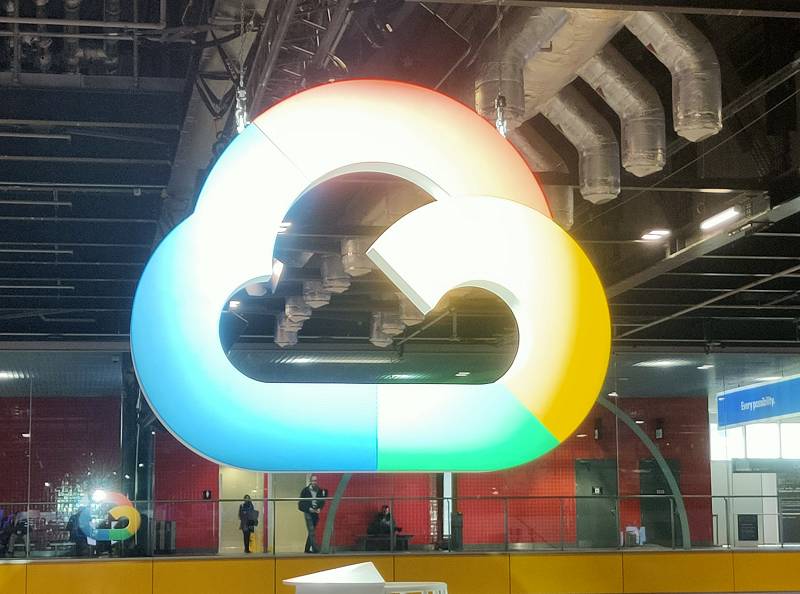
Let’s get one thing straight: Google Cloud Next this year wasn’t about the cloud. It was about AI. Every announcement, every rebranding, every flashy demo screamed ‘Artificial Intelligence’ louder than a chatbot stuck in a recursion loop. And honestly, after two decades of watching Silicon Valley chase the next big thing, I’ve learned to be suspicious when a company renames something three times and slaps an ‘AI’ label on it.
We’re talking about Google splitting its Tensor chip lineup – one for inference, one for training. Neat. Then there’s the Vertex AI development platform, now apparently the Gemini Enterprise Agent Platform. Because adding more syllables and an acronym makes it sound more revolutionary, right? This is supposed to be the single pane of glass for creating and managing AI agents. Sounds like another layer of complexity masquerading as simplification.
But here’s the real kicker, the thing that makes my cynical old journalist bones tingle: the Mythos leak. Anthropic’s much-hyped cybersecurity AI model apparently had a vulnerability that allowed someone – and the article is conspicuously vague on who exactly – to gain improper access. And guess what? The results suggest Mythos was, surprise, surprise, less capable than the marketing machine made it out to be. This isn’t just a tech hiccup; it’s a perfect illustration of the chasm between AI hype and AI reality.
Is Everything Actually AI Now?
Look, I’m not saying AI isn’t important. It’s the underlying tech powering a lot of genuinely useful stuff. But when an event ostensibly about cloud infrastructure dedicates itself to AI announcements, you have to ask: is this innovation, or is it a desperate attempt to ride the AI wave before it crests? Google is clearly betting big on AI as its future revenue driver. The question is, are enterprises ready to pony up the cash for these fancy new tools, especially when the security promises are already being tested?
And this Mythos debacle? It’s a flashing red warning sign. If a cybersecurity AI can be breached, what does that say about the security of the AI systems being developed and deployed across industries? The hype machine is running at full tilt, but the reality of securing these complex systems is proving to be a much tougher nut to crack than anyone wants to admit.
‘The incredibly small amount of time it took someone to gain improper access to Anthropic’s Mythos cybersecurity AI model.’
That quote, buried in the original write-up, is the real headline. It encapsulates the problem. We’re building these powerful AI models, showering them with buzzwords, and then finding out they’re not as strong as we thought, or worse, that they’re vulnerable to the very threats they’re supposed to combat. It’s a classic Silicon Valley play: build it fast, market it harder, and hope the money follows before the cracks appear.
Where’s the Actual ROI?
This is where my journalistic skepticism really kicks in. Google Cloud Next is a showcase, a marketing event. They’re trying to sell you on a vision. But visions don’t pay the bills. What they need are actual contracts, actual deployments, actual dollars. And while they’re boasting about new chips and rebranded platforms, the underlying question for any CFO or CTO is: what’s the return on investment here? Are these AI agents going to save my company millions, or are they just going to add another expensive line item to the budget?
Historically, the big tech companies have always been good at creating demand for their own platforms. They build the ecosystem, and then they sell you the pieces. AI is no different. They’re selling you the compute, the development tools, and the promised intelligence. The real test won’t be the feature lists announced at Google Cloud Next; it will be the quarterly earnings reports down the line. And if those reports don’t show a significant uptick in AI-driven revenue, then all the buzzwords in the world won’t matter. It’ll just be another overhyped tech trend that fizzled.
My bet? We’re going to see a lot more AI announcements, a lot more rebrands, and a lot more hand-wringing about security and ROI. The AI gold rush is on, but it’s still too early to tell who’s actually finding gold and who’s just digging for dirt.
What’s clear is that AI is no longer a niche technology; it’s the default setting for innovation. The question is whether this AI-centric approach will translate into tangible business value or just more expensive, over-engineered solutions that might not be as secure as we’d like to believe.