This isn’t just another tech conference recap. This is about what happens when the silicon brains behind our digital future get a serious upgrade, and how that translates to your everyday life, not just in some distant sci-fi flick, but now. Imagine your phone instantly understanding complex voice commands, your doctor having AI analyze medical scans with lightning speed, or your commute being guided by predictive traffic systems that actually work. That’s the promise, the electrifying undercurrent, thrumming beneath the polished chrome and dazzling displays.
Las Vegas — a city that practically vibrates with amplified ambition — played host to Dell Technologies World 2026, and while the neon lights might grab your attention, it was the quiet, powerful advancements in memory technology from SK hynix that truly stole the show. This isn’t just about faster chips; it’s about building the fundamental infrastructure for an AI-driven world. Think of it like the difference between a dirt road and a superhighway. AI needs that superhighway, and SK hynix is laying down more lanes than ever before.
The AI Memory Machine: Beyond the Hype
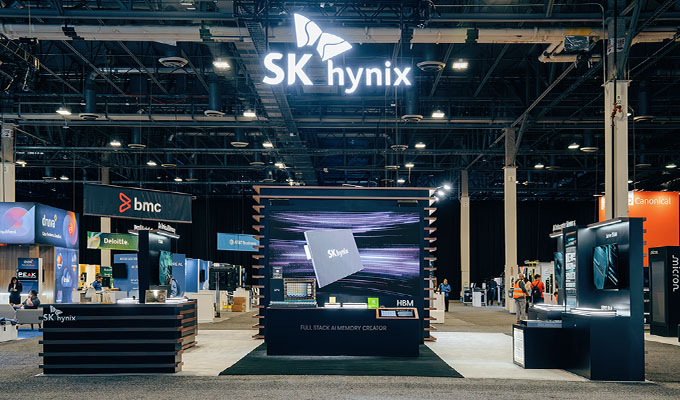
SK hynix, a name synonymous with pushing the boundaries of what memory can do, didn’t just show up at DTW 2026; they laid out their entire arsenal. Their booth, a sleek edifice of black and copper that mimicked semiconductor layering, wasn’t just for show. It was a statement: we are the architects of the AI memory ecosystem, from the ground up.
The centerpiece, of course, was the High Bandwidth Memory (HBM) – the lifeblood of AI accelerators. We’re talking about actual units of HBM4 and HBM3E on display, not just abstract concepts. These aren’t just memory chips; they’re the superchargers that allow GPUs to chew through colossal datasets at speeds that would make your head spin. When you see GPU system models for cutting-edge AI data centers alongside these memory modules, you’re witnessing the core components that are making AI not just possible, but practical.
But AI’s thirst isn’t quenched by HBM alone. SK hynix also flexed its muscles in Server DRAM, showcasing products like the 192GB SOCAMM22 and the colossal 256GB 3DS3 RDIMM4. These aren’t just bigger numbers; they represent an increased capacity to hold and process the vast amounts of data AI models require. It’s like giving a supercomputer a bigger brain, allowing it to think faster and deeper.
And then there’s the storage. SK hynix didn’t shy away from demonstrating their diverse range of eSSD products, including those designed for direct liquid cooling. This is the nuts-and-bolts stuff that keeps AI systems from overheating under pressure – a crucial, often overlooked, aspect of scalability. The sheer variety on display — from E1.S to E3.S and M.2 form factors — underscores a commitment to providing solutions for every conceivable AI workload, from massive data centers to the edge.
From Data Centers to Your Desk: The AI PC Effect
The conversation, however, didn’t stop at the server rack. SK hynix made a compelling case for AI’s integration into our personal computing lives with their cSSD and PC DRAM offerings. The PQC21 M.2 2230, already being supplied to Dell, is a prime example. Built on 321-layer QLC NAND and leveraging SLC caching, this isn’t just about storing more files; it’s about delivering the high performance needed for AI applications to run smoothly on your laptop. Imagine your PC helping you brainstorm ideas, summarize long documents, or even generate creative content – that’s the AI PC future SK hynix is helping to build.
The company’s PC DRAM portfolio, featuring CSODIMM and LPCAMM2 modules, further cements this vision. These aren’t just incremental upgrades; they’re designed to pack more power and efficiency into smaller form factors, perfectly suited for the next generation of AI-enabled laptops. This move towards personal AI integration is perhaps the most tangible aspect of the platform shift for the average user.
“The company focused on demonstrating its overwhelming technological capabilities as a full-stack AI memory creator.”
This quote from the original announcement isn’t just corporate speak; it’s a statement of intent. SK hynix isn’t content to be a component supplier; they are positioning themselves as the foundational layer for the entire AI revolution. Their partnership with Dell, showcased by a Dell server system humming with SK hynix memory and storage, is a clear signal of this integrated vision.
The Platform Shift: More Than Just Specs
What truly excites about these developments isn’t the terabytes or gigahertz numbers. It’s the inherent understanding that AI is no longer a specialized tool but a fundamental platform upon which future technologies will be built. We are witnessing the silicon foundations of this new era being laid, brick by painstaking, innovative brick.
This move towards a fully integrated AI memory solution across all tiers of computing – from massive cloud infrastructure down to the individual AI PC – feels less like an evolution and more like a paradigm shift. It’s the kind of seismic change that redefines industries and reshapes how we interact with technology. The raw processing power is meaningless without the memory to feed it and store its insights. SK hynix and Dell are clearly speaking the same language of accelerated, scalable intelligence.
🧬 Related Insights
- Read more: AMD Ryzen 7700X3D: Cheaper 3D V-Cache Arrives
- Read more: Meta & UC San Diego Unveil TLX Compiler: Boosting GPU ML Production
Frequently Asked Questions
What are SK hynix’s key AI memory products? SK hynix showcased High Bandwidth Memory (HBM) like HBM4 and HBM3E, alongside Server DRAM products like 192GB SOCAMM22 and 256GB 3DS3 RDIMM4, as well as various eSSD and cSSD solutions for different AI applications.
Will this impact the development of AI PCs? Yes, SK hynix’s cSSD and PC DRAM products, like the PQC21 M.2 2230 and LPCAMM2 modules, are specifically designed to enhance the performance and capabilities of AI PCs, making them more powerful and efficient.
How significant is the partnership between SK hynix and Dell? The collaboration is highlighted by the integration of SK hynix’s AI memory and storage solutions into Dell server systems, demonstrating a unified approach to building actual AI data centers and reinforcing SK hynix’s role as a key partner in Dell’s AI infrastructure strategy.