Fifty percent. That’s how much of an advanced automotive SoC might be packed with embedded SRAM, according to a recent deep dive from Synopsys. Let that sink in. We’re so often caught up in the dazzling dance of CPU cores and AI accelerators, but the plumbing – the ubiquitous memory that feeds them – is undergoing a radical, and frankly, more critical, transformation. This isn’t just about stuffing more RAM onto a chip; it’s about intelligent placement and sophisticated design, especially as we push into the treacherous, yet tantalizing, territory of 3nm and 5nm process nodes for vehicles.
The Data Drought in the Car
The traditional wisdom for bridging the gap between a processor’s hunger for data and the snail’s pace of off-chip DRAM access has always been cache. Multiple levels of it, mind you, a sophisticated dance designed to keep the most critical bits of information right where the CPU can grab them without breaking a sweat. It’s a beautiful system, elegant even, but it buckles under the weight of modern AI.
AI models, particularly those designed for tasks like real-time object recognition in cars or complex sensor fusion, don’t play by the Von Neumann rules. They churn through vast, unpredictable datasets, processing frames of streaming data and generating equally massive, often erratic, intermediate results. Caching them effectively is like trying to herd cats through a hurricane.
And then there’s the car itself. Modern vehicles are transforming from collections of discrete electronic boxes into complex, interconnected systems. The old domain-based approach, where one chip handled, say, the infotainment, and another the engine control, is giving way to zonal architectures. Imagine a single, powerful chip responsible for everything happening in the front half of the car. It’s cleaner, reduces wiring, and theoretically, cuts costs. But it also means a single SoC has to juggle CPUs, GPUs, neural processing units (NPUs) for AI, and a bewildering array of other peripherals. This explosion in complexity demands that data be kept not just accessible, but immediately accessible, by spreading smaller SRAM blocks closer to the specific computational cores that need them.
Why SRAM is the New Rock Star (Under the Hood)
This push for distributed SRAM isn’t just an architectural preference; it’s a performance imperative. When you’re processing incoming video feeds for a self-driving system, or crunching data from a dozen sensors simultaneously, the time spent ferrying intermediate calculations across a sprawling chip can become a significant bottleneck. Placing small, high-speed SRAM chunks right next to the multiply-accumulate units in an AI accelerator, or the pixel-processing engines in a GPU, shaves off precious nanoseconds. These aren’t minor tweaks; they translate directly into a system that can react faster, process more data, and ultimately, be safer and more capable.
But it’s not just about raw speed. The sheer volume of SRAM needed means that Power, Performance, and Area (PPA) optimization becomes paramount. And for automotive applications, which demand a longevity measured in years, often in extreme temperature fluctuations, reliability is the absolute king. This is where the discussion gets really interesting, especially when we look at the cutting edge of silicon manufacturing.
The 3nm Tightrope Walk
The automotive industry, historically a bit more conservative with process adoption than, say, the consumer electronics market, is now eyeing the leading edge. TSMC’s N5A and N3A processes, specifically tuned for automotive needs, are no longer niche offerings. These advanced nodes, while not the absolute bleeding edge reserved for the most benign environments, offer significant advantages in density and performance. They also come with the necessary features – and associated design challenges – for achieving automotive-grade reliability and functional safety (FuSa) requirements, all while keeping PPA goals in sight.
However, these aggressive nodes aren’t plug-and-play. They require incredibly sophisticated design tools and methodologies. And that’s where advanced SRAM compilers come into play. These aren’t just basic memory generators; they’re highly parameterized engines that can be tailored to produce SRAM instances optimized for specific needs:
- High-speed compilers: Built with high-current bit cells for maximum throughput.
- Ultra-high-density compilers: Prioritizing small area and low power, using more delicate bit cells.
- High-density compilers: A middle ground, balancing medium speed with power efficiency.
- Pseudo two-port architectures: A clever trick for even greater power and area savings.
Synopsys’ white paper details how these compilers enable techniques like dynamic voltage and frequency scaling (DVFS) to slash leakage and dynamic power consumption. Lower power means less heat, and less heat means improved long-term reliability – a critical factor for any car component. The paper also highlights customer successes, including one anecdote about eliminating a timing bottleneck to achieve higher SRAM clock rates, and others showcasing improvements across all three PPA dimensions.
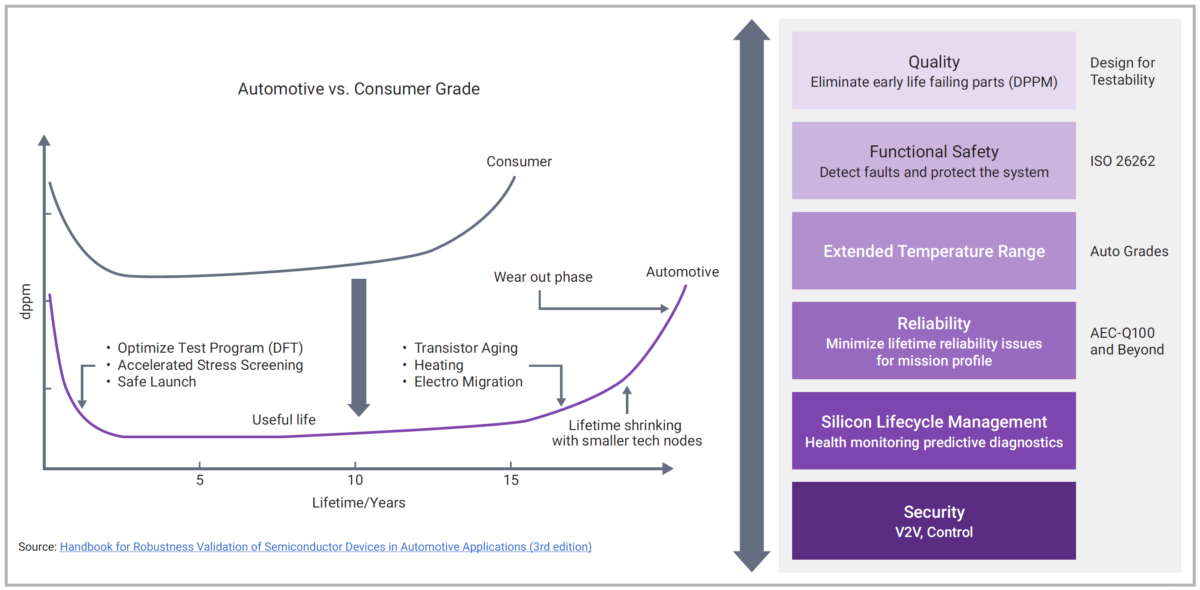
The real kicker, though? It’s the challenge of achieving ultra-low defective parts per million (DPPM) on these advanced nodes in an automotive context. This is where the precision of an advanced SRAM compiler, particularly one built with ASIL-D functional safety requirements in mind (which Synopsys claims its compilers can provide), becomes non-negotiable. It’s the difference between a chip that works perfectly for a decade and one that fails catastrophically on the highway.
This isn’t just a story about memory; it’s a story about the foundational architecture of future mobility. The processor might be the brain, but the distributed, highly optimized SRAM is the nervous system, ensuring everything runs with speed and precision, even when the stakes are as high as they are in a moving vehicle. The next time you hear about AI in cars, remember the unseen, complex world of SRAM compilers that make it all possible on the most advanced silicon we can build.
The Reliability Paradox: More SRAM, More Risk?
Here’s the dirty secret: While more distributed SRAM is generally a good thing for performance, it also introduces potential failure points. A monolithic block of SRAM might be easier to test and qualify than hundreds or thousands of smaller, scattered instances. These smaller blocks, scattered across a complex SoC, are more susceptible to subtle manufacturing variations, signal integrity issues, and environmental stresses. This is where the concept of DPPM becomes incredibly acute. For consumer electronics, a few faulty chips per million might be acceptable. For automotive, where a component failure can have life-or-death consequences, the target DPPM is orders of magnitude lower. This necessitates not just sophisticated compilers but also extremely rigorous verification and testing methodologies, extending into the physical design and layout stages.
What’s Next for On-Chip Memory?
The trend towards distributed, heterogeneous memory architectures is only going to accelerate. As AI models become even more complex and vehicle systems more integrated, the demand for specialized memory solutions will grow. We might see further evolution towards memory technologies beyond traditional SRAM for specific functions, or even more tightly integrated processing-in-memory (PIM) concepts. But for now, the advanced SRAM compiler, quietly optimizing the data flow on 3nm automotive chips, remains the silent workhorse enabling the automotive revolution.
🧬 Related Insights
- Read more: Amazon’s Jassy: Trainium and Graviton Now Gunning for NVIDIA’s Throne
- Read more: Memorial Day Tech Deals: RTX 50-Series GPUs & Ultra CPUs Appear
Frequently Asked Questions
What does an SRAM compiler do? An SRAM compiler is a design tool that automatically generates memory blocks (SRAM) for a chip based on user-defined parameters, such as size, speed, and power consumption, and targets specific manufacturing processes.
Will advanced SRAM compilers replace human chip designers? No. While SRAM compilers automate memory generation, human designers are still essential for architectural decisions, system integration, verification, and optimizing for complex requirements like functional safety and extreme reliability.
Why is SRAM important for AI in cars? AI applications in cars require processing large amounts of data very quickly. Distributing SRAM close to the processing units minimizes data access latency, which is critical for real-time tasks like object detection and sensor fusion.