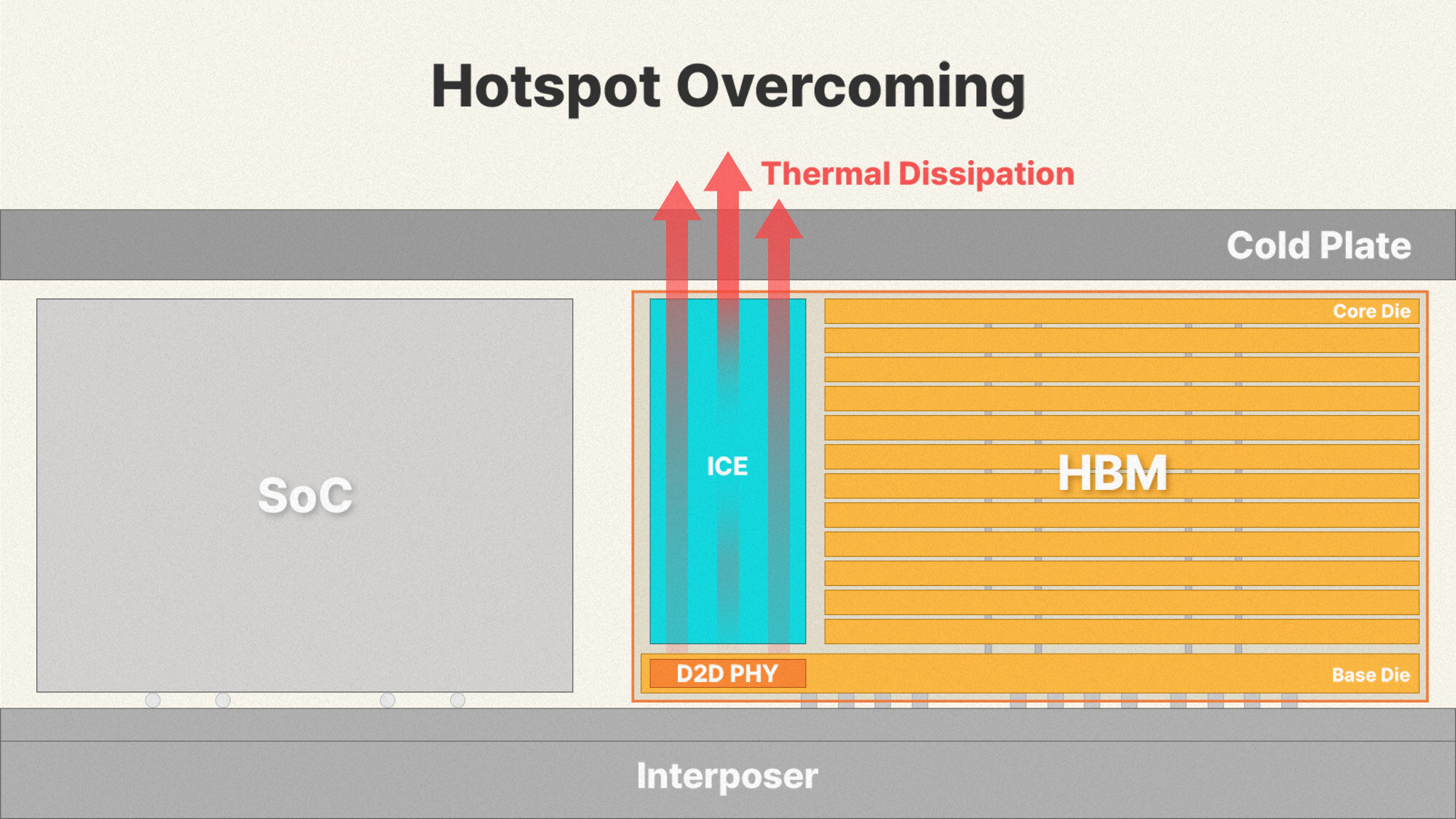
So, what does SK hynix announcing something called ‘iHBM’ actually mean for you, the everyday person who just wants their AI chatbots to stop sounding like they’re reading from a Wikipedia entry in a wind tunnel? It means the AI revolution isn’t just about smarter algorithms anymore; it’s about the sheer, unadulterated physics of making those algorithms run without melting into a puddle of precious metals.
Think of it this way: Right now, your super-powered AI chips are like athletes pushing their bodies to the absolute limit. They’re incredibly fast, incredibly powerful, but they generate a ton of heat. And just like a marathon runner needs to hydrate and manage their energy, these chips need efficient cooling. The current methods are okay – like using a big fan to blow air across the whole setup. But SK hynix’s new ‘iHBM’ (integrated High Bandwidth Memory) solution is like giving that athlete an internal cooling system, injecting coolant directly where it’s needed most, right inside the heart of the action.
This isn’t just a minor tweak; it’s a fundamental platform shift. We’ve been talking about AI as a new operating system for everything, and for that OS to truly flourish, its hardware needs to keep pace. Heat has been the silent saboteur, the invisible hand holding back progress. Every extra degree Celsius means a slight throttling, a whisper of instability, a limit on how much we can truly squeeze out of these incredible processors. By embedding ‘integrated cooling elements’ (ICEs – which, yes, is a wonderfully ominous acronym) directly into the HBM package, right at the interface between the memory and the GPU, SK hynix is creating a direct conduit for heat to escape. It’s like upgrading from a single-lane country road to a multi-lane superhighway for thermal dissipation.
They claim a 30% reduction in thermal resistance. That’s not just a number; it’s the sound of progress humming a little quieter, a little more efficiently. It means those gargantuan AI data centers can potentially run cooler, draw less power, and therefore, be more sustainable. It means the AI models that power everything from medical diagnostics to your favorite streaming service recommendations can churn through more data, faster, with greater reliability.
And here’s where the real magic starts to creep in: this isn’t some far-off theoretical dream. SK hynix has the mass-production chops to actually make this happen. Their advanced packaging techniques, honed over years, mean they can integrate this cooling tech without turning HBM production into some sort of artisanal craft. This isn’t just about making a few bleeding-edge chips; it’s about enabling the next generation of HBM, like HBM5, to hit the market with this capability baked in from the start. For customers – the chip designers and server manufacturers – this means less wrestling with complex thermal management solutions and more focus on building faster, more capable AI systems. It’s designed for high compatibility, meaning minimal fuss to adopt. That’s the kind of forward-thinking that truly unlocks potential.
Now, SK hynix’s PR spin is, as usual, a bit… PR-y. The Senior Vice President talks about “cementing its AI memory leadership” and “offering values needed in the AI environment.” Look, it’s good marketing, but what it really means is they’ve identified a massive bottleneck and built a solution that’s so fundamental, so integrated, it’s almost invisible. They’re not just selling memory chips; they’re selling the enabler for the next wave of AI computation.
We’ve seen platform shifts before. The internet. Mobile. Each time, the underlying hardware had to evolve to meet the demands of the new software paradigm. AI is that paradigm shift, and the relentless pursuit of efficiency and performance at the silicon level – like this iHBM – is what fuels it. This is the unseen engine, the quiet hum beneath the dazzling surface of AI innovation.
Why Does This Matter for the Future of AI?
This isn’t just about preventing chips from overheating; it’s about unlocking higher clock speeds, denser stacking, and ultimately, more powerful AI computations. As AI models become increasingly complex and data-hungry, the thermal envelope becomes a hard limit. SK hynix’s iHBM tackles this head-on by making cooling an intrinsic part of the memory itself, rather than an afterthought. This allows for sustained high performance, a critical factor for training massive AI models and running real-time inference at scale. It’s about moving from ‘can we run it?’ to ‘how much further can we push it?’
Is This Just More Hype?
SK hynix is a major player in the memory market, and thermal management is a well-documented challenge for advanced HBM. The technical approach described – embedding cooling elements directly in the package – is a logical, if complex, solution to a pressing problem. Their emphasis on mass-production capabilities and design compatibility suggests a practical, market-ready offering rather than a speculative experiment. The reduction in thermal resistance is a quantifiable benefit that, if realized in practice, directly translates to performance gains. So, while the marketing language might be a bit enthusiastic, the underlying innovation appears to be a genuine step forward.
“iHBM is an optimal solution for thermal management, combining our memory design capabilities with advanced packaging technology,” said Kangwook Lee, Senior Vice President and Head of PKG Development at SK hynix, adding “The company will cement its AI memory leadership by taking preemptive steps to offer values needed in the AI environment for its customers.”
When you look at the trajectory of AI, it’s clear that performance and efficiency need to evolve hand-in-hand. The raw processing power is there, but without the ability to dissipate the resulting heat effectively, that power is capped. SK hynix’s iHBM is a concrete example of how the industry is addressing these fundamental hardware constraints. It’s a quiet revolution happening at the microscopic level, one that will have macroscopic impacts on the AI capabilities we’ll see emerge in the coming years. Get ready for AI that’s not just smarter, but also a whole lot cooler – literally.
🧬 Related Insights
- Read more: Scintil Photonics: AI’s Network Bottleneck Solved?
- Read more: Siemens EDA & TSMC: AI Powers the Future of Chips
Frequently Asked Questions
What is SK hynix’s iHBM solution? SK hynix’s iHBM (integrated High Bandwidth Memory) solution embeds integrated cooling elements (ICEs) directly within the HBM package, specifically in the area where heat concentration is highest, to improve heat dissipation and enable more stable AI chip operation.
Will this make AI faster? Yes, by more effectively managing heat, the iHBM solution allows AI chips to operate more stably under high-temperature and high-pressure conditions, which can enable higher performance and sustained operation.
Is this a new type of memory chip? The iHBM solution is an advancement in the packaging and thermal management of High Bandwidth Memory (HBM) chips, rather than a fundamentally new type of memory technology itself. It enhances the performance and stability of existing HBM architectures.