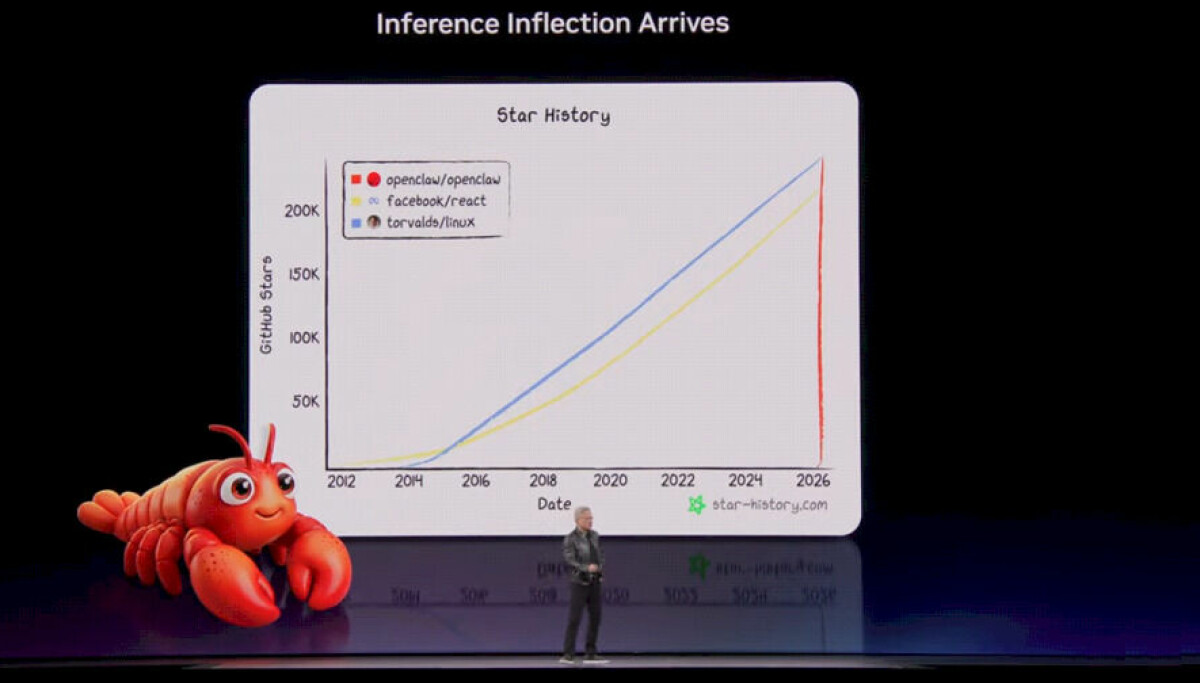
250,000 GitHub stars. In under four months.
That’s OpenClaw—rocketing past React, the web dev darling, to claim the throne as the most starred non-aggregator project ever. Picture the chart: a near-vertical line, like some exponential fever dream. No plateaus, no dips. Just pure, unadulterated adoption velocity.
Born in late 2025 as Clawdbot, then Moltbot, it shed skins until January’s OpenClaw rebrand unleashed the beast. Self-hosted AI agents, wired into WhatsApp, Telegram, Discord. They’ll summarize chats, book flights, crank out code—all with scant human babysitting. And yeah, access to your sensitive data.
Security folks hit the panic button hard. Gartner? “Insecure by default,” they spat, risks “unacceptable.” Cisco called it a nightmare. Threat actors swarmed the vulns like flies on roadkill.
But here’s the thing—AI insiders couldn’t care less about the red flags.
“A genius with a lot of amazing ideas about the future of very smart agents interacting with each other to do very useful things for people. We expect this will quickly become core to our product offerings.”
Sam Altman, OpenAI’s head honcho, poached creator Peter Steinberger. OpenClaw’s heading to a foundation, staying open-source. Altman’s bet? Agent swarms as the next big unlock.
Why Did OpenClaw Explode Faster Than Linux?
Jensen Huang didn’t hold back at GTC 2026. “Probably the single most important release of software… ever.” Linux took three decades for this traction; OpenClaw? Weeks. Nvidia’s running it everywhere—code gen, tool dev. Huang equates it to Linux, Kubernetes, HTML. The agent inflection point, he says. From chatty GPT bots to doers.
Claude Code and OpenClaw sparked it, pushing AI into action. Huang gets the fears—agents slurping employee data, firing off code, phoning home externally. “Obviously, this can’t possibly be allowed.”
Yet he’s all-in. Every company needs an OpenClaw strategy, stat.
Think architecture. OpenClaw isn’t just another LLM wrapper. It’s the protocol stack for agentic AI—modular, extensible, begging for integrations. Why the surge? Developers crave autonomy. Tired of prompting chatbots for eternity? Let claws loose. They chain tasks, reason across apps, act. It’s TCP/IP for intelligence: open, composable, viral.
My take? This mirrors the browser wars of ‘95. Netscape opened the web floodgates; everyone built on HTML+JS. OpenClaw does that for agents. But without Netscape’s security scars? Nah. Early web was spam-fest central.
Is Nvidia’s NemoClaw the Security Savior?
Nvidia’s not blind. Enter NemoClaw: their fortified stack. Bolt on Nemotron models, wrap in OpenShell—a sandboxed runtime with guardrails. Network fences, privacy routers, policy engines from SaaS giants.
Download, tweak, hook to CrowdStrike or Cisco tools. Runs local on RTX gear—GeForce PCs, DGX beasts—or cloud-frontier models. OpenShell enforces: no rogue data leaks, no wild code execs.
Huang pitches it as reference architecture. Connect your policies; let claws execute safely. Partners? CrowdStrike, Cisco, Google, Microsoft Security. Compatibility locked in.
Does it fix the mess? Sandboxing helps—isolates the chaos. Privacy routers segment data flows. But here’s my unique poke: it’s reactive armor, not a rethink. True agent safety demands formal verification, like crypto proofs for code paths. Nvidia’s playing catch-up; the Wild West gold rush already minted million-vuln projects. Prediction: 2027 sees the first OpenClaw mega-breach, forcing a Kubernetes-level overhaul.
Strip it down. Agents thrive on trust minima. OpenClaw’s default? Permissive. NemoClaw adds bolts, but humans config ‘em wrong 90% of time (looking at you, Kubernetes YAML hell). Architectural shift needed: zero-trust baked into the agent kernel, not bolted-on.
And the hype? Huang’s PR spin shines bright—“next frontier to everyone.” Skeptical eye: Nvidia’s hardware empire needs agent workloads to juice GPU sales. OpenClaw agents? Thirsty for parallel compute. Cozy alignment.
How Will OpenClaw Reshape Enterprise AI?
Forget chatbots. Agentic stacks mean orchestration. Fleets of claws: one scouts data, another codes, a third deploys. Nvidia’s vision—NemoClaw as the orchestrator—scales this.
Internally? Nvidia’s already there. Code from agents, tools built autonomously. Externally? Enterprises wire it to ERP, CRM. Book flights? Sure. But supply chain tweaks? Finance audits? That’s the prize—and the peril.
Growth math terrifies. 2 million weekly GitHub views at peak. Straight-up hockey stick. React took years; OpenClaw? Thunderbolt.
Bold call: By 2028, 70% of Fortune 500 run OpenClaw derivatives. Not because it’s perfect, but because it’s first-mover open. Competitors—Anthropic’s Claude agents, xAI swarms—will fork and feud.
Security’s the wedge. If NemoClaw proves battle-tested, adoption explodes. Botch it? Backlash kills the vibe.
Huang nailed the why: action over words. GPT chattybots were demo toys. OpenClaw agents? Production beasts. The how? Open protocols + hardware accel = flywheel.
🧬 Related Insights
- Read more: Edge AI’s Speed Trap: Forget TOPS, Chase Latency
- Read more: What If Chip Fabs Never Needed Humans Again? Intel 18A and the Digital Twin Revolution
Frequently Asked Questions
What is OpenClaw and why is it blowing up?
OpenClaw’s an open-source AI agent framework for autonomous tasks like coding, scheduling, and app integrations. It’s exploding—250k GitHub stars in months—because it turns chat AI into actors.
Does Nvidia’s NemoClaw fix OpenClaw security issues?
NemoClaw adds sandboxes, privacy routers, and policy hooks via OpenShell. It’s safer for enterprise, but relies on proper config; not foolproof yet.
Will OpenClaw replace human developers?
Not fully—agents excel at rote tasks but falter on novel architecture. Expect augmentation: devs orchestrate claw fleets, not get canned.