Look, for months, the chatter was all about bigger models, more parameters, and that relentless march toward AGI. We were all expecting NVIDIA to keep cranking out raw power, bigger GPUs, and fancier ways to train colossal language models. And sure, they’re doing that. But today, with the unveiling of Nemotron 3 Nano Omni, NVIDIA isn’t just shouting about raw compute anymore. They’re talking about intelligent action. This isn’t just another AI model; it’s a fundamental platform shift, a building block for the AI agents that will soon be running our digital lives.
What’s the big deal? Imagine your AI assistant. Right now, it’s good at answering questions, maybe summarizing an email. But ask it to do something complex – navigate a spreadsheet, process a video feed in real-time, and understand the nuanced frustration in a customer’s voice all at once? That’s where current AI agents sputter and stall. They’re like a brilliant professor trying to operate heavy machinery – all brains, no brawn, and certainly no finesse.
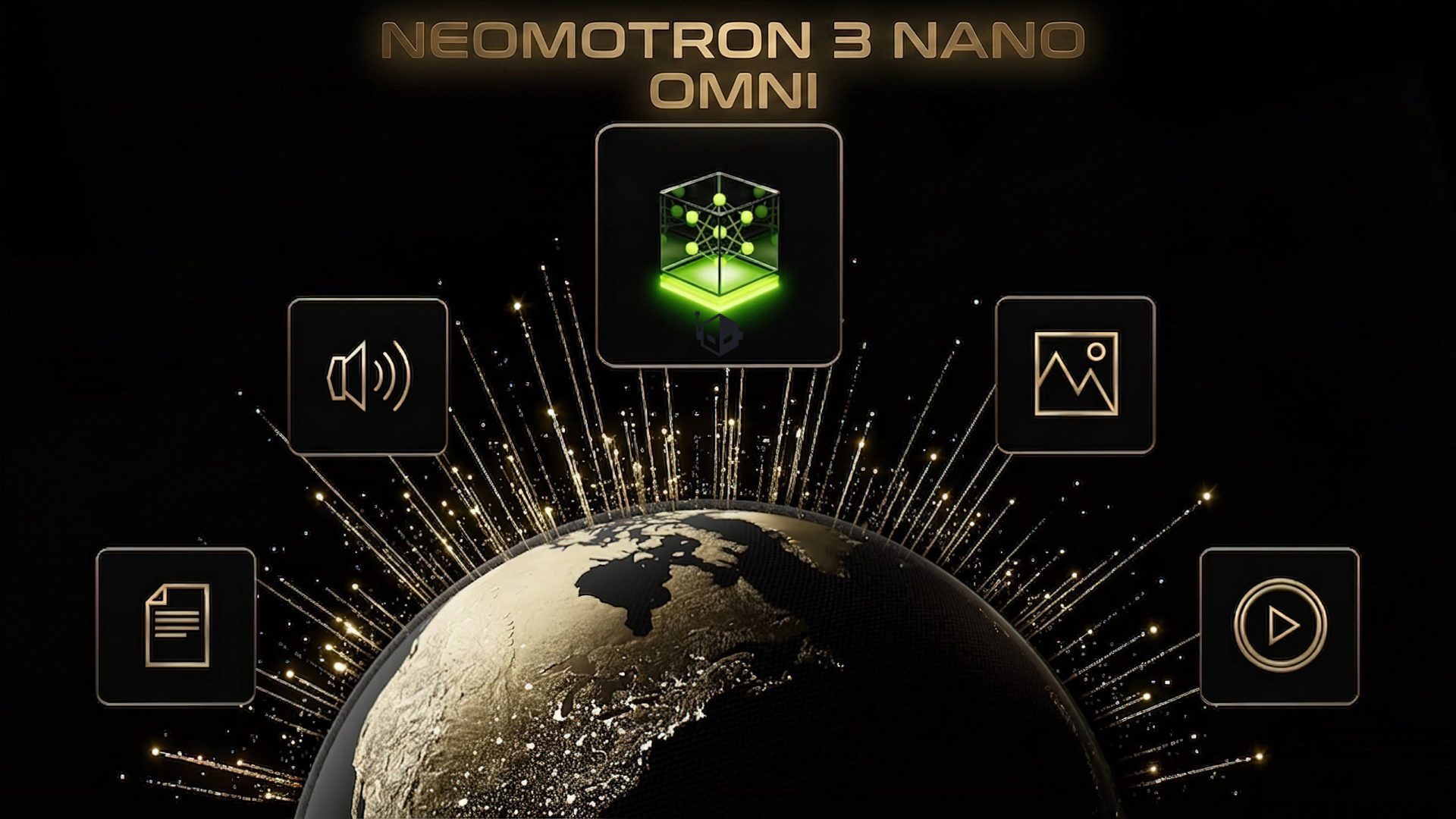
Nemotron 3 Nano Omni is different. It’s an open multimodal model, which is a fancy way of saying it can chew on video, audio, images, and text, all at the same time, and spit out something coherent and useful. And it does it 9x faster than its open-source peers. Nine times. That’s not just a bit faster; it’s like comparing a horse-drawn carriage to a rocket ship. This speed isn’t just for show; it means AI agents can finally react, reason, and perform tasks with a fluidity we’ve only dreamed of.
The “Omni” Advantage: Why Multimodality Matters
Think of it like this: previously, building a truly aware AI agent was like trying to assemble a crack team where each specialist only spoke one language. You had a text expert, a video interpreter, an audio analyst, and an image guru. They’d pass information back and forth, but there was always friction, always delay. Nemotron 3 Nano Omni collapses that. It’s the multilingual super-agent who can see, hear, read, and understand a situation holistically. This unified approach, baked into its 30B-A3B hybrid mixture-of-experts architecture, eliminates the need for separate perception models. That’s efficiency that translates directly into cost savings and, more importantly, scalability for businesses.
“This best-in-class model gives enterprises and developers a production path for more efficient and accurate multimodal AI agents with full deployment flexibility and control.”
This quote from NVIDIA’s release is critical. They’re not just offering a research paper toy; they’re giving businesses a viable, production-ready pathway. And the early adopters? They’re a who’s who of industry. Foxconn, Palantir, Oracle, Dell, DocuSign – these aren’t fly-by-night startups. These are giants who understand the practical implications of AI that can actually act in the real world. Palantir, in particular, has been a major player in pushing AI into complex operational environments. Their interest here isn’t just an endorsement; it’s a signal flare.
Beyond the Hype: Real-World Agentic Workflows
So, what does this look like in practice? NVIDIA breaks down a few key areas:
-
Computer Use Agents: This is mind-blowing. Imagine an AI that can watch you use a computer and learn from it, or even take over tasks. Nemotron 3 Nano Omni powers agents that can navigate graphical interfaces, understand what’s on screen in real-time, and track user interface states over time. H Company’s latest agent, running at a stunning 1920x1080 native resolution, demonstrates incredibly high-fidelity visual reasoning. This means AI that can interact with software just like a human, but faster and with perfect recall.
-
Document Intelligence: Enterprises are drowning in documents. AI that can digest dense reports, extract key figures from charts, and understand the relationship between text and visuals within a screenshot is no longer a luxury; it’s a necessity. Nemotron 3 Nano Omni’s ability to reason across this mixed media is a game-changer for compliance, analysis, and decision-making.
-
Audio and Video Understanding: Customer service bots that can genuinely understand tone and context, research tools that can analyze hours of video footage for specific events, monitoring systems that tie spoken words, visual cues, and on-screen text into a single, actionable stream – this is the future of operational AI.
My Take: A Bet on Intelligence, Not Just Scale
Here’s the insight that has me genuinely buzzing: NVIDIA’s strategy with Nemotron 3 Nano Omni feels like a deliberate pivot. For years, the narrative has been about scaling up the hardware – more CUDA cores, more memory. That’s still happening, of course. But this model signals a profound belief that the next frontier isn’t just more brute force, but more intelligent application of that force. They’re not just selling you a faster engine; they’re selling you the blueprints for a smarter vehicle.
This isn’t just about making existing AI tasks faster. It’s about unlocking entirely new categories of AI applications that were previously impossible due to computational or perceptual limitations. Think of how the iPhone wasn’t just a better flip phone; it was a platform for a mobile revolution. Nemotron 3 Nano Omni feels like that kind of foundational shift for AI agents. The corporate partnerships are validation, yes, but the real excitement is in the potential for creativity this unleashes for developers. It’s a call to arms for anyone building the next generation of intelligent systems.
🧬 Related Insights
- Read more: Intel Core Ultra 270K: Killer Specs, Murderous Market
- Read more: Telcos Flip Networks into AI Grids with NVIDIA’s Blackwell Muscle
Frequently Asked Questions
What does NVIDIA Nemotron 3 Nano Omni actually do? NVIDIA Nemotron 3 Nano Omni is an open multimodal AI model designed for AI agents. It can process and reason across video, audio, image, and text simultaneously, enabling agents to respond faster and perform complex tasks with greater accuracy.
Will this model replace human jobs? AI models like Nemotron 3 Nano Omni are likely to automate certain tasks and workflows, potentially changing the nature of many jobs. However, they are also expected to create new opportunities and roles focused on AI development, management, and oversight, and augment human capabilities rather than fully replacing them across the board.
Is Nemotron 3 Nano Omni better than proprietary models like OpenAI’s GPT-4? Nemotron 3 Nano Omni is an open multimodal model, meaning its architecture and weights are available for modification and deployment by enterprises. Its strength lies in its efficiency and multimodal reasoning for agentic tasks, offering a production path with greater control and flexibility. Direct comparisons to proprietary models depend heavily on the specific task and benchmark, but its 9x throughput boost for agentic AI is a significant advantage in its category.