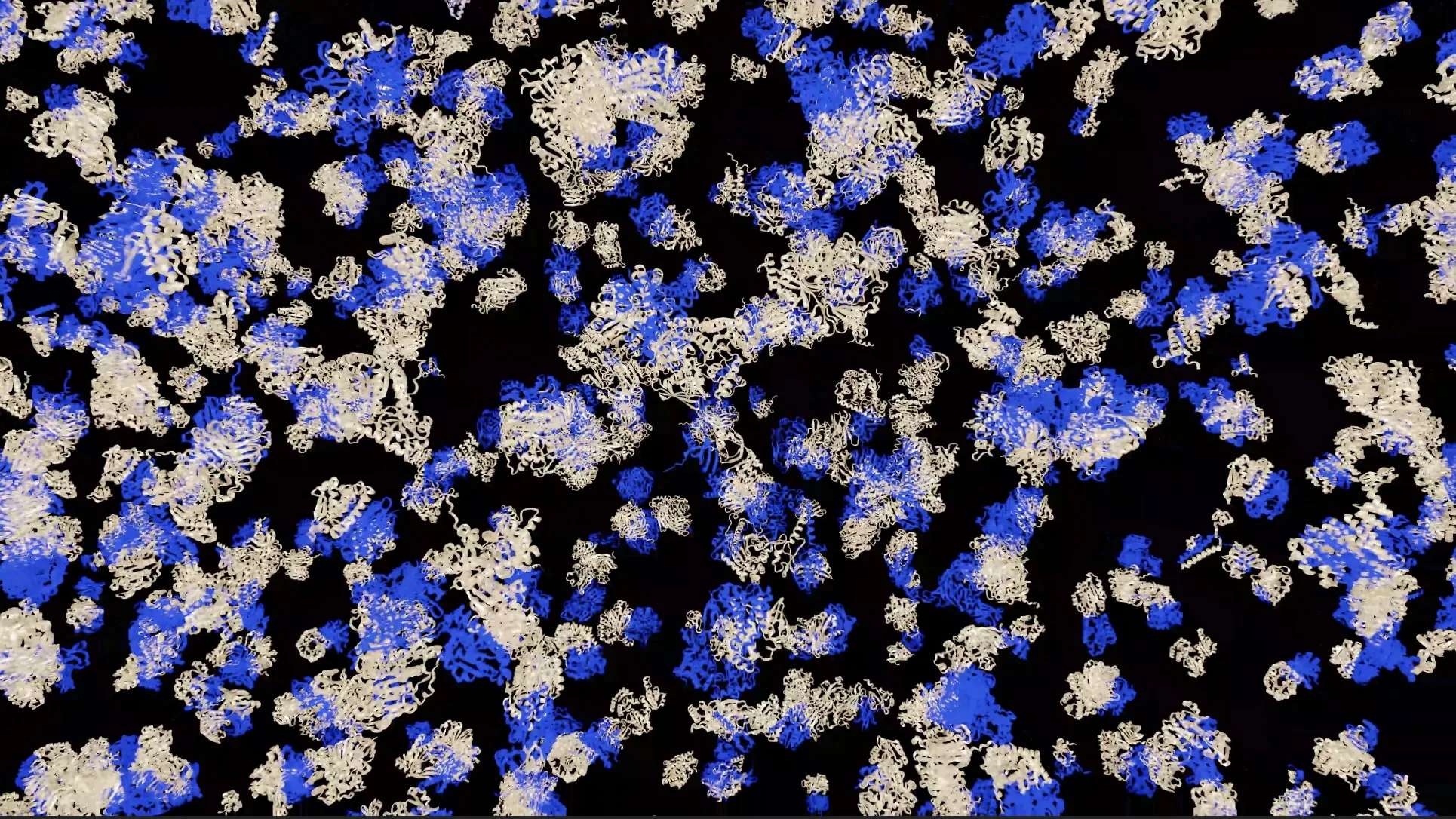
Over 200 million protein structures now sit in the AlphaFold Database, courtesy of DeepMind. Yet complexes — those messy teams of proteins doing the real work in your cells — remain mostly a black box for 99% of cases.
That’s the gap NVIDIA’s team smashed wide open, churning out predictions for proteome-scale homomeric and heteromeric complexes on a DGX H100 SuperPOD. Impressed? Hold on. I’ve chased Silicon Valley promises for two decades; this smells like NVIDIA flexing its GPU muscle while bio folks foot the compute bill.
Why Protein Complexes Are the New Folding Frontier
Proteins don’t play solo. They huddle in complexes, quaternary structures that AlphaFold2 mostly ignored. The original AFDB? Great for single proteins. But interactions? Combinatorial nightmare — millions of possible pairings across proteomes.
NVIDIA didn’t just whine about it. They built a pipeline: MMseqs2-GPU for lightning MSAs, TensorRT and cuEquivariance for folding, all scaled across clusters via SLURM. Result? Homomers from top proteomes (humans first, naturally), and heteromers filtered by STRING interactions — dimers only, intra-proteome, to dodge the explosion.
“We extended the AFDB with large-scale predictions of homomeric protein complexes generated by a high-throughput pipeline based on AlphaFold-Multimer—made possible by NVIDIA accelerated computing.”
That’s straight from their blog. Sounds slick. But here’s my unique spin: this echoes the GPU-fueled genomics crash in the 2010s. Remember when sequencing a genome cost $100 million, then GPUs slashed it to $1,000? Same playbook. NVIDIA’s not curing disease; they’re commoditizing structural bio, priming the pump for AI drug designers — and their datacenter sales.
But. Does it work? They benchmarked heteromers against modalities. Confidence scores? Calibrated. Yet biological interpretability? Still iffy without wet-lab validation.
Can Your Lab Afford Proteome-Scale Prediction?
Short answer: probably not. This demands a SuperPOD — hundreds of H100s, high-speed storage, SLURM wizards. They split MSA gen (colabfold_search on GPUs) from inference, key for throughput. Why? MSAs scale with sequence depth; folding loves tensor equivariance.
Look, if you’re a solo bioinformatician, stick to ColabFold. But scaling? Python scripts, shell hacks, SLURM jobs per proteome rank. Prioritize humans, pathogens (WHO list). For heteromers, STRING physical evidence — score >700 if you want quality over quantity.
It’s cynical, sure. NVIDIA touts “principles to increase throughput,” but who’s making bank? Them, selling A100/H100 clusters to pharma giants. Biotech startups? They’ll rent from CoreWeave or Lambda, pray for grants. Me? I’ve seen cycles: hype, adoption, then commoditization kills margins.
Prediction: by 2026, expect open-source forks running on consumer RTX 5090s. History repeats — AlphaFold went from Google exclusive to GitHub gold.
A single sentence: Cost per complex plummeted.
Then sprawl: They optimized kernel-level with MMseqs2-GPU (faster alignments), TensorRT (inference speed-up), cuEquivariance (geometry-aware nets without the usual triangular smoothing slog). Mapped to HPC: max GPU util, scale-out clusters. You could mimic it — if your grant covers the power bill (hint: it won’t).
Who’s Really Winning from This GPU Protein Rush?
NVIDIA, duh. Every SuperPOD sale funds more AI papers. DeepMind/EMBL-EBI get free data boosts. Biologists? Faster hypotheses, maybe. Drug hunters at Pfizer? Goldmine for target validation.
Skeptical aside — datasets consistent? Benchmarks solid? Sure, they claim. But STRING evidence? Literature says high scores predict better, yet false positives lurk. No inter-proteome yet; that’s next compute apocalypse.
And the PR spin: “Help you set up a similar pipeline.” Noble. Or lead-gen for enterprise sales? I’ve covered enough NVDA keynotes.
Workflow nitty-gritty. Define scope: all-against-all for small proteomes, ranked for big. Separate pipelines: MSA first (store intermediates), then fold. SLURM arrays for parallelism.
“Inference scaling across millions of complexes.”
Millions. That’s the stat that stops you. From bottleneck to database fodder.
Is AlphaFold-Multimer Ready for Prime Time?
Accuracy holds for homomers. Heteromers? Tricky, but GPU accel closes the gap. Challenges linger: combinatorial space, MSA costs (they’re brutal), confidence calibration.
My take: solid step, not moonshot. Hype it as “proteome-scale revolution,” and I’ll yawn. Real win? Democratizing via cloud — but watch those invoices.
🧬 Related Insights
- Read more: Intel Wakes a Raccoon-Haunted Fab to Chase Packaging Gold
- Read more: Aitech’s U-C860X: Battlefield AI Without the Buzzword Bloat
Frequently Asked Questions
What is proteome-scale protein structure prediction?
It’s predicting 3D structures for all protein complexes across entire organism proteomes, not just singles — using AI like AlphaFold-Multimer on massive GPU clusters.
How do NVIDIA GPUs accelerate AlphaFold?
Via MMseqs2-GPU for MSAs, TensorRT for inference, cuEquivariance for equivariant nets, scaled on H100 SuperPODs with SLURM.
Can I run proteome-scale predictions myself?
Only with serious HPC access; start small with ColabFold, scale via their pipeline if you’ve got the budget and SLURM know-how.