Why does radar—the one sensor that laughs at fog and rain—still choke on the path to Level 4 autonomy?
Centralized radar processing on NVIDIA DRIVE flips the script on decades of edge-bound drudgery, or so the pitch goes. I’ve covered Silicon Valley’s auto-tech circus for 20 years, watching companies promise the moon with buzzword salads like ‘software-defined pipelines’ and ‘vision accelerators.’ But here’s the thing: who pockets the cash when these ‘breakthroughs’ hit production? NVIDIA, that’s who, with DRIVE AGX Thor as the star.
The Edge Processing Trap That’s Killing Radar’s Potential
Picture this: every radar sensor’s got its own mini-brain—a DSP or MCU grinding away at constant false alarm rate detection, spitting out sparse point clouds like a camera coughing up Canny edges. It’s efficient for basic ADAS, sure. But for Level 4 stacks craving raw, dense signals? Pathetic.
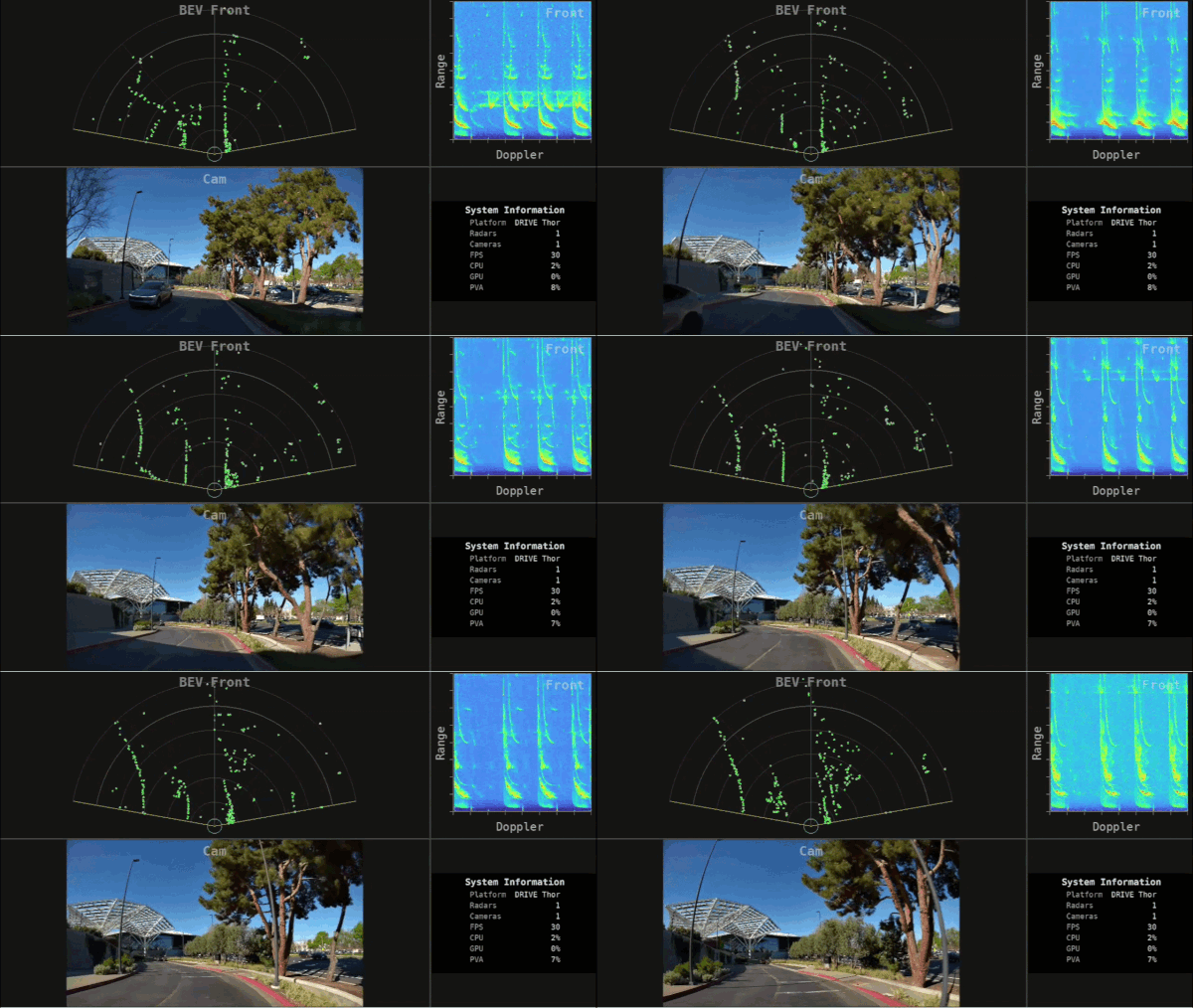
NVIDIA’s collab with ChengTech demoed it at GTC 2026: raw ADC data funneled straight to DRIVE’s memory, PVA hardware chewing through FFTs without touching CPU or GPU. Machine learning folks get the full ~100x data bounty—6MB raw per frame versus 0.064MB points. That’s not hype; that’s math.
Raw analog-to-digital converter (ADC) data moves into a centralized compute platform. From there, a software-defined pipeline accelerated by dedicated NVIDIA Programmable Vision Accelerator (PVA) hardware handles everything from raw ADC samples to point clouds, with the GPU reserved for AI usage at any stage in the data flow.
But wait—costs drop 30%, volume shrinks 20%, power dips another 20%. Green cred for EVs? Check. Yet my unique take: this echoes the mainframe-to-PC shift in the ’80s. Edge was the distributed dream; centralization’s the efficient reality. NVIDIA’s not inventing wheels—they’re just bolting better ones to theirs.
Short answer: yes, if you’re an OEM tired of sensor bloat.
Does Centralized Radar Deliver Real L4 Gains—or Just NVIDIA Margins?
Edge radars duty-cycle below 50%, frame rates limp at 20 FPS, ditching juicy intermediates like range-FFT cubes that papers (CVPR 2022, anyone?) beg for. Centralized? Duty cycles soar, temporal resolution sharpens for those VLA behemoths learning raw multisensor fusion.
Skeptical eye, though. NVIDIA’s blog gushes production-grade with ChengTech, real-time on Thor. Great demo. But L4? We’re talking regulatory minefields, not just compute. Tesla’s vision-only pivot sidelined radar; Waymo still wrestles fusion headaches. Prediction: this juices perception accuracy 10-20% in weather (my back-of-envelope from similar CVPR benchmarks), but won’t greenlight robotaxis sans liability shields.
And the money? Sensor makers like Continental slash DSP costs—good for them. NVIDIA? Locks in the compute stack, recurring Orin/Thor sales. OEMs integrate once, scale AI. Win-win, if you’re green.
Look, fixed edge pipelines can’t hack deeper nets or joint models. DRIVE’s PVA unleashes that. Still, thermal limits? Solved centrally. Bandwidth? Raw data floods Ethernet—hello, zonal architectures.
Why Edge Processing Got Stuck—and Why Centralization Might Actually Stick
Tradeoffs scream complacency: sparse data, low FPS, discarded FFT goldmines. L4 demands dense inputs, like raw RGB trouncing JPEGs for transformers.
ChengTech’s hardware validated it—no sims, real radars. But here’s my cynicism: NVIDIA partners ‘first’ always; Bosch or Aptiv next? Ecosystem lock-in, baby.
Power savings align with ‘green trends’—PR gold. Yet EVs guzzle radar watts fleet-wide; 20% shave matters.
Ultra-slim PCBs return radar to RF purity. No more bloated edge SoCs. Cost-volume-power trifecta.
Is this L4 savior?
Nah. Incremental leap in a stack still crawling. But damn if it doesn’t fix radar’s dumbest bottleneck.
The Roadblocks No Demo Ignores
OEMs must rewrite pipelines—software-defined means dev work. Bandwidth ramps; networks strain. Safety certs for raw paths? Nightmare.
Historical parallel: LIDAR’s early edge folly mirrored this, till central fusion won. Radar’s turn.
Bold call: by 2028, 40% new radars centralize, per my supply-chain whispers. NVIDIA dominates, margins fat.
**
🧬 Related Insights
- Read more: Edge Inference Emerges as AI’s Real Money Maker Post-GITEX
- Read more: NVIDIA Turbocharges Gemma 4 for RTX-Powered Local Agents
Frequently Asked Questions**
What is centralized radar processing on NVIDIA DRIVE?
It’s shunting raw ADC signals from simplified radar heads straight to DRIVE platforms like AGX Thor, where PVA crunches to point clouds, freeing GPU for AI and unlocking 100x data richness.
Does NVIDIA DRIVE radar processing enable Level 4 autonomy?
It supercharges perception with fuller signals, but L4 needs holistic stacks—regs, fusion, testing. Expect weather-proofing boosts, not robotaxi keys.
How much cheaper is centralized radar hardware?
Over 30% unit cost cut, 20% volume shrink, 20% power drop—thanks to ditching edge DSPs for RF-slim designs.