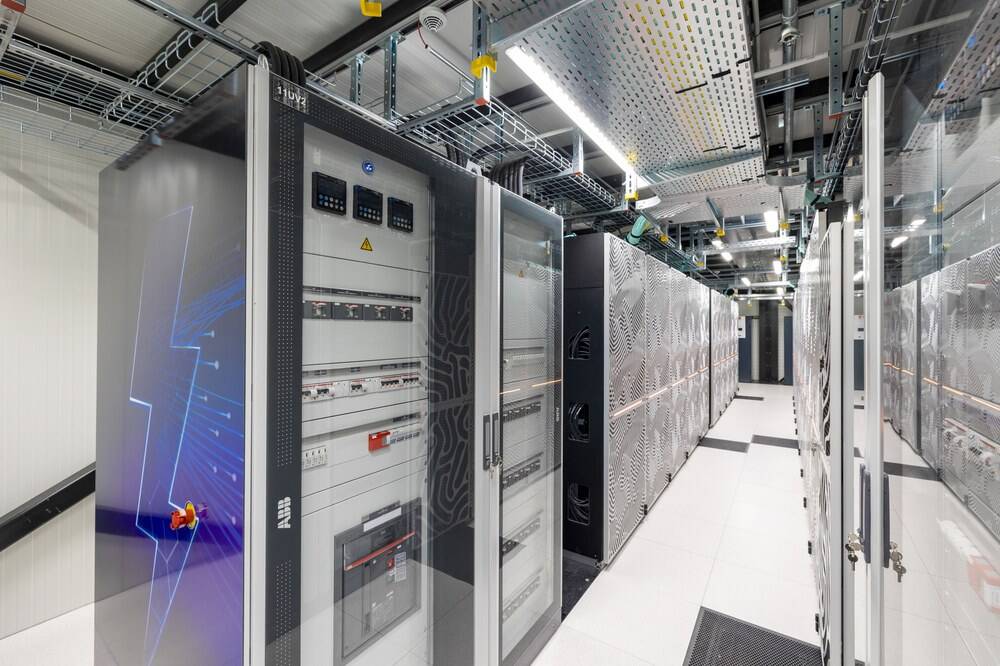
1,000 petaFLOPS. That’s Europe’s Jupiter Booster, clocking in at exactly one exaFLOPS on the latest Top500 list—making it the first non-US public system to crash the exascale party.
SC25 delivered the news. EuroHPC’s beast, built by Eviden with Nvidia’s Grace-Hopper GH200 superchips, leaped from a June partial run of 793 petaFLOPS to full exascale glory. China lurks in the shadows with undisclosed machines, but Jupiter’s the first transparent entrant outside America.
And it’s not done. The Booster—packing 6,000 BullSequana XH3000 nodes and 24,000 GH200s—sits 12 petaFLOPS shy of Argonne’s Aurora. A gap that’s basically a rounding error in supercomputing terms.
Jupiter’s Booster: Raw Specs
| Rank | System | Cores | Rmax (PFlop/s) | Rpeak (PFlop/s) | Power (kW) |
|---|---|---|---|---|---|
| 1 | El Capitan | 11,340,000 | 1,809 | 2,821.10 | 29,685 |
| 2 | Frontier | 9,066,176 | 1,353 | 2,055.72 | 24,607 |
| 3 | Aurora | 9,264,128 | 1,012 | 1,980.01 | 38,698 |
| 4 | Jupiter Booster | 4,801,344 | 1,000 | 1,226.28 | 15,794 |
| 5 | Eagle | 2,073,600 | 561.20 | 846.84 | ? |
| 6 | HPC6 | 3,143,520 | 477.90 | 606.97 | 8,461 |
| 7 | Fugaku | 7,630,848 | 442.01 | 537.21 | 29,899 |
| 8 | Alps | 2,121,600 | 434.90 | 574.84 | 7,124 |
| 9 | LUMI | 2,752,704 | 379.70 | 531.51 | 7,107 |
| 10 | Leonardo | 1,824,768 | 241.20 | 306.31 | 7,494 |
“Jupiter became the first public system outside the US to exceed one exaFLOPS of double precision performance.”
That’s the money quote. Straight from the announcement. No hype, just numbers.
Why Jupiter Still Has Gas in the Tank
Construction continues. The Booster’s only half the story—or less. Enter the Universal Cluster, Jupiter’s CPU sidecar, still cooking with SiPearl’s Rhea1 processors. Taped out in July, these Arm Neoverse V1 chips (80 cores, 64 GB HBM each) will slot into 1,300 nodes with 2,600 processors total. Expect another five petaFLOPS by late 2026.
GPUs dominate the heavy lifting—Jupiter’s Booster theoretical peak hits 1.6 exaFLOPS on matrix ops. But CPUs? They’re the Swiss Army knife. Not every workload GPU-fies easily. Software lags. Hence “Universal.”
Jülich Supercomputing Centre’s team knows the drill. Squeeze those extra petaFLOPS via tuning. Lawrence Livermore did it with El Capitan, jumping 67 petaFLOPS to 1.809 exaFLOPS on 44,544 AMD MI300A APUs. Oak Ridge pulled 250 petaFLOPS more from Frontier since 2022, landing at 1.35 exaFLOPS.
Small tweaks, big leaps. Systems this massive reward obsession.
Is Europe’s Exascale Push Just Catching Up—or a Real Threat?
Europe joins the US as exascale superpower. Bold claim. But let’s dissect. America’s trio—El Capitan, Frontier, Aurora—still laps the field. Jupiter’s power draw? A modest 15,794 kW versus Aurora’s 38,698. Efficiency edge, sure. Yet the leaderboard screams dominance: US holds top three.
Here’s the acerbic truth: This feels like Europe’s polite nod to the arms race. Nvidia powers it—Grace-Hopper everywhere. Eviden assembles. SiPearl chips in domestically. Noble. But without US silicon? Crickets.
Historical parallel? Think Cold War computing. Soviets built behemoths, chased benchmarks, but innovation flowed West. Europe risks the same—impressive iron, chasing American software ecosystems and AI workloads.
Bold prediction: By Top500 spring 2026, full Jupiter vaults to number two, nipping Frontier’s heels at 1.4 exaFLOPS combined. Aurora falls if Argonne slacks. But El Capitan? Untouchable till 2028.
HPL reigns supreme. High-Performance Linpack measures raw grunt. But AI shifts the game—lower precision, conjugate gradients. Top500 added HPCG in 2017 for memory-bound realism. HPL’s vector math feels dated amid tensor cores.
Jupiter’s GH200s excel here, blending CPU+GPU per superchip. Yet the list clings to double-precision dogma. Scientific holdouts versus AI pragmatists.
Corporate spin? EuroHPC touts sovereignty. Fair. But Nvidia’s footprint undercuts it. Europe’s chipping away—literally, with Rhea1—but exascale bragging rights mask deeper dependencies.
Power hogs all. El Capitan gulps 29 MW. Jupiter sips relatively. Green claims incoming, but grids strain.
The top hasn’t budged much since spring. Eagle, HPC6, Fugaku trail. LUMI, Leonardo represent Europe pre-Jupiter. Momentum builds.
Skeptics yawn. Benchmarks ≠ breakthroughs. Exascale promised climate models, drug discovery. Deliveries lag. AI ate the budget.
Still, Jupiter signals intent. Europe invests €1.2 billion in EuroHPC. Results? Measurable now.
Will Full Jupiter Topple Aurora?
Dead simple. Yes, if optimizations click. Booster alone hit 1 exaFLOPS. Universal adds five. Tune the stack—watch Aurora’s 1.012 shrink in the mirror. Assuming no surprises from Microsoft’s Eagle or Japan’s Fugaku tweaks.
Developers eye this. HPL’s grind tests code at scale. Jupiter’s mix—Nvidia GPUs, Arm CPUs—mirrors hybrid futures.
Exascale matters for Europe. Geopolitical flex against US-China duopoly. But without apps, it’s expensive wallpaper.
🧬 Related Insights
- Read more: SK hynix’s Ethics Double: From Korean Trailblazer to Global Standard-Setter
- Read more: Qualcomm’s Laptop Chip Strategy Falters [Market Analysis]
Frequently Asked Questions
What is Jupiter supercomputer?
EuroHPC’s Jupiter at Jülich, Germany—Nvidia GH200 Booster (1 exaFLOPS now) plus incoming SiPearl Rhea1 Universal Cluster. Europe’s top machine.
How does Jupiter compare to Frontier?
Jupiter Booster: 1,000 petaFLOPS, #4. Full system eyes 1.4+ exaFLOPS, challenging Frontier’s 1.353 (#2). US still leads.
When does Jupiter full system launch?
Universal Cluster online late 2026, boosting total compute by ~5 petaFLOPS.