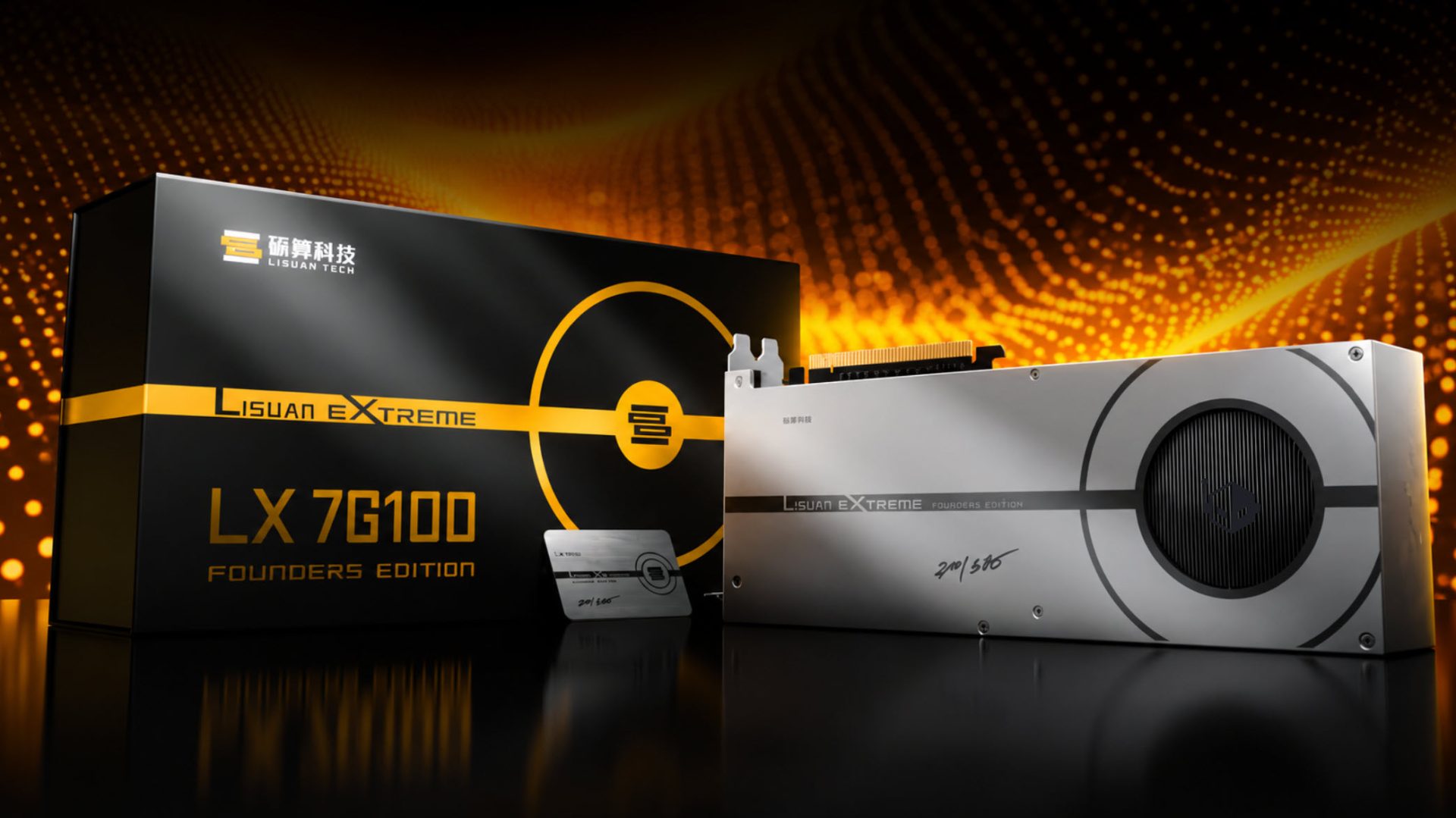
Did you ever stop and wonder if the next big computing platform shift was brewing in plain sight, disguised as a mere graphics card launch? Because that’s precisely the vibe I got when Lisuan Tech announced its 7G100 Extreme Founders Edition. Here was China, a nation pushing hard in the chip game, finally throwing its hat into the dedicated consumer gaming GPU ring. The whispers were of competitive power, of a genuine alternative finally appearing. And for a moment, the air crackled with possibility.
But then, reality hit. And boy, did it hit hard.
The Promise and the Peril
The narrative around Lisuan’s 7G100 was, frankly, compelling. A homegrown GPU, built on a 6nm process, boasting 12GB of GDDR6 memory, and promising compatibility with all the latest APIs and engines? This wasn’t just a piece of hardware; it felt like a statement. Especially when the initial demos, often conducted in synthetic benchmarks like Geekbench and 3DMark, hinted at performance rivaling an RTX 4060. We’re talking about democratizing high-end graphics, right? Bringing more choice, more innovation, more stuff to gamers who might have felt locked into the NVIDIA-AMD duopoly.
This is the kind of moment that should feel like watching a rocket launch. The anticipation, the build-up, the hope for breaking orbit. The potential for this to be an inflection point in the global semiconductor landscape—a signal that the old guard’s reign wasn’t absolute. It felt like watching the dawn of a new silicon era, where innovation could bloom from unexpected gardens.
When Benchmarks Lie (or at least, mislead)
Here’s the kicker: the synthetic benchmarks painted a rosy picture. But as 潮玩客 over at Bilibili quickly discovered, the real world is a far harsher mistress. When Lisuan’s LX 7G100 Extreme was unleashed into actual games, the dream dissolved faster than a sugar cube in hot coffee. We’re not talking about a slight dip in performance here; we’re talking about a chasm. In Cyberpunk 2077 at 1080p, this supposed gaming powerhouse chugged along at a measly 88 FPS. Meanwhile, a five-year-old RX 6600 XT, a card that’s practically ancient by GPU standards, was casually blasting past 200 FPS. No amount of fiddling with anti-aliasing or enabling FSR could bridge that gap. The 7G100 didn’t just fail to keep up; it lagged behind cards several generations older. It was like showing up to a Formula 1 race with a go-kart.
And the issues didn’t stop at raw frame rates. Ray tracing? Forget it. The hardware simply doesn’t support it. Then there’s the stuttering, the jarring frame-pacing issues that make even a functional frame rate feel like a slideshow. Driver updates might fix some of this, but as a launch product, it’s a dismal showing.
The Price of Disappointment
But the most gut-wrenching part? The price. This underperforming silicon is hitting the market with a Founders Edition price tag of 3299 RMB, which hovers around $500 USD. That’s not just competitive; that’s aiming squarely at the turf of the upcoming RTX 5060 Ti—a card that hasn’t even been released yet, but which the market expects to deliver significantly more. Even currently available cards in that price bracket, like some RTX 3060 variants, offer a much better all-around package, including ray tracing and stronger AI compute capabilities. Intel’s Arc B580, while also not a speed demon, offers a better value proposition with its 12GB of VRAM at a lower cost.
This isn’t just a case of a new entrant stumbling; it’s a stark reminder that silicon design and manufacturing is a monumental challenge. Building a chip is one thing. Making it perform, efficiently and competitively, for the demanding world of gaming? That’s a whole other beast. And right now, Lisuan’s beast looks more like a kitten.
It’s a tough pill to swallow, not just for Chinese gamers, but for anyone hoping to see genuine diversification in the GPU market. The dream of a truly independent Chinese gaming GPU contender is still, unfortunately, just that—a dream.
In terms of specifications, the Lisuan Extreme is powered by the 6nm 7G106 GPU and is the company’s first true graphics card design for gamers. This graphics card features 12 GB of GDDR6 memory across a 192-bit bus interface and PCIe 4.0 x16 compliance.
Why Does This Matter for the Global Chip Race?
This isn’t just about Lisuan; it’s a macro-level indicator. China has poured immense resources into developing its domestic semiconductor industry, aiming for self-sufficiency and global competitiveness. The 7G100 was supposed to be a flagship moment in their GPU ambitions. Its performance deficit, especially at its price point, isn’t just a business setback for Lisuan; it’s a signal to the world that while the will and investment are present, the execution at the bleeding edge of consumer GPUs is still a mountainous climb. It suggests that the complex dance of architecture, driver optimization, and manufacturing yield needed to compete with the established giants is a secret sauce that’s incredibly hard to replicate overnight. This development doesn’t halt China’s chip ambitions, but it does underline the long, arduous road ahead and temper expectations for immediate disruption in the high-end gaming GPU market.
What About Driver Updates?**
While early reviews highlight significant performance and feature limitations, keep in mind that driver updates can sometimes unlock substantial performance gains and fix compatibility issues. Lisuan has stated that games did run, and the lack of crashes is a positive sign. However, the performance gap observed is so vast that it’s highly unlikely that driver updates alone can elevate the 7G100 to compete with even mid-range GPUs from the last few generations. Major architectural or hardware-level limitations, like the lack of ray tracing support, cannot be fixed by software. So, while future driver improvements might make the experience smoother, don’t expect miracles that will suddenly make this card a contender.
Will This Affect the Global GPU Market?**
In the short term, probably not significantly. The Lisuan 7G100 is primarily targeted at the Chinese market, and its current performance and pricing make it uncompetitive against established players like NVIDIA, AMD, and even Intel in that specific segment. The global GPU market is driven by performance benchmarks, feature sets, and brand loyalty that Lisuan hasn’t yet established. However, this launch is a data point in the ongoing geopolitical and technological race for semiconductor independence. If China can eventually use the lessons learned from products like the 7G100 to produce competitive hardware in the future, it could indeed shift market dynamics. For now, it remains a localized effort with limited immediate impact on international pricing or availability.