The hum of servers in a hyperscale data center. It’s the sound of progress, and increasingly, the sound of AI.
Andy Bechtolsheim, a man whose name is practically synonymous with the rise of Silicon Valley, has thrown his considerable weight behind another optical standard. This time, it’s called Extra-dense Pluggable Optics, or XPO for short. And it’s a desperate gambit, really, to keep the venerable pluggable optics game alive in the face of a co-packaged future that Nvidia, for one, is already betting big on. It’s not that Bechtolsheim dislikes co-packaged optics (CPO) – far from it. He just notes, with a healthy dose of skepticism, that they haven’t exactly been easy to churn out at scale. Yet.
Nvidia’s embrace of CPO for its upcoming Quantum X800 and Spectrum X800 switches, and a further commitment for its ‘Feynman’ GPUs in 2028, is a signal flare. It means the future Nvidia envisions for its rack-scale AI systems, intertwined with Arm server CPUs, will likely feature CPO ports. This isn’t a maybe; it’s a roadmap. And to grease the wheels, Nvidia has already poured billions into laser manufacturers like Lumentum and Coherent, not to mention multi-year supply deals. A recent $2 billion pact with Marvell for NVLink Fusion ports might also hint at some Celestial AI CPO tech trickling in.
But here’s the rub for the here and now: AI data centers are choking on density. The SFP, QSFP, and OSFP pluggable modules that have been the workhorses for two decades are, frankly, getting plump. Especially the OSFP modules, first conceived by Arista Networks (where Bechtolsheim is also a co-founder and chief development officer), a company that knows a thing or two about challenging incumbents like Cisco. These modules became the darlings of the industry, delivering 400 Gb/sec speeds. Now, they’re too wide for the kind of network radix modern AI demands, particularly if Ethernet is your scaling fabric of choice.
The XPO Gambit: More Bandwidth, More Heat
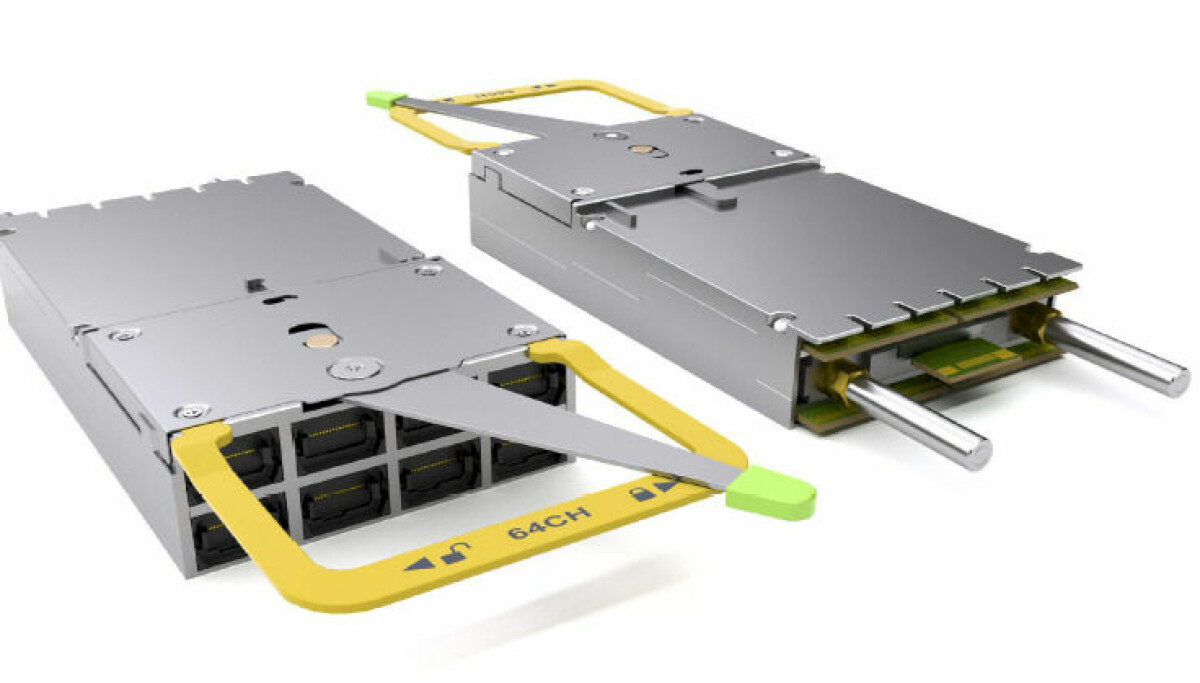
Enter XPO. It’s a multi-source agreement, a coalition of the willing — Arista, Microsoft, Marvell, Broadcom, Ciena, and a hundred others. Notably absent? Google. This might mean they’re planning to skip OSFP and jump straight to on-chip CPO, bypassing the XPO era entirely. The XPO module itself is a neat trick: it crams more bandwidth into the same physical footprint as an OSFP module. Think denser front panels, higher radix. The trade-off, as physics dictates, is heat. XPO modules demand liquid cooling via cold plates, a minor inconvenience in a world where liquid cooling is rapidly becoming the norm for rack-scale AI systems.
Bechtolsheim lays it out plainly. With 1.6 Tb/sec OSFP modules, you get 32 ports on a 1U switch, totaling 51.2 Tb/sec. Each module gulps 30-40 watts. Slap a cold plate on it, and you’re still limited. A 204.8 Tb/sec switch ASIC, which is apparently just around the corner, would require a colossal 4U chassis just to house the 128 OSFP modules needed to hit that throughput.
XPO promises a fourfold increase in lane density by packing 64 channels at 200 Gb/sec into the space of two OSFP modules. Bandwidth skyrockets eightfold. Heat dissipation, however, climbs tenfold, hitting a hefty 400 watts per module. Yikes.
“There is some lucky geometry going on here, says Bechtolsheim, in that the paddle cards – the little motherboards of circuits – fit into the same exact space as two OSFP modules. So the chips and paddle card designs did not have to be changed. You put two side by side and then stack a pair of those pairs belly to belly and you get eight times the lanes in twice the space.”
It’s almost elegant. The paddle cards, the tiny circuit boards holding all the magic, fit perfectly into the same real estate occupied by two OSFP modules. No need to reinvent the wheel for the chips or the board design. Stack them, flip them, and suddenly you’ve got eight times the lanes in double the space. When you see it, XPO just makes sense. Like many truly good engineering ideas, it seems obvious in hindsight.
The XPO module will support a variety of front panel fiber connectors, offering flexibility. The key takeaway, according to Bechtolsheim, is that XPO is designed to be agnostic – it supports any optics standard, any technology, any type of driver. It’s a broad church for optical interconnects, attempting to unify and push forward without dictating a single vendor’s approach.
Is XPO the Last Stand of Pluggable Optics?
This entire endeavor feels like the tech industry’s equivalent of a swan song. Pluggable optics have served us well. They’ve been modular, upgradable, and relatively easy to manage. But AI’s insatiable appetite for bandwidth is pushing them to their absolute limits, and beyond. XPO is a valiant attempt to squeeze more life out of a proven form factor. It’s a technical marvel, a proof to clever engineering. But can it outrun the inevitable march towards full co-packaging, where the optics are integrated directly onto the silicon? Nvidia seems to think so. The billions invested, the future roadmap – it all points to a future where the optical connection is baked in, not plugged in.
It’s a battle of incremental innovation versus a more radical redesign. XPO is the former, a brilliant refinement. CPO is the latter. Given the pace of AI development and the sheer scale of the investment from companies like Nvidia, it’s hard to see pluggable optics, even souped-up XPO versions, having a long-term future. This feels like a brilliant, perhaps final, hurrah for a technology that defined an era.
**
🧬 Related Insights
- Read more: Neuromorphic Computing Chips: Brain-Inspired Processors Explained
- Read more: Agentic AI Unlocks Chip Design’s Hidden Magic
Frequently Asked Questions**
What is XPO optics? XPO stands for Extra-dense Pluggable Optics, a new standard designed to increase bandwidth density in data center networking equipment compared to existing OSFP modules, often requiring liquid cooling.
Will XPO replace current pluggable optics? XPO aims to offer a significant density upgrade over OSFP and QSFP modules for AI and high-performance computing applications, but its widespread adoption will depend on manufacturing scale, cost, and the ongoing transition to co-packaged optics (CPO).
Is XPO compatible with existing equipment? While XPO modules are designed to fit into existing switch chassis footprints that previously held OSFP modules, the increased power and cooling requirements mean that system designs will need to be adapted to support them.