The sterile hum of a server farm. Another Tuesday. NVIDIA, bless its silicon heart, has decided the world needs more realistic 3D medical images. Apparently, the existing ones are just too scarce, too private, too expensive. Who knew?
Their latest gambit, dubbed MAISI (Medical AI for Synthetic Imaging), is the supposed savior. It’s a generative model designed to conjure up high-resolution 3D CT volumes, complete with pixel-level anatomical segmentation. The goal? Privacy-preserving data augmentation and, naturally, more research.
NVIDIA’s NV-Generate-CTMR, built on this MAISI architecture, is now an open-source framework. It promises to crank out synthetic CT and MRI volumes, along with those crucial segmentation maps, at scale. This is supposed to plug directly into training pipelines, accelerating the whole medical imaging AI endeavor. Sounds… efficient. For someone.
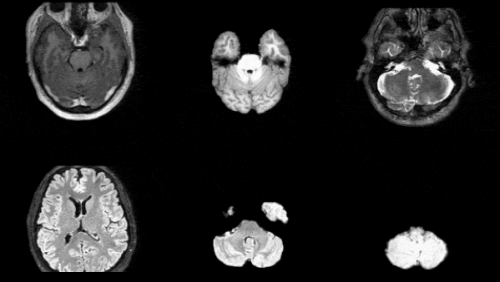
And now, NV-Generate-MR-Brain. This one’s all about the human brain. Trained on the new, gargantuan MR-RATE dataset—a monster compiled from 100,000 brain MRI studies—it’s meant to be another step in their scalable, open synthetic workflow. It’s practically a data buffet.
The MR-RATE dataset itself is quite the collection. 83,000+ patients, 700,000 volumes, and paired de-identified reports and DICOM metadata. The stated purpose? To build an open foundation for AI systems that grasp both imaging and clinical context. A noble goal. If they stick to it.
This data captures the messy reality of neuroimaging: different scanners, protocols, pathologies. It’s released under a CC-BY-NC license for research, with commercial options through Forithmus. The code, pre-trained weights, and configs are all there, right out of the box. Users can generate images, or fine-tune the models. Lowering barriers, they say. Of course.
The Endless Data Drought
Medical image synthesis. It’s become an indispensable tool. Teams use it to pad out skimpy training sets, translate between CT and MRI, simulate rare diseases, and share data without showing you Aunt Mildred’s scan. Realistic, anatomically correct 3D volumes with segmentation labels are supposed to help models generalize better and allow for consistent benchmarking. If only it were that simple.
As imaging gets more personalized, heterogeneous, and multimodal—which it inevitably will—scalable, controllable generation frameworks aren’t just nice-to-haves. They’re essential. The pressure is on. And NVIDIA, naturally, is here to provide the pressure cooker.
Historically, medical image synthesis has trotted out three main steeds: direct regression models, GANs, and, most recently, diffusion models. Diffusion models are the current darlings, offering better stability and the ability to model complex anatomy. But shoehorning them into real clinical workflows? That’s where the wheels tend to fall off.
Why? Because real-world medical images are a chaotic mess. Different scanners, protocols, voxel spacings. Models trained on a narrow slice of that chaos tend to choke when faced with anything else. Then there’s the sheer computational expense. 3D diffusion models eat time and GPU memory for breakfast. And even when you feed them conditioning signals—masks, anatomical hints—the generated outputs might just wave them away, refusing to cooperate.
Is This Just Better Pixels?
NVIDIA’s pitch is that MAISI, with its Latent Rectified Flow approach, addresses these shortcomings. It’s designed to synthesize high-resolution 3D CT volumes and paired segmentations. They claim it enables privacy-preserving data augmentation and research. The promise of generating realistic 3D volumes and paired segmentations at scale is certainly alluring for anyone knee-deep in medical AI development.
But here’s the kicker. This entire ecosystem—code, data, models—is being released under open-source licenses, most under the NVIDIA Open Model License. Inferencing can run on NVIDIA RTX GPUs royalty-free. They’re practically giving it away. Or at least, they’re making it easy to get hooked on their ecosystem. It’s a classic strategy: build the tools, sell the hardware. Clever. Or cynical. Depends on your perspective.
The problem with synthetic data, even really good synthetic data, is that it’s still a simulacrum. It can paper over cracks, fill gaps, and make datasets look bigger. But does it truly capture the subtle, often idiosyncratic, anomalies that a seasoned radiologist spots in a real patient scan? Or is it just smoothing over the rough edges, potentially leading models to miss critical, rare pathologies that deviate too far from the synthesized norm? This is where the skepticism truly kicks in. We’ve seen AI models perform brilliantly on clean, curated datasets, only to falter spectacularly in the messy, real-world clinical environment. NVIDIA’s MAISI could be another step toward creating AI that’s too perfect, and therefore, fragile.
This isn’t just about generating pretty pictures. It’s about building AI that can reliably assist in diagnosing diseases. If synthetic data helps models generalize across different scanners and protocols, fantastic. But if it introduces its own set of biases—derived from the training data of the synthesizer itself—we’re just trading one set of problems for another. The journey from synthetic data to actual diagnostic accuracy in the wild is a long and winding road, and I’m not convinced NVIDIA has paved all of it yet.
My biggest concern? This push for synthetic data, while solving immediate logistical hurdles, might distract from the fundamental need for more diverse, representative real-world data. The kind that reflects the full spectrum of human health and disease, not just what a generative model has been trained to mimic. Ultimately, AI is only as good as the data it learns from. And synthetic data, by its very nature, is a derivative.
Medical image synthesis has rapidly become a core capability for medical AI development. Teams use synthetic data to augment limited training sets, translate between imaging modalities such as CT and MRI, simulate rare pathologies, and enable privacy‑preserving data sharing without exposing real patient information.
Still, the availability of tools like NV-Generate-MR-Brain, especially with open-source licenses and royalty-free inferencing on NVIDIA hardware, lowers the bar significantly. For researchers and smaller labs, this is undeniably a boon. It allows them to experiment and innovate without needing to wrestle with exorbitant data acquisition costs or complex, proprietary pipelines. But for widespread clinical adoption, the proof will be in the pudding—or rather, in the diagnostic accuracy of AI trained on this synthetic fare when faced with a live patient.