Quantum computing promises to solve problems that are fundamentally intractable for classical computers, from simulating molecular interactions for drug discovery to breaking modern encryption. At the heart of every quantum computer is a specialized chip that manipulates quantum bits, or qubits, which can exist in superpositions of 0 and 1 simultaneously. Building these chips is arguably the most difficult engineering challenge in the semiconductor industry today, and multiple competing technologies are vying for dominance.
Why Quantum Chips Are Different
Classical computer chips store and process information using transistors that switch between two definite states, 0 and 1. Quantum chips exploit three quantum mechanical phenomena: superposition (a qubit can be in a blend of 0 and 1 simultaneously), entanglement (qubits can be correlated so that measuring one instantly reveals information about another), and interference (quantum states can be manipulated to amplify correct answers and cancel wrong ones).
These properties allow quantum computers to explore many computational paths simultaneously, providing exponential speedups for certain problem types. However, qubits are extraordinarily fragile. Any interaction with the environment, from thermal vibrations to stray electromagnetic fields, can destroy the quantum state in a process called decoherence. This fragility makes quantum chip engineering fundamentally different from classical semiconductor design, where reliability and reproducibility are well-established.
The two critical metrics for quantum chips are qubit count (how many qubits the chip contains) and qubit quality (how long qubits maintain coherence and how accurately gate operations can be performed). Both matter enormously, and different technologies make different tradeoffs between them.
Superconducting Qubits: IBM and Google
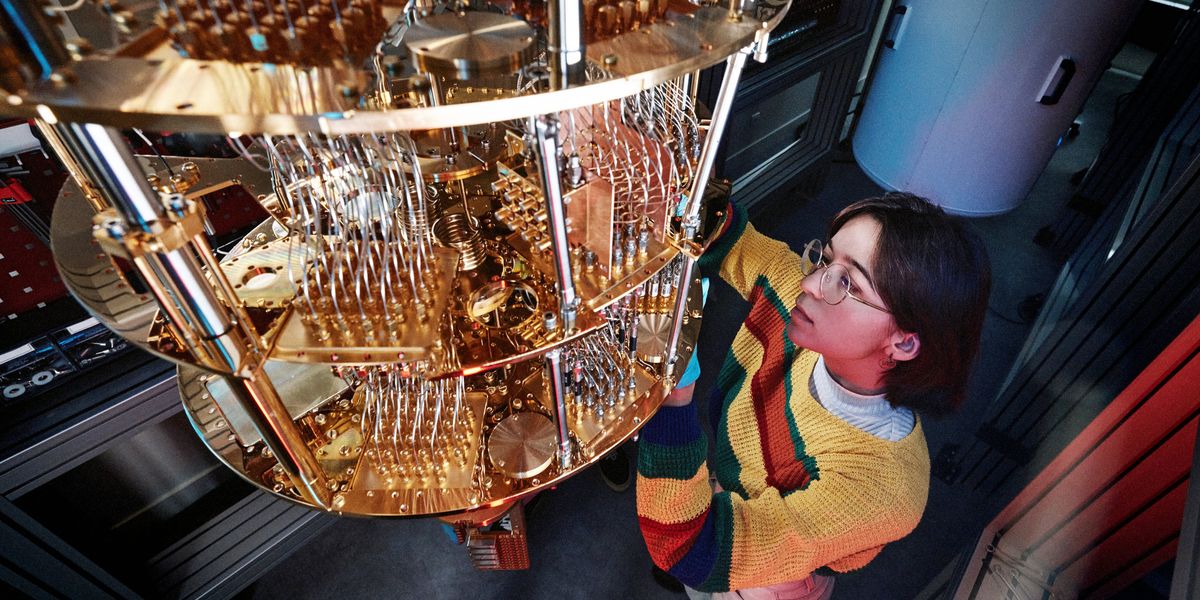
Superconducting qubits are currently the most mature quantum computing technology. These qubits are fabricated using semiconductor manufacturing techniques similar to conventional chips, with aluminum circuits cooled to roughly 15 millikelvin, colder than outer space, to achieve superconductivity. At these temperatures, electrical current flows without resistance, and the circuit exhibits quantum behavior.
IBM has been the most consistent player in superconducting quantum computing. Its roadmap has progressed from the 127-qubit Eagle processor (2021) through the 1,121-qubit Condor (2023) to plans for systems exceeding 100,000 qubits by the end of the decade. IBM's approach emphasizes modularity, connecting multiple quantum chips through quantum interconnects to build larger systems without requiring monolithic chips with impractical qubit counts.
Google achieved a significant milestone in 2019 when its 53-qubit Sycamore processor performed a computation in 200 seconds that Google claimed would take a classical supercomputer 10,000 years. More recently, Google's Willow chip demonstrated quantum error correction at scale, showing that adding more qubits can actually reduce errors rather than increase them, a critical threshold for practical quantum computing.
The primary challenge with superconducting qubits is the extreme cooling requirement. Dilution refrigerators that maintain millikelvin temperatures are expensive, physically large, and limit the scalability of the systems. Each qubit also requires individual control wiring that must pass from room-temperature electronics into the cryogenic environment, creating a wiring bottleneck that becomes severe as qubit counts increase.
Trapped Ion Qubits: IonQ and Quantinuum
Trapped ion quantum computers use individual atoms, typically ytterbium or barium, suspended in electromagnetic fields inside a vacuum chamber. Laser pulses manipulate the quantum states of these ions, and their natural quantum properties provide inherently high-quality qubits. Where superconducting qubits are manufactured, trapped ion qubits are, in a sense, found in nature.
IonQ, a publicly traded company, has been the most prominent trapped ion startup. Its systems use ytterbium ions arranged in linear chains, with laser beams performing gate operations. IonQ's approach benefits from very high gate fidelities (above 99.5 percent for two-qubit gates) and long coherence times, but scaling to large qubit counts is challenging because the ions interact increasingly weakly as the chain grows longer.
Quantinuum, formed from the merger of Honeywell Quantum Solutions and Cambridge Quantum, operates the H-Series quantum computers based on trapped ions. Quantinuum's systems consistently rank among the highest in quantum volume, a metric that combines qubit count, gate fidelity, and connectivity. The company's QCCD (quantum charge-coupled device) architecture moves ions between zones in a complex trap structure, providing flexibility that fixed-chain approaches lack.
Comparing Key Technologies
- Superconducting: Fast gates (nanoseconds), manufactured on-chip, requires extreme cooling, moderate coherence times
- Trapped ion: Slow gates (microseconds), highest gate fidelities, operates at room temperature (vacuum chamber), long coherence times
- Photonic: Room temperature operation, natural networking capability, difficult to make photons interact, probabilistic gates
- Neutral atom: Large qubit arrays possible, reconfigurable connectivity, mid-range gate speeds, rapidly improving fidelities
Photonic and Neutral Atom Approaches
Photonic quantum computing encodes qubits in properties of individual photons, such as polarization or path. PsiQuantum, backed by over $700 million in funding, is pursuing a photonic approach that it claims can scale to a million qubits using modified semiconductor manufacturing processes. Xanadu, a Canadian company, takes a different photonic approach using squeezed light states. The primary advantage of photonic systems is room-temperature operation and natural compatibility with quantum networking, but making photons interact with each other is fundamentally difficult.
Neutral atom quantum computing, pursued by companies like QuEra Computing and Pasqal, uses arrays of individual atoms held in place by focused laser beams called optical tweezers. These systems can arrange hundreds or thousands of atoms in arbitrary patterns, providing flexible qubit connectivity. Harvard researchers using QuEra's technology demonstrated a 48 logical qubit system in 2023, one of the largest demonstrations of error-corrected quantum computation to date.
The Error Correction Challenge
The biggest obstacle to practical quantum computing is not qubit count but qubit quality. Today's qubits are "noisy," meaning they introduce errors at rates that make complex computations unreliable. Current two-qubit gate error rates range from 0.1 to 1 percent, depending on the technology. For comparison, classical transistors fail at rates below one in a billion.
Quantum error correction addresses this by encoding a single "logical qubit" across many physical qubits, using redundancy to detect and correct errors. The overhead is substantial: depending on the error rate, 1,000 to 10,000 physical qubits may be needed for each logical qubit. A practically useful quantum computer might need millions of physical qubits to support the few thousand logical qubits required for meaningful computations.
This error correction overhead explains why achieving a useful "quantum advantage" remains elusive despite rapidly growing qubit counts. A 1,000-qubit noisy processor is not necessarily more useful than a 100-qubit processor with better error rates. The field is gradually converging on the understanding that both scale and quality must improve simultaneously.
Timeline and Commercial Outlook
Optimistic projections suggest that quantum computers could begin solving commercially valuable problems that classical computers cannot by 2028 to 2030. Likely first applications include molecular simulation for pharmaceuticals, optimization problems in logistics and finance, and materials science modeling. General-purpose quantum computing and the ability to break current encryption standards remain much further out, likely a decade or more.
Investment in quantum computing has been substantial, with over $30 billion in combined government and private funding committed globally. The United States, China, and the European Union have each launched multi-billion-dollar quantum initiatives. However, the technology risk remains high, and the path from laboratory demonstrations to commercial products is longer than many early projections suggested.
For the semiconductor industry, quantum computing represents both an opportunity and a challenge. Quantum chips require specialized fabrication, but they also leverage existing semiconductor manufacturing expertise. Whichever qubit technology ultimately prevails, the chips that implement it will need to be manufactured at scale with the precision and reliability that the semiconductor industry has spent decades perfecting.