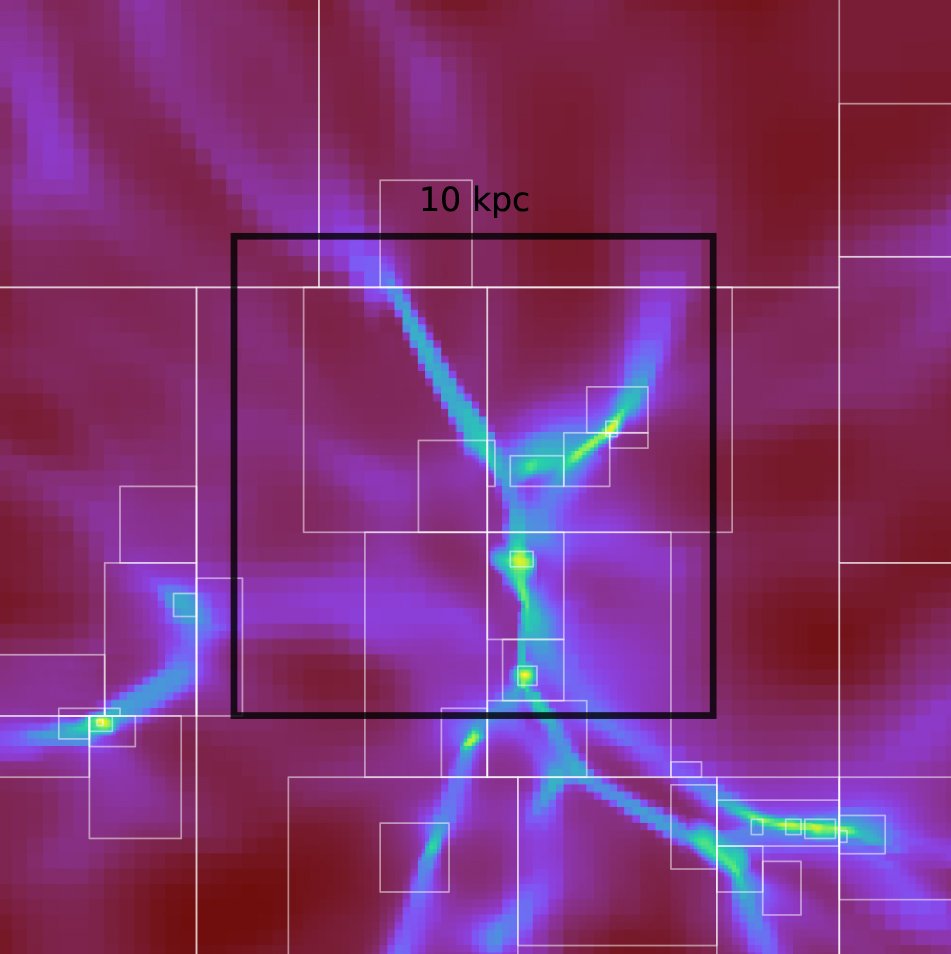
The faint hum of supercomputers at San Diego Supercomputer Center (SDSC) and Texas Advanced Computing Center (TACC) is now the soundtrack to the universe’s infancy. It’s here, amidst the whirring fans and humming processors, that astrophysicists are using an AI called StarNet to compress eons of cosmic evolution into digestible simulations, a feat that pushes the boundaries of both computational astrophysics and artificial intelligence.
This isn’t just another incremental update to scientific modeling. It’s a fundamental shift in how we approach understanding the cosmos. Mike Norman and his team at UC San Diego’s Halıcıoğlu School of Data Science and Computing have woven a deep learning surrogate model, StarNet, into the fabric of massive cosmological simulations. The goal? To more accurately and, critically, much faster, track how matter clumps and structures form from the Big Bang to the present day. Think of it as an AI shortcut, trained on gargantuan datasets, that can predict complex physical phenomena without requiring the raw, brute-force computation of traditional methods.
Why does this matter? Because the universe is, to put it mildly, a big and complicated place. Simulating its evolution from the primordial soup to the galaxies we see today involves wrestling with dark matter, gas dynamics, gravity, and cosmic expansion across vast three-dimensional volumes. Historically, these simulations have been so computationally intensive that scientists often had to make significant compromises, either simplifying the physics or running shorter, less detailed cosmic timelines. StarNet, however, acts as an intelligent proxy, handling the notoriously tricky physics of primordial star formation and their explosive feedback effects — processes that happen on scales far too small to be directly modeled in the larger cosmic picture. It’s like having a seasoned expert instantly tell you the outcome of a complex chess move, rather than having to calculate every possible variation yourself.
The Secret Sauce: StarFind Meets FBNet
At the heart of StarNet lies a clever combination of AI architectures. The heavy lifting is done by StarFind, a 3D convolutional neural network built with PyTorch. This network is essentially trained to ‘see’ and ‘understand’ the subtle patterns within vast quantities of simulation data – over 100 terabytes of it, in this case. It learns to correlate specific initial conditions and physical inputs with the emergent behaviors of nascent stars and their subsequent supernova explosions. Think of it as a hyper-advanced pattern recognition engine that can identify the ‘fingerprint’ of star formation.
But StarNet isn’t just a one-trick pony. StarFind is coupled with a simpler regression model, FBNet. This duo allows the system to not only identify the star formation events but also to predict their immediate consequences, like the energy released and the distribution of heavy elements. This symbiotic relationship between a deep learning model and a regression model is where the real magic happens, allowing for rapid, accurate predictions of subgrid physics that would otherwise bog down the main simulation. Norman himself describes the core achievement as:
The main result is a fast, accurate AI/ML surrogate model for incorporating subgrid physics into hydrodynamic cosmological simulations, specifically the formation of primordial stars (Population III) and their supernova feedback effects. Our study describes the design, implementation, training, and validation of the model.
This breakthrough was enabled by significant allocations on NSF-funded supercomputing systems. The Expanse system at SDSC, with its mix of CPU and GPU nodes and high-performance interconnect, was crucial for running suites of simulations that integrated traditional cosmology codes with StarNet. Simultaneously, the Frontera system at TACC provided the sheer horsepower needed to train StarNet on the massive datasets derived from earlier, high-resolution simulations – the aptly named Phoenix simulations.
Why Does This Matter for Developers?
For developers and computational scientists, this signals a broader trend: the increasing integration of AI and machine learning into the core of scientific discovery. It’s no longer just about building faster hardware; it’s about building smarter software that can use that hardware more effectively. The StarNet project exemplifies how AI can democratize access to high-fidelity simulations. By creating these surrogate models, researchers can perform parameter studies, explore a wider range of cosmological models, and quantify uncertainties with far greater efficiency than before. This translates to faster iteration cycles, more strong scientific conclusions, and ultimately, a deeper understanding of the universe. The fact that StarNet was developed using PyTorch and integrated into existing cosmological codes also highlights the importance of flexible, open-source tools in advancing scientific frontiers.
Furthermore, the recent addition of a NAIRR-funded partition of Dell XE9640 GPU nodes to Expanse, equipped with NVIDIA H100 GPUs and Intel Sapphire Rapids CPUs, points towards an evolving hybrid computing paradigm. Norman’s team is now able to experiment with combining CPU and GPU workloads for both simulation and AI inference, a strategy that will likely become increasingly common across scientific disciplines. This isn’t just about raw power; it’s about intelligent resource management and workflow optimization, areas where AI plays an ever-larger role.
A New Era for Cosmic Cartography
The implications of StarNet are profound. By accelerating these simulations, scientists can now generate more realistic predictions for observable phenomena that upcoming sky surveys will capture. This includes things like X-ray emissions from galaxy clusters, the Sunyaev–Zel’dovich effect, and weak-lensing signals. In essence, StarNet is not just speeding up our understanding of the past; it’s enhancing our ability to interpret what we see in the present and what we will discover in the future. It’s a proof to how the relentless pursuit of computational efficiency, when coupled with intelligent AI design, can unlock entirely new vistas of scientific exploration.
This work, building on decades of numerical modeling, represents a significant leap. The ability to efficiently incorporate complex, unresolved physics into large-scale simulations is a game-changer for cosmology. StarNet isn’t just simulating the universe; it’s helping us to read its story faster and with greater clarity. It’s a powerful reminder that the most exciting frontiers in science are often found at the intersection of raw computational power and sophisticated, human-designed intelligence.
🧬 Related Insights
- Read more: Zuck’s Tent Cities: How Meta’s $200M Talent Heist and GPU Bunkers Could Reshape AI for Everyone
- Read more: Siemens EDA: AI Redefines Chip Design
Frequently Asked Questions
What is StarNet? StarNet is a deep learning surrogate model designed to accelerate complex cosmology simulations by predicting the physics of primordial star formation and supernova feedback effects, significantly reducing computational time and resources required.
How does StarNet speed up simulations? StarNet acts as an AI proxy, using trained neural networks (StarFind and FBNet) to rapidly estimate the outcomes of subgrid physics that would otherwise require extensive, time-consuming calculations within traditional simulation codes.
What kind of supercomputers were used? The research utilized NSF-funded supercomputing systems, including Expanse at SDSC and Frontera at TACC, to run and train the StarNet AI model and integrate it into cosmological simulations.