Is your last Amazon order a bit… anticlimactic? Mine usually is. A cheap cable that breaks in a week, or a book I’ll never read. But then you hear stories like this, and you start to wonder if your Prime membership is missing a secret perk.
This time around, it’s a user on Reddit, u/TheDankestYo, who apparently used up his entire year’s supply of good fortune in a single click. He ordered one, just one, Samsung 990 PRO 2 TB Gen 4 SSD. You know, the kind of drive that makes your boot times laughably short and your game loads feel instantaneous. The invoice shows he paid a cool $479 for this single piece of tech. Standard. Happens all the time.
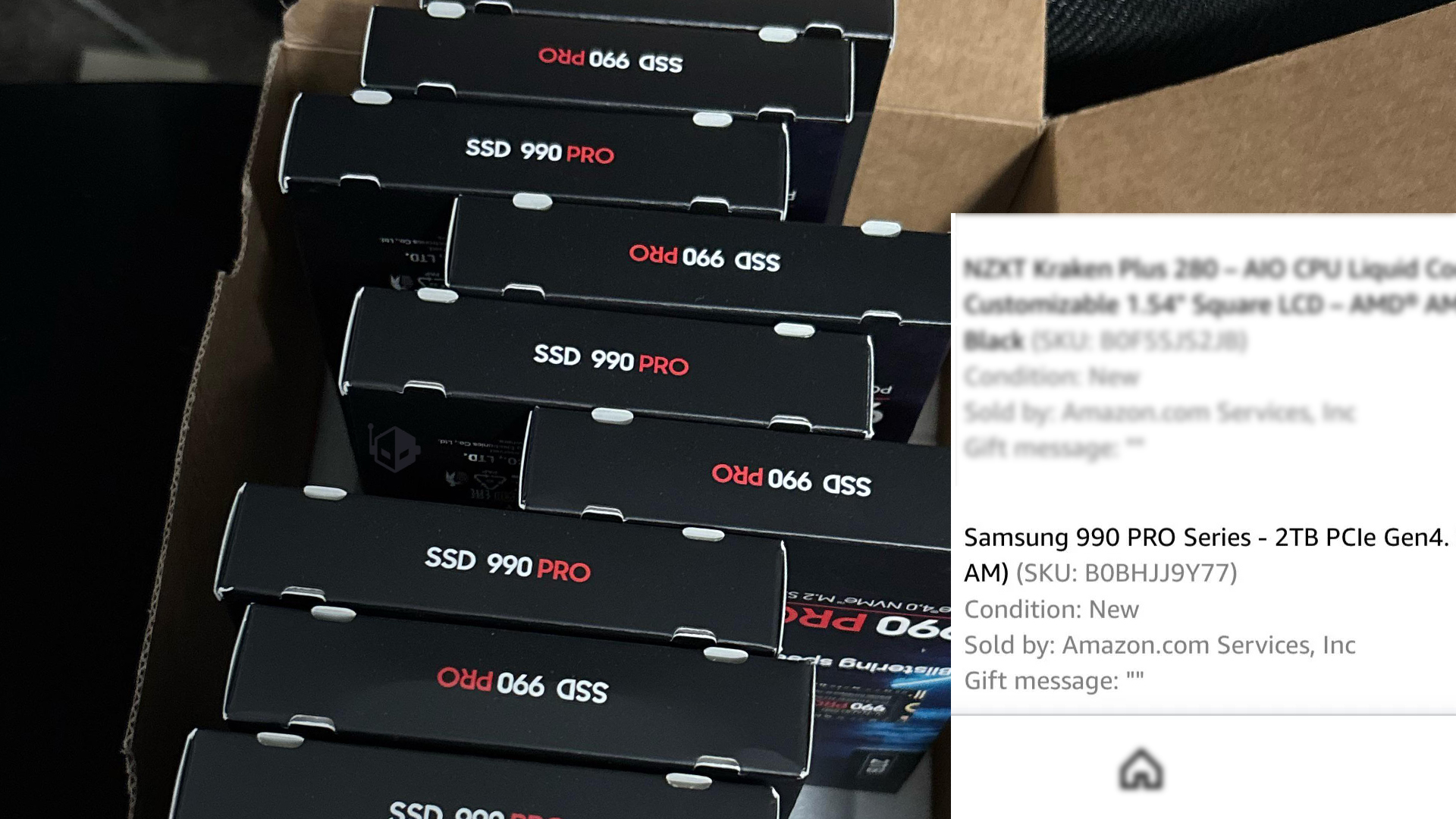
Except, when the package arrived, it wasn’t just one SSD nestled in its pristine anti-static bag. Oh no. This guy pulled a fast one on the universe and wound up with ten of them. Ten. That’s not a typo. This little oopsie by Amazon’s logistics department means he’s now sitting on nearly $4,800 worth of bleeding-edge storage. For free.
The user uploaded the invoice, which shows he ordered a single Samsung 990 PRO 2 TB Gen 4 SSD, which cost him $479. This means the total value of 10 such SSDs is nearly $4,800.
And what does one do with nearly five grand in SSDs? The original report floats some interesting possibilities. Build a monster gaming rig, naturally. Think RTX 5080, maybe even a 5090 if you’re feeling spicy. Or, and this is where I start to get cynical, cash them out. Because let’s be honest, who among us wouldn’t immediately get on eBay faster than a Ryzen 7000 hits its boost clock? It’s free money, practically falling off the back of a digital truck.
Who’s Actually Making Money Off This Glitch?
This isn’t the first time Amazon’s warehouse staff have apparently decided to play Santa Claus with high-value components. We’ve seen similar stories pop up before, usually involving multiple SSDs. The company’s policy, from what we can gather, is often to just let it slide. This is where the real story lies, isn’t it? It’s not just about the lucky customer; it’s about the cost to Amazon, and more importantly, who absorbs it. Is it a direct hit to their profit margin on that specific warehouse? Or is it bundled into the overall cost of doing business, a tiny statistical anomaly in their massive, sprawling operation that they’d rather not draw attention to? My money’s on the latter. A small percentage of error is baked into the cost of operating at that scale.
It also makes you wonder about the process. Did a packer just… eyeball it? Did a scanner go rogue? Or is there a rogue element deliberately over-shipping, perhaps to circumvent inventory counts or for reasons we’ll never truly know? The sheer volume here – ten units when only one was ordered – suggests something more than a simple typo on a pick slip. It’s the kind of error that makes you wonder about the human element in an increasingly automated world, or perhaps, the automated element making a very human mistake.
Will This Happen to Me?
Look, I’ve been covering this industry for two decades, and I’ve seen plenty of hype, plenty of failures, and yes, a few spectacular screw-ups. This kind of windfall from a major retailer is as rare as a stable crypto price. While it’s fun to imagine striking gold like u/TheDankestYo, the odds are astronomically against you. Amazon’s systems, for all their occasional quirks, are designed to prevent precisely this kind of massive over-shipment. So, don’t cancel your plans to buy that next component just yet. You’re more likely to find a unicorn in your backyard than ten NVMe drives in your Amazon delivery.
Still, it’s a good reminder that sometimes, the universe—or at least a poorly programmed inventory system—throws you a bone. And if it happens to you, well, don’t be shy about sharing the story. Just maybe… don’t ask too many questions about how it happened.