In August 2022, President Biden signed the CHIPS and Science Act into law, committing $52.7 billion in federal subsidies to revitalize domestic semiconductor manufacturing in the United States. The legislation represented the most significant U.S. industrial policy since the space race, driven by national security concerns about America's dependence on Asian chip fabrication. Two years into implementation, the CHIPS Act is reshaping the global semiconductor landscape, attracting massive investments while raising questions about the effectiveness of government intervention in a fiercely competitive global industry.
Why the CHIPS Act Was Needed
The United States invented the transistor, created the integrated circuit, and led the semiconductor industry for decades. But beginning in the 1990s, chip manufacturing steadily migrated to Asia, drawn by government subsidies, lower costs, and the rise of specialized foundries like TSMC. By 2020, the U.S. share of global semiconductor fabrication capacity had fallen from 37 percent in 1990 to approximately 12 percent.
This decline became a national security concern during the COVID-19 pandemic, when chip shortages disrupted automotive production, consumer electronics, and defense systems. The geographic concentration of advanced manufacturing was stark: TSMC in Taiwan produced over 90 percent of the world's most advanced chips, and Taiwan sits in one of the most geopolitically sensitive regions on Earth. A Chinese blockade or invasion of Taiwan could cut off the chip supply that underpins the entire global economy.
These vulnerabilities, combined with the recognition that semiconductors are foundational to AI, defense systems, and economic competitiveness, created bipartisan support for unprecedented federal intervention. The CHIPS Act passed with broad bipartisan majorities in both the House and Senate, a rarity in today's polarized political environment.
What the CHIPS Act Includes
The legislation allocates $52.7 billion in total funding, structured across several programs. Understanding the allocation reveals the government's priorities.
The largest component is $39 billion in direct manufacturing subsidies, administered by the Commerce Department's CHIPS Program Office. These funds are awarded as grants and loans to companies building or expanding semiconductor fabrication facilities in the United States. The subsidies are designed to close the cost gap between building fabs in the U.S. and in Asia, where government incentives have historically been more generous.
An additional $11 billion funds research and development initiatives, including the National Semiconductor Technology Center (NSTC), which aims to create a collaborative research hub for next-generation chip technologies. The NSTC is intended to bridge the gap between university research and commercial manufacturing, accelerating the transition of new materials and processes from laboratory to production.
The legislation also includes a 25 percent investment tax credit for semiconductor manufacturing equipment, which provides additional financial incentives beyond direct grants. This tax credit applies to both new fab construction and upgrades to existing facilities.
- $39 billion: Direct manufacturing subsidies (grants and loans)
- $11 billion: R&D and workforce development
- $2.7 billion: Workforce and education programs
- 25% investment tax credit: For semiconductor manufacturing equipment purchases
Major Award Recipients
The Commerce Department began announcing CHIPS Act awards in early 2024, with the largest grants going to the companies making the most significant manufacturing investments.
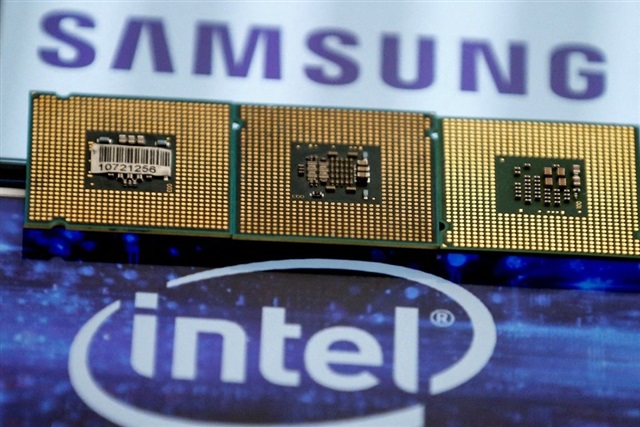
Intel: Intel received up to $8.5 billion in grants and $11 billion in loans, the largest CHIPS Act award. This funding supports Intel's massive expansion plans, including new fabs in Arizona, Ohio, Oregon, and New Mexico. Intel's investment is the most ambitious, encompassing both its own chip manufacturing and its contract foundry business (Intel Foundry Services), which aims to manufacture chips for other companies in competition with TSMC.
TSMC: TSMC received up to $6.6 billion in grants and up to $5 billion in loans for its Arizona fab complex, which will eventually include three fabrication plants producing chips at 4nm, 3nm, and 2nm process nodes. TSMC's Arizona investment, totaling over $65 billion, represents the most advanced chip manufacturing ever planned outside of Asia.
Samsung: Samsung received up to $6.4 billion in grants for its expanding fab complex in Taylor, Texas, where it plans to produce advanced logic chips and potentially high-bandwidth memory. Samsung's total Texas investment exceeds $40 billion.
Micron: Micron received up to $6.1 billion in grants for new memory manufacturing facilities in New York and Idaho. This investment aims to bring leading-edge DRAM production to the United States for the first time in decades.
Smaller awards have gone to GlobalFoundries, Texas Instruments, Amkor (packaging), and several other companies. The awards collectively represent over $150 billion in total semiconductor investment, with the federal subsidies covering roughly 15 to 25 percent of each project's total cost.
Guardrails and Conditions
CHIPS Act funding comes with significant strings attached. Recipients must agree to not expand advanced manufacturing capacity in China for 10 years, a provision that directly targets the common practice of companies operating cutting-edge fabs in both the U.S. and China. Recipients must also provide detailed financial disclosures, share excess profits with the government under certain conditions, and meet workforce development requirements.
The prohibition on China expansion has been controversial. Companies like Intel and Samsung maintain significant operations in China and have had to restructure their investment plans to comply. Critics argue the restrictions are too broad and could harm companies' global competitiveness. Supporters contend they are essential to prevent U.S. taxpayer-funded technology from benefiting China's semiconductor ambitions.
Recipients must also demonstrate that they cannot fully finance their U.S. investments without government support, and that the funded facilities would not be built without the subsidy. This "but for" test is designed to ensure the CHIPS Act creates genuinely new capacity rather than subsidizing investments that companies would make regardless.
Early Results and Challenges
The CHIPS Act has unquestionably spurred an investment boom. The Semiconductor Industry Association estimates that over $450 billion in semiconductor investments have been announced in the United States since the legislation was proposed, far exceeding the direct federal spending. This multiplier effect was a key goal of the legislation.
However, several challenges have emerged. Construction costs in the United States significantly exceed costs in Asia. TSMC has publicly stated that building its Arizona fab costs roughly four times more than an equivalent facility in Taiwan, driven by higher labor costs, regulatory requirements, and the lack of established semiconductor supply chain infrastructure. These cost overruns threaten to delay projects and reduce the economic viability of U.S. manufacturing.
Workforce shortages present another obstacle. The U.S. lacks sufficient numbers of semiconductor technicians, engineers, and construction workers experienced in fab construction. TSMC brought thousands of Taiwanese workers to Arizona for its initial construction phase, sparking debates about visa policies and the timeline for developing a domestic workforce.
Global Ripple Effects
The CHIPS Act has triggered a global subsidy race. The European Union responded with its own European Chips Act, committing to mobilize over 43 billion euros to double Europe's share of global chip production by 2030. Japan has provided over $13 billion in subsidies to attract TSMC and other manufacturers. South Korea announced a $470 billion semiconductor investment plan with significant tax incentives. India launched a $10 billion semiconductor incentive program.
This proliferation of subsidies raises concerns about overcapacity. If every major economy successfully attracts the manufacturing capacity it is targeting, the total global supply could significantly exceed demand, potentially leading to price crashes and financial distress for manufacturers. The semiconductor industry has historically experienced boom-and-bust cycles, and government subsidies could amplify these swings by encouraging investment based on political goals rather than market signals.
The CHIPS Act represents a fundamental shift in U.S. economic policy, from market-driven to government-directed industrial development in a critical technology sector. Whether this approach successfully rebuilds American semiconductor manufacturing or creates expensive overcapacity will not be clear for years. What is already clear is that the era of purely market-driven semiconductor investment decisions is over, replaced by a global competition in which government subsidies play a decisive role in determining where chips are made.