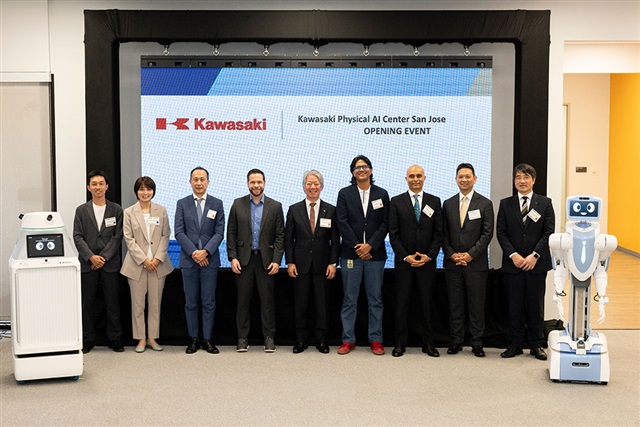
San Jose, CA – The air in Silicon Valley has a particular scent this week – a mix of ozone from server farms and desperation from the latest venture pitch. Kawasaki Heavy Industries, yes, the motorcycle and jet ski folks, just plugged in their Kawasaki Physical AI Center here. Their stated aim? To “accelerate real-world deployment of physical AI” and, naturally, deepen US-Japan collaboration in semiconductors. Translation: they want their robots to get smarter, and they’re betting big on Nvidia’s brainpower to do it.
It’s easy to get swept up in the corporate pronouncements. “Physical AI.” Sounds like something out of a sci-fi flick, doesn’t it? But let’s be blunt: what we’re really talking about is advanced robotics, and every time a major player plants a flag for this, the question that should immediately follow is, ‘Who’s actually making money here?’ For Kawasaki, the hope is obvious: more intelligent, adaptable robots for manufacturing, logistics, maybe even caregiving down the line. But the real benefactor, at least in the short term, seems to be the company that powers all this intelligence.
The Nvidia Connection: Is This Just a New Nvidia Reseller?
This isn’t just some abstract collaboration; it’s a very concrete partnership. Kawasaki is explicitly leaning on Nvidia’s hardware and software, likely including their latest GPUs and the Isaac platform for robotics. This means a substantial chunk of the investment flowing into this center is likely finding its way into Nvidia’s coffers. It’s a classic Silicon Valley playbook: build the infrastructure, attract the talent, and let a hardware giant provide the raw processing grunt.
“We aim to develop practical… AI solutions that contribute to the resolution of social issues and the creation of new industries.”
That’s the official line. But what are these “social issues”? And what are these “new industries” that couldn’t be served by existing, less AI-ballyhooed robotics? My money’s on efficiency gains and new service contracts. The press release mentions “robotics solutions for various industrial fields,” which could mean anything from automating another warehouse floor to building the next generation of automated factory lines. The language is deliberately vague, a common tactic to cast a wide net.
Why Does This Matter for Developers?
For the engineers and developers on the ground, this could mean new opportunities, or it could mean being absorbed into a larger ecosystem controlled by a few dominant players. If Kawasaki’s center truly becomes a hub for developing advanced robotic systems, there will be a demand for talent skilled in AI, machine learning, computer vision, and, of course, robotics programming. However, this also points to a potential consolidation of power. As more companies tie their robotic futures to platforms like Nvidia’s, the barrier to entry for smaller, independent robotics startups could become even higher. It’s the same story we’ve seen with cloud computing and AI model training – a few big players tend to define the landscape.
The core challenge for Kawasaki, and indeed for the entire field of physical AI, remains the gap between sophisticated algorithms and the messy, unpredictable reality of the physical world. Robots are still notoriously clumsy compared to humans when it comes to navigating novel environments, performing delicate tasks, or adapting to unexpected changes. This center is supposed to bridge that gap. It’s an ambitious goal, and frankly, one that’s been pursued with varying degrees of success for decades.
So, is Kawasaki’s new physical AI center a genuine leap forward for robotics, or is it another PR exercise designed to boost investor confidence and secure lucrative hardware contracts? The proof, as always, will be in the pudding – or rather, in the robots that actually get built and deployed. Until then, it’s a lot of hype, a lot of Nvidia chips, and a very hopeful Japanese industrial giant.
🧬 Related Insights
- Read more: Apple’s Memory Grab: Chinese Flagships Face Extinction
- Read more: ZSNES reborn: GPU powers ultimate accuracy
Frequently Asked Questions
What is Kawasaki’s physical AI center? Kawasaki’s Physical AI Center is a new facility in San Jose, California, focused on developing and deploying advanced AI for physical robots, with a strong partnership with Nvidia.
What kind of AI is Kawasaki focusing on? They are focusing on “physical AI,