The whine of fans is almost drowned out by the hiss of liquid nitrogen. A cluster of engineers, hunched over a motherboard, watches numbers tick higher on a monitor.
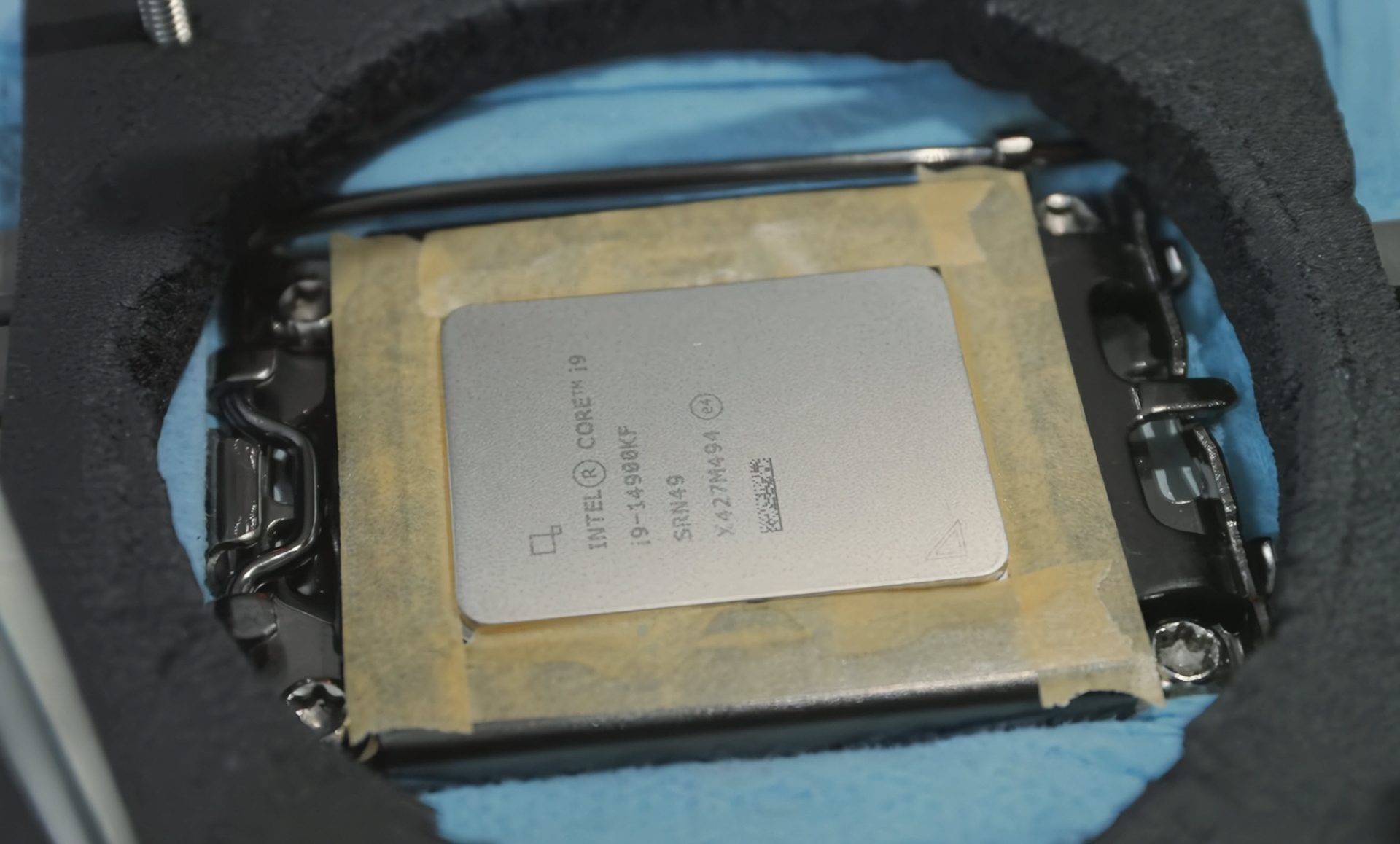
This scene, mundane for extreme overclockers, was the backdrop for a new world record: Intel’s Core i9-14900KF has officially crossed the 9.2 GHz threshold. For context, that’s nearly double the frequency of your average high-end desktop chip out of the box. It’s a proof to how, even with diminishing returns in architectural leaps, brute force and extreme environments can still yield astonishing results. This isn’t about practical desktop performance; this is about the absolute bleeding edge, a digital Everest conquered by a veteran chip.
It’s important to frame this achievement: the i9-14900KF, a chip that’s been around for a few years, was coaxed to 9206 MHz. This wasn’t a gentle nudge. It involved a full suite of extreme cooling techniques, specifically Liquid Nitrogen (LN2), and a selective enabling of cores—just 7 out of its 24 P-cores and E-cores were active, alongside 7 threads. The voltage? A demanding 1.348V. Think of it like pushing a car engine to its absolute redline for a quarter-mile drag race, not for a cross-country road trip.
What this tells us isn’t so much about the i9-14900KF itself as a daily driver, but about the persistent, almost absurd, drive to find the physical limits of silicon. The original 14th Gen CPUs were already flirting with the 9 GHz mark, but this submission by Chinese overclocker wytiwx, utilizing an ASUS ROG Maximus Z790 APEX motherboard and some rather speedy DDR5 memory (16 GB at DDR5-5792 CL32, no less), cemented the victory. It bumps AMD’s own high-frequency records down the rankings—their FX-8370, once a contender, now sits well outside the top tier for pure clock speed.
Is This Even Real-World Performance?
Let’s be crystal clear: this 9.2 GHz record is for bragging rights and synthetic benchmarks, not for your gaming rig or workstation. The massive LN2 container pictured at the event is a giveaway. Sustaining such frequencies requires constant monitoring and refilling of cryogenic coolant, and even then, stability is a fleeting mistress. The chip was essentially operating under conditions that would instantly fry a consumer-grade processor. It’s akin to a sprinter running a 100-meter dash in a specialized vacuum suit – impressive, but not how you’d run to catch a bus.
This kind of record-breaking is less about the CPU’s practical application and more about the validation of platform stability and the sheer, unadulterated will of the overclocking community. It’s a validation that the underlying silicon, designed for a certain operating range, can be pushed far beyond its intended parameters with the right equipment and expertise. The fact that a 3-year-old chip architecture can still be pushed to achieve such a headline-grabbing feat speaks to the foundational strength of Intel’s process nodes and design philosophies, even as newer, more efficient architectures emerge.
My unique insight here is seeing this as the technological equivalent of a moonshot. We know we can get to orbit; we know we can land on the moon. But the really expensive, resource-intensive efforts are about pushing that frontier just a little bit further, proving that the physics and engineering still allow it. This 9.2 GHz record doesn’t change the desktop CPU market overnight, but it does serve as a stark reminder of the sheer potential locked within these microscopic silicon wafers.
This record was achieved under LN2 cooling, and the chip only had 7 cores and 7 threads enabled. With this, the Intel Core i9-14900KF was pushed to 9206 MHz, the highest recorded frequency for any processor to date.
The corporate spin, of course, will focus on “pushing the limits” and “unleashing potential.” And sure, that’s part of it. But the real story is the dedication of a niche community and the raw, unvarnished demonstration of what happens when you throw enough power and extreme cooling at a piece of silicon.
What Does This Mean for the Average User?
For most users, this record is purely academic. Your everyday i9-14900KF, or even the slightly newer KS variant that previously held a high-frequency record, operates at a fraction of these speeds for good reason: power efficiency, thermals, and stability. Intel’s current generation CPUs offer significant performance gains through architectural improvements, specialized cores (P-cores and E-cores), and higher, more sustainable boost clocks. The real advancements that impact user experience—faster gaming, quicker application loads, improved multitasking—come from these more holistic design changes, not from hitting astronomical clock speeds that require industrial-grade refrigeration.
Yet, the very existence of these records fuels innovation in other areas. The pursuit of these extremes drives advancements in motherboard VRMs (Voltage Regulator Modules), memory controllers, and cooling solutions that, over time, trickle down into more mainstream products. It’s a symbiotic relationship: the extreme pushes the boundary, and the mainstream benefits from the lessons learned.
🧬 Related Insights
- Read more: Boris Cherny’s Claude Code Workflow: Five AIs, One Terminal, Infinite Output
- Read more: AMD FSR 4 Now Official for Older Radeon Cards
Frequently Asked Questions
**What exactly is CPU frequency?
CPU frequency, measured in Gigahertz (GHz), indicates how many cycles a processor can execute per second. Higher frequency generally means faster processing, but it’s only one factor among many determining overall performance.