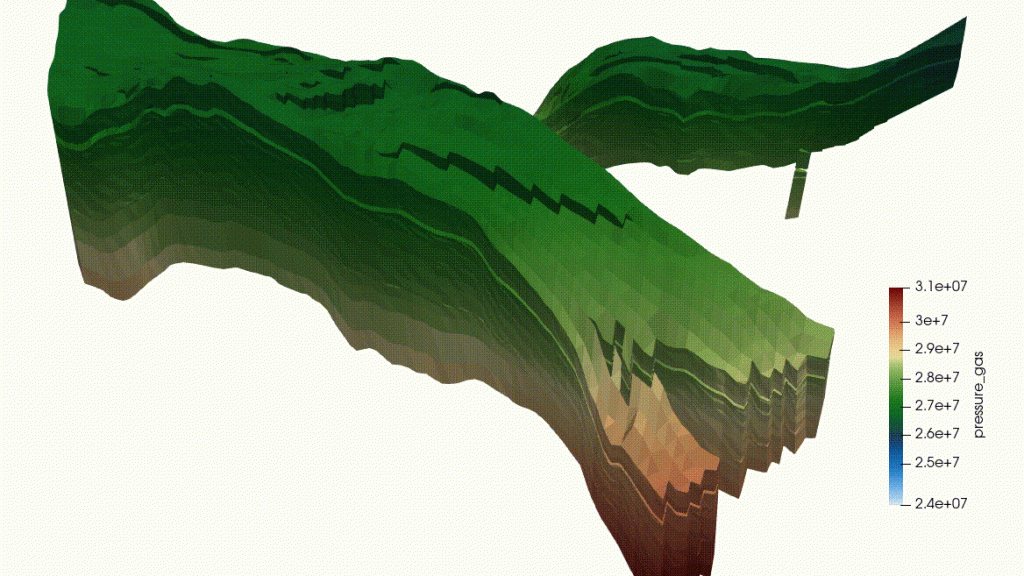
Something’s gotten out of hand. We’re talking about simulation turnaround times. They’ve gone from bad to worse, stretching a single day into several. This isn’t just a minor inconvenience; it’s a full-blown project killer for subsurface engineering. The industry’s digital evolution, it seems, has hit a rather inconvenient wall.
For ages, the magic behind unlocking subsurface potential was in the hands of experts. These brilliant minds spent countless hours wrestling with data, stitching together insights, and running simulations. Now, as the data piles up and grows in complexity, the chasm between what machines can do instantly and what humans can manage within a workday yawns wider. This is the bottleneck. This is where everything grinds to a halt.
And the current simulation setups? They’re not exactly lightning-fast. You’ve got the manual data wrangling, which is about as exciting as watching paint dry. Then there’s the inherent latency. Engineers are stuck aggregating, synthesizing, and translating mountains of technical documents. It’s a knowledge consolidation nightmare that adds weeks to project timelines. Don’t even get me started on the asynchronous nature of simulation jobs. When a simulation decides to finish its work at 2 AM, or while an engineer is heroically juggling five other emergencies, precious hours evaporate. What should be a 24-hour cycle? It balloons into a multi-day delay. Global teams just… wait.
AI for the rescue? Apparently. The pitch here is that agentic AI, perched atop NVIDIA’s computing platform, is the knight in shining armor. It’s meant to convert these slow, human-limited workflows into something always-on, something compute-driven. Think of it: repetitive technical tasks offloaded, allowing engineers to stop fiddling with the ‘good enough’ and start exploring a genuinely wider solution space. The goal? Drive more value from assets. More strategic oversight for humans, less grunt work.
The Engineer as Supervisor, Not Slave
This new paradigm positions the engineer as a strategic supervisor. They’re still in the loop, mind you, providing the high-level direction. But the agents? They handle the execution. This isn’t about replacing seasoned professionals, the article insists. It’s about augmenting their existing tools. The examples focus on subsurface simulation, but the framework is apparently tool-agnostic. Any industry drowning in complex simulation workflows could theoretically benefit.
At the heart of this system is a master architecture featuring a central orchestration agent. This agent coordinates specialized agents, the ones that actually talk to simulators and manage the workflow. Think of the reservoir simulation assistant as a digital domain expert. It’s the bridge between the engineer, all that dense technical documentation, and the actual simulator. It’s a fast track, working alongside your current setup to chew through the tedious, repetitive stuff.
The agent goes beyond plotting time series curves to provide quick diagnostics. It can instantly answer complex questions, including “Why am I seeing an early water breakthrough at Well-X?” It would normally require hours of manual cross-referencing.
This assistant is supposed to unlock instant interaction. Forget hunting through nested menus or endless terminal commands for simple data points like the skin factor for a specific well. Drag a simulation deck to a chat interface, ask your question, and boom – instant results. Analysis becomes rapid too. No more spending hours cross-referencing data to figure out why water’s breaking through early. And frictionless ‘what-if’ scenarios? The agent handles syntax headaches and baseline comparisons. Its self-healing logic supposedly fixes convergence issues and input errors on the fly, with an optional human check to keep things running 24/7. It’s billed as transforming a multi-step manual administrative process into a single, natural conversation. Exciting stuff, if it actually works.
The Heuristic Pause: A Cognitive Bottleneck
But the real headaches, the deep dives like history matching and field development optimization, those are where the true bottlenecks reside. These aren’t just about waiting for a simulation to finish; they’re about the infamous ‘heuristic pause.’ After every simulation cycle, an expert has to manually sift through high-dimensional data. They must then decide on the pivot points for the next run. This requires years of experience, or a reliance on scarce external consultants. It’s a cognitive bottleneck, a major contributor to project timelines stretching into the abyss as the workflow waits for human intervention.
The article mentions moving from a single-agent setup to something more complex to tackle these larger studies. This implies a layered approach where individual agents handle specific tasks, and a higher-level agent or orchestration layer makes the strategic decisions based on the cumulative results. It’s a more sophisticated dance, aiming to automate not just the execution but also the critical analysis and decision-making steps that have traditionally chained engineers to their desks.
There’s a historical parallel here, though it’s a bit strained. Think of the early days of industrial automation. We replaced manual labor on assembly lines with machines. Now, the argument is we’re replacing manual cognitive labor in complex data analysis with AI agents. The potential is massive, but so is the potential for things to go spectacularly wrong if the agents aren’t trained correctly or if the underlying system is flawed. This isn’t just about speed; it’s about accuracy and the reliability of decisions made by autonomous or semi-autonomous systems. The stakes in subsurface engineering are high—billions of dollars in assets, environmental considerations, and safety.
Is This Just More Hype?
NVIDIA is a big name, and agentic AI is the hot buzzword of the moment. But turning this vision into reality across diverse engineering workflows will be a massive undertaking. It requires not just powerful hardware but also sophisticated software development, strong data pipelines, and a fundamental shift in how engineers think about their roles. The promise of an always-on, compute-driven simulation future is attractive. Whether this specific implementation delivers on that promise, or just adds another layer of complexity to an already challenging field, remains to be seen. But the industry is clearly desperate for solutions, and the potential payoff for getting this right is enormous.
If these agentic AI systems can truly streamline complex simulations, reduce the manual burden on engineers, and accelerate critical decision-making, it could unlock significant value. However, the transition will undoubtedly be fraught with challenges. Trusting AI with critical engineering decisions requires rigorous validation and a clear understanding of its limitations. The move to supervisory roles for engineers is exciting, but it also means a significant upskilling is required for the human element to remain effective. The subsurface digital ecosystem is about to get a lot more interesting – or a lot more complicated.