No single piece of equipment is more important to the future of computing than an extreme ultraviolet (EUV) lithography machine. These room-sized systems, built by only one company in the world, are the gatekeepers of advanced semiconductor manufacturing. Without EUV, the chips powering AI models, smartphones, and modern data centers simply could not exist at their current performance levels.
Why EUV Was Necessary
For decades, the semiconductor industry used deep ultraviolet (DUV) lithography with light at wavelengths of 248nm and 193nm to print circuit patterns on silicon wafers. As transistors shrank, chipmakers hit a fundamental limit: the features they needed to print were smaller than the wavelength of light being used. Imagine trying to paint a miniature portrait using a house-painting brush.
The industry developed clever workarounds. Multiple patterning involved printing the same layer two, three, or even four times with slightly offset masks, effectively multiplying the resolution. But multi-patterning was expensive, slow, and introduced alignment errors with each additional exposure. At 7nm and below, the number of patterning steps made DUV-only manufacturing economically impractical.
EUV lithography uses light at a wavelength of 13.5nm, roughly 14 times shorter than the 193nm DUV light. This dramatically shorter wavelength can print features in a single exposure that would require multiple DUV passes, simplifying the process and improving pattern fidelity. But generating and controlling light at 13.5nm required solving engineering challenges that took over two decades.
How EUV Light Is Generated
EUV light generation is one of the most extreme industrial processes in existence. It begins with tiny droplets of molten tin, each about 25 micrometers in diameter, fired from a nozzle at speeds exceeding 300 kilometers per hour. A high-power carbon dioxide laser strikes each droplet twice: a pre-pulse flattens the droplet into a pancake shape, and a main pulse vaporizes it into a plasma with a temperature exceeding 200,000 degrees Celsius.
This plasma emits light across a range of wavelengths, including the desired 13.5nm EUV. However, the conversion efficiency from laser energy to usable EUV photons is only about 6%. The light source generates approximately 50,000 tin droplets per second, each precisely targeted by the laser, to produce enough EUV power for practical manufacturing. The system fires roughly 250 watts of EUV power, requiring a laser input of over 40 kilowatts.
An All-Reflective Optical System
Unlike DUV lithography, which uses glass lenses to focus light, EUV requires an entirely reflective optical system. At 13.5nm, almost all materials absorb rather than transmit light, so lenses are physically impossible. Instead, EUV systems use a series of multilayer mirrors made from alternating layers of molybdenum and silicon, each layer precisely tuned to reflect EUV light through constructive interference.
Even these specialized mirrors reflect only about 70% of the EUV light that hits them. With 10 to 12 mirrors in the optical path, the total throughput is remarkably low, which is why generating enough EUV power at the source is so critical. The mirrors must also be atomically smooth; a surface imperfection of just one atom can scatter light and degrade image quality.
The entire light path operates in a near-perfect vacuum, because EUV photons are absorbed by air. The reticle (mask) is also reflective rather than transmissive, representing another departure from conventional lithography. ASML's EUV machines contain over 100,000 components and require specialized facilities for installation, including vibration isolation, temperature control, and enormous power supplies.
ASML: The Sole Supplier
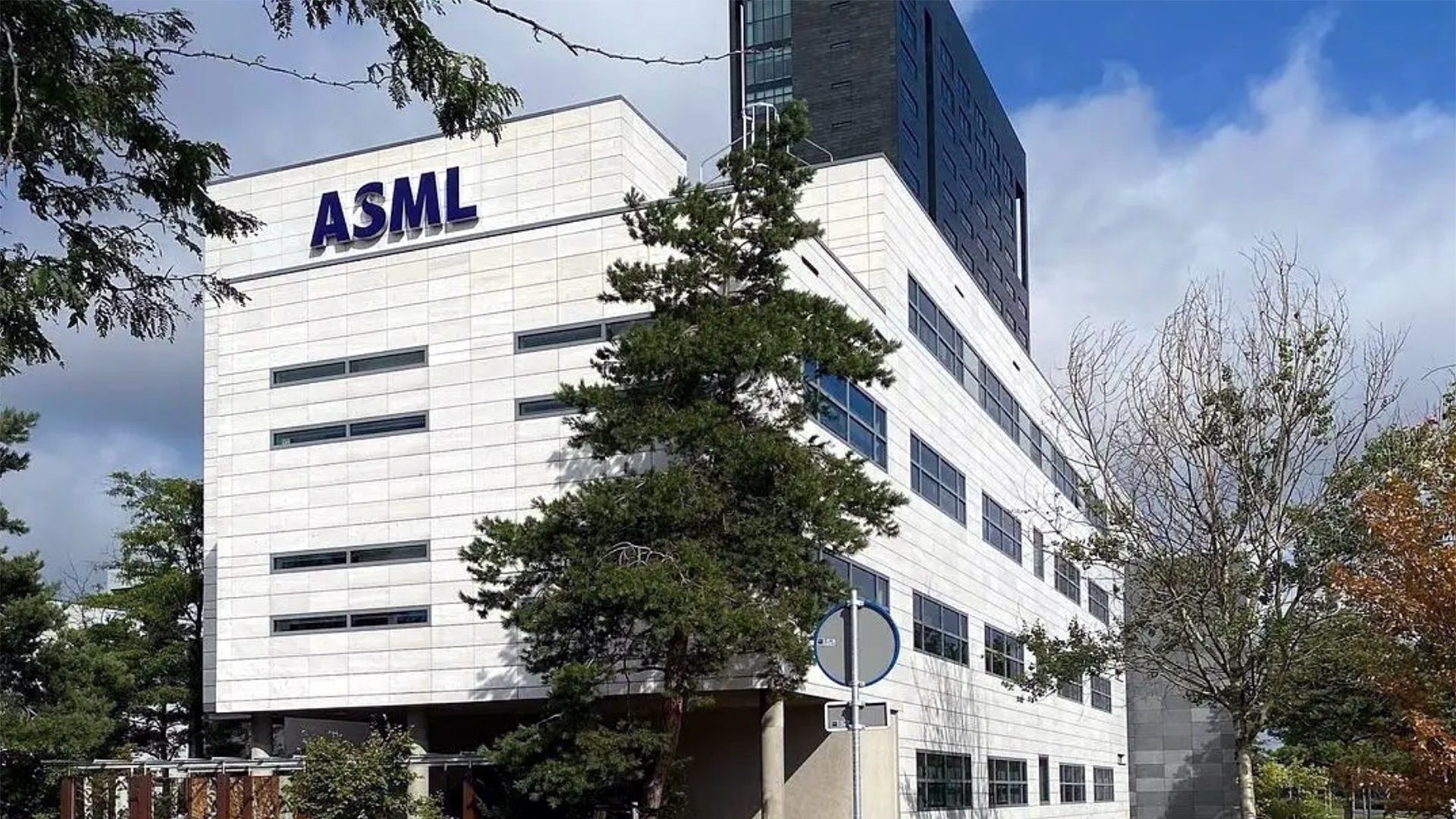
ASML, headquartered in Veldhoven, the Netherlands, is the only company in the world that manufactures EUV lithography machines. This monopoly is not the result of anti-competitive behavior but of extraordinary technical difficulty. Other companies, including Nikon and Canon (which dominate DUV lithography), abandoned EUV development after spending billions without achieving the required performance.
ASML's EUV machines, designated NXE and EXE series, represent the pinnacle of precision engineering. The NXE:3600D, used for current-generation chips, costs approximately $200 million. The next-generation High-NA EUV system (EXE:5000 series) roughly doubles the resolution capability and costs over $350 million per unit. Only a few High-NA systems have been delivered so far, primarily to TSMC, Samsung, and Intel for process development.
ASML itself is an integrator, assembling components from a global supply chain. Carl Zeiss SMT in Germany produces the mirror optics, TRUMPF provides the laser systems, and hundreds of other specialized suppliers contribute components. This deep supply chain makes EUV a truly international technology, and also a focal point of geopolitical tension.
High-NA EUV: The Next Frontier
High numerical aperture (High-NA) EUV represents the next step in lithography capability. By increasing the numerical aperture from 0.33 to 0.55, High-NA systems can print smaller features without resorting to multi-patterning. This is critical for 2nm and sub-2nm process nodes where even single-exposure EUV reaches its resolution limits.
The engineering challenges of High-NA are substantial. The larger optics required a completely new mirror design from Zeiss, and the anamorphic (non-uniform) magnification introduces new complexities in mask making. The wafer stage must also be redesigned to handle the larger optical field. Each High-NA machine weighs approximately 150 metric tons and requires over 1,000 square meters of floor space.
Early High-NA tools are being used for development and pathfinding at leading chipmakers. Volume production using High-NA is expected to begin around 2027-2028. The transition will be gradual, with High-NA used only for the most critical layers while standard EUV handles the rest.
The Geopolitical Dimension
EUV lithography has become a linchpin in the semiconductor trade war between the United States and China. Under pressure from Washington, the Dutch government imposed export controls preventing ASML from selling EUV machines to Chinese customers. Since no alternative EUV supplier exists, this effectively caps China's domestic chip manufacturing at approximately the 7nm node.
China's chipmakers, led by SMIC, have demonstrated some ability to produce 7nm-class chips using multi-patterning DUV lithography, but this approach is slower, more expensive, and lower-yielding than EUV-based manufacturing. Developing an indigenous EUV capability is one of China's highest technology priorities, but experts estimate it would take at least a decade and potentially longer to replicate ASML's technology independently.
This makes ASML, a company with roughly 42,000 employees, one of the most strategically important corporations in the world. Its technology determines which countries can participate in leading-edge chip manufacturing, with cascading effects on AI capabilities, military technology, and economic competitiveness.
The Cost and Complexity Equation
EUV lithography has enabled the semiconductor industry to continue scaling, but at an enormous cost. A single EUV machine requires approximately 1.5 megawatts of power when operating, and a leading-edge fab may contain 15 to 20 EUV systems. The consumables alone, including tin, hydrogen for mirror cleaning, and specialized pellicles to protect the reticle, add millions of dollars per year per machine.
These costs are ultimately passed on to chip buyers, which is why advanced node chip prices continue to rise even as transistor counts increase. A leading-edge chip design can cost $500 million or more in development and mask costs, creating a natural consolidation toward only the largest chip companies being able to afford the most advanced processes.
Despite these costs, EUV has proven indispensable. The alternative, increasingly complex multi-patterning with DUV, would be even more expensive and lower-yielding at sub-5nm nodes. EUV simplified the patterning process enough to keep semiconductor scaling economically viable, even if the absolute costs continue to climb.