The hum of a laboratory magnet is fading, replaced by the whisper of silicon. Imagine a world where understanding the subtle chemical decay of a battery, the freshness of your food, or even the health of your own cells happens not under a hulking microscope, but with a device that fits in your pocket.
This isn’t science fiction anymore; it’s the accelerating reality of chip-scale Electron Paramagnetic Resonance (EPR) spectroscopy.
Free radicals. They sound ominous, and often they are. These are molecules with an unpaired electron, making them twitchy, eager to snatch an electron from somewhere else. Think of them as molecular saboteurs, chipping away at materials, degrading food, and contributing to cellular damage. Antioxidants in our diet? They’re essentially the peacekeepers, neutralizing these volatile agents.
“Free radicals determine the quality of almost everything on the planet,” says Jens Anders, a pioneer in this field. And he’s not just talking about your morning coffee; he’s talking about the very stuff of our technological world – batteries that lose capacity, solar panels that age prematurely. The implications are colossal.
Traditionally, sniffing out these free radicals meant lugging around massive, room-filling EPR spectrometers, anchored by behemoth electromagnets. Now, thanks to ingenious engineering and the relentless march of miniaturization, the whole shebang is being squeezed onto a chip.
The Chip-Scale Revolution: Bringing the Lab to the Field
Researchers across California, Germany, and now France are racing to shrink this powerful analytical technique. The latest contender is a team from France’s CEA-Leti and CEA-IRIG, who recently unveiled a potentially lightning-fast approach to chip-scale EPR at the IEEE International Solid-State Circuits Conference. But they’re not alone; competitors are also pushing the envelope, aiming for supersensitive, real-time results.
How does this wizardry work? EPR spectroscopy is like a finely tuned detector for the magnetic properties of those unpaired electrons in free radicals. In the old-school machines, a sample sits between the jaws of a giant electromagnet, lining up these spins. Then, a secondary, oscillating magnetic field is applied, essentially ‘pinging’ the spins. When the frequency of this ping matches the resonant frequency of the unpaired electron, you get a signal – a signature of the free radical.
The clever trick with chip-scale EPR? Instead of a giant sweeping magnet, they use a small, static magnet and instead sweep the frequency of the oscillating field. Think of it like tuning a radio. The chip’s circuitry then listens for those resonant ‘notes’ sung by the free radicals.
Speed Kills (the Wait Time)
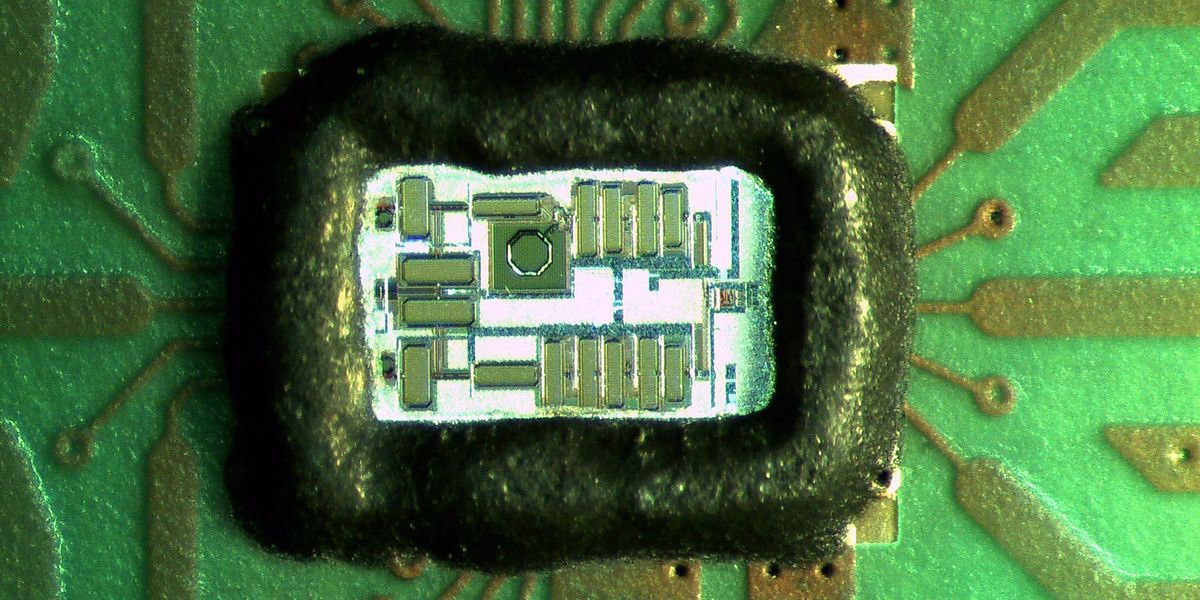
The CEA-Leti team is pushing this even further. Their new chip, a mere 4.4 square millimeters, employs a method called injection-locked phase detection. This isn’t just an incremental speed-up; it’s a leap. They claim their system can sweep through its detection bandwidth in a mere 200 nanoseconds – that’s 1,400 terahertz per second, three times faster than existing systems. Why does this breakneck speed matter? Because lingering on a single frequency can muddy the waters, drowning out faint signals. For applications where chemical changes happen in the blink of an eye, like monitoring a rapidly discharging battery, this speed is transformative.
This isn’t just about raw speed, though. The sensitivity remains remarkably high, capable of detecting micromolar quantities of free radicals in samples as tiny as 10 nanoliters. This is like being able to detect a single whisper in a crowded stadium.
The ‘O.G.’s’ Paved the Way
It’s important to acknowledge the pioneers. Jens Anders, often called one of the ‘O.G.s’ of chip-scale EPR, was developing portable versions a decade ago. His early work at the University of Stuttgart laid the foundational principles, often involving a voltage-controlled oscillator and an inductor to generate that crucial sweeping magnetic field. Most subsequent chip designs have iterated on this core idea.
But as Jean-Baptiste David of CEA-Leti points out, the feedback loop inherent in these designs can limit the sweep speed. This is where the new injection-locked oscillator (ILO) approach comes in – a paradigm shift designed to overcome those previous speed ceilings.
The Big Picture: A Platform Shift in Sensing
This isn’t just another incremental improvement in lab equipment; this is a platform shift. We’re witnessing the birth of a new class of ubiquitous chemical sensors. Imagine industrial quality control stations that can instantly flag deviations, medical diagnostic tools that can spot early signs of disease at the point of care, or even consumer products that self-monitor their own degradation. This technology has the potential to democratize sophisticated chemical analysis, moving it from specialized labs into the hands of anyone who needs it, anywhere.
It’s like moving from mainframe computers to the personal computer revolution, but for chemistry. The implications for materials science, environmental monitoring, food safety, and even personalized medicine are staggering. We’re on the cusp of understanding and managing the molecular world with an unprecedented level of detail and immediacy.
Why Does This Matter for Developers?
For developers working on embedded systems, IoT devices, and even mobile applications, this miniaturization opens up a universe of possibilities. Imagine integrating these sensors into drones for environmental surveying, wearable health monitors that track oxidative stress in real-time, or smart packaging that signals food spoilage directly to your smartphone. The demand for sophisticated sensing capabilities is exploding, and chip-scale EPR is poised to be a key enabler. Understanding the underlying principles and the potential applications will be critical for those building the next generation of intelligent devices.
Will This Replace My Job?
It’s unlikely that chip-scale EPR will directly ‘replace’ jobs in the traditional sense. Instead, it will augment human capabilities and create new roles. Analysts and scientists will be able to perform more complex analyses in the field, freeing up lab time for more in-depth research. New job opportunities will emerge in the development, deployment, and interpretation of data from these new sensing technologies. Think of it as a powerful new tool that empowers professionals rather than making them obsolete.
What Does Chip-Scale EPR Actually Do?
Chip-scale EPR is a miniaturized version of Electron Paramagnetic Resonance spectroscopy. It allows scientists to detect and identify free radicals – molecules with unpaired electrons that are highly reactive and can cause degradation in materials, food, and biological systems. This technology shrinks bulky lab equipment onto a small chip, enabling portable and real-time analysis outside of traditional laboratory settings.
How Fast is the New Chip-Scale EPR Technology?
The latest chip-scale EPR technology, developed by CEA-Leti, claims to be significantly faster than previous iterations. It is designed to sweep through its detection bandwidth in just 200 nanoseconds, or 1,400 terahertz per second. Researchers state this is up to three times faster than competing systems, enabling quicker detection of fast-changing free radical concentrations.
Where Can Chip-Scale EPR Be Used?
The applications for chip-scale EPR are vast and growing. They include monitoring battery degradation, assessing the aging of photovoltaic panels, ensuring food quality and freshness, and potentially in medical diagnostics to detect signs of oxidative stress. Essentially, any field where understanding the presence and concentration of free radicals is important can benefit from this portable technology.