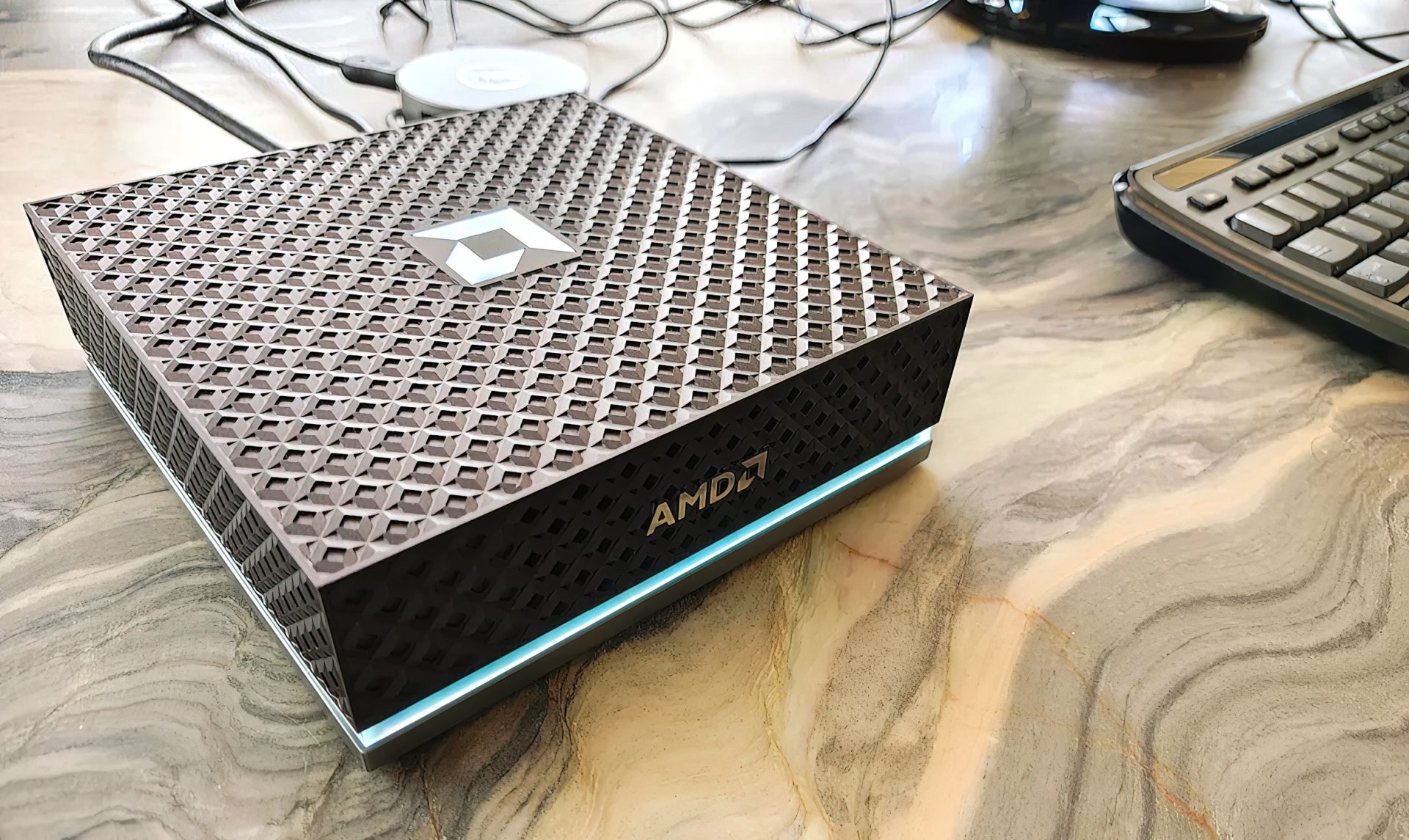
Alright, folks, gather ‘round. For years, the AI development scene has been largely dominated by NVIDIA’s monolithic DGX systems – hulking beasts that cost more than a decent car, designed to chew through training data and spit out intelligent models. The expectation? More of the same, just bigger, faster, and with an even more ludicrous price tag. Then, like a whisper in the silicon halls, AMD starts talking about a Mini PC. A Mini PC for AI development. Yeah, I raised an eyebrow too.
It’s called the Ryzen AI Halo, and AMD apparently wants it out the door by June. They showed it off recently, and the word on the street is it’ll pack their top-tier Ryzen AI MAX+ 395 System-on-Chip (SoC). Now, I’ve seen plenty of these ‘developer platforms’ come and go. Most are just rebranded consumer hardware with a sticker that says ‘AI Dev Kit’ and a hefty markup. The question, as always, is who’s actually making money here and for whom is this really built?
Is This Tiny Box Really an NVIDIA DGX Spark Competitor?
AMD’s narrative positions this Halo as a direct challenger to NVIDIA’s DGX Spark. Let’s call a spade a spade: the DGX Spark isn’t exactly in Best Buy’s impulse buy section. We’re talking $4,699 for a 128GB LPDDR5X configuration. AMD’s offering, with its fancy Ryzen AI MAX+ 395 SoC, Zen 5 CPU, RDNA 3.5 GPU, and XDNA 2 NPU — all the buzzwords, check! — is reportedly targeting a price point between $2,000 and $3,000. That’s still a chunk of change, but it’s half the price of the DGX Spark. It’s small, it’s supposed to be powerful, and it’s coming with ROCm support – AMD’s answer to CUDA, which is still a work in progress, let’s be honest.
Here’s the real kicker: AMD says it’ll have ‘Day 0 support for leading AI models.’ That’s a bold claim. For years, developers have lived and died by NVIDIA’s ecosystem. Getting timely support, optimized libraries, and a stable platform is paramount. AMD has been inching closer, but ‘Day 0’ feels like marketing bravado until proven otherwise.
On paper, the AMD Ryzen AI Halo is designed as an AI Developer Platform, similar to NVIDIA’s DGX Spark, which is designed to accelerate AI development and AI workflows.
I’ve been covering this industry for two decades, and ‘developer platform’ is often code for ‘expensive hardware that might work for you if you’re willing to do all the heavy lifting.’ What worries me is the ‘Mini PC’ form factor. AI workloads, especially training large models, are power-hungry beasts. You’re talking about massive datasets, parallel processing, and heat. Cramming all that into a ‘small form factor’ with a ‘dual-fan cooling solution’ sounds… ambitious. We’ve seen plenty of powerful mini-PCs struggle with sustained loads, throttling performance when it matters most. Can this thing actually deliver the horsepower needed for serious AI development without melting into a puddle of silicon?
Who’s Actually Buying This Thing?
AMD is throwing around names like LM Studio, ComfyUI, and VS Code, along with models like GPT-OSS and SDXL. These are real tools, real applications. This isn’t just for hobbyists playing with prompts. However, the price point suggests it’s not for your average home user either. It’s squarely aimed at the ‘SFF AI users’ and developers. But how many developers are truly going to ditch a mature, albeit expensive, NVIDIA ecosystem for a new AMD platform in a compact box? That’s the million-dollar (or rather, the $2,500-dollar) question.
Look, AMD has been trying to crack the AI market for a while. They’ve got the raw silicon power, no doubt. The Zen 5 cores, RDNA 3.5 graphics – they’re competitive. But building an ecosystem takes more than just powerful hardware. It takes developer mindshare, strong software support, and a track record of reliability. Right now, NVIDIA owns that space. This Ryzen AI Halo could be a fantastic piece of kit for a niche audience, or it could be another footnote in AMD’s long quest to dethrone the GPU king. The fact that they’re even mentioning DGX Spark is telling – they know who they’re up against. And honestly, the programmable LED accent bar? That’s cute, but it’s not going to convince a data scientist to switch their entire workflow.
We’ll see. June is just around the corner. I’ll be watching to see if the actual performance stacks up, and more importantly, if developers flock to it or just admire it from afar. Because at the end of the day, it’s not about the hype; it’s about who gets the job done and who gets paid doing it.
🧬 Related Insights
- Read more: Framework’s RTX 5070 12GB: 72% More VRAM, 72% Higher Price
- Read more: Taiwan’s Chip Middlemen Strike AI Gold While Nvidia Grabs Headlines
Frequently Asked Questions
What is the AMD Ryzen AI Halo Mini PC? It’s a compact computer designed for artificial intelligence development and tasks, featuring AMD’s latest Ryzen AI MAX+ 395 SoC.
How much will the AMD Ryzen AI Halo Mini PC cost? While no official pricing has been announced, estimates place it in the $2,000-$3,000 US price range, making it significantly cheaper than NVIDIA’s DGX Spark.
When is the AMD Ryzen AI Halo Mini PC launching? AMD is expected to launch the Ryzen AI Halo Mini PC in June.