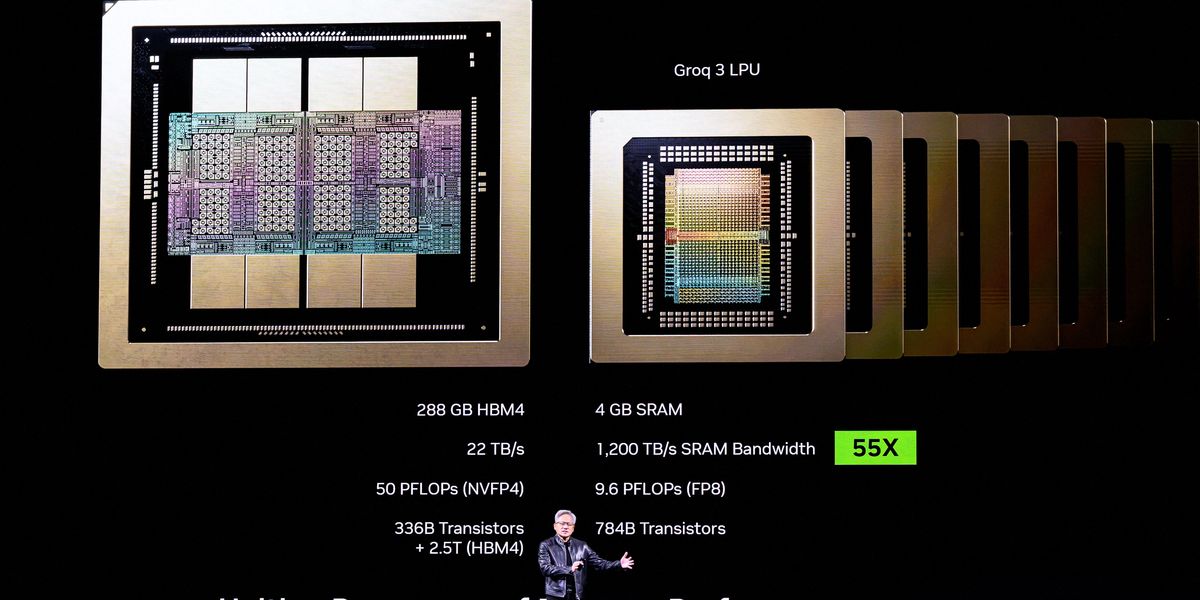
Everyone showed up at Nvidia’s GTC expecting the usual fireworks: bigger, badder GPUs for training ever-larger AI models, the Rubin series stealing the spotlight with its 288 GB of HBM and 50 petaFLOPS of compute muscle. But Jensen Huang flipped the script. He rolled out the Nvidia Groq 3 LPU, a chip laser-focused on AI inference—the unglamorous workhorse that actually delivers answers to your queries.
This changes everything. Inference isn’t some side quest anymore; it’s the main event as AI scales from lab toys to real-world drudgery.
Huang nailed it on stage: > “Finally, AI is able to do productive work, and therefore the inflection point of inference has arrived. AI now has to think. In order to think, it has to inference. AI now has to do; in order to do, it has to inference.”
Spot on. Training guzzles data in massive parallel batches, weeks on end with backpropagation churning through gradients. Inference? It’s on-demand, real-time—your ChatGPT prompt hits, and boom, low-latency tokens must fly out, often through chains of reasoning steps before you even see a word.
Nvidia didn’t invent this need. Startups exploded in a Cambrian burst: D-Matrix with in-memory digital tricks, Etched’s transformer ASICs, RainAI’s neuromorphic bends, EnCharge’s analog sorcery, Tensordyne’s log-math hacks, FuriosaAI’s tensor tweaks. Then, Christmas Eve last year, Nvidia drops $20 billion to license Groq’s IP. Two and a half months later? Groq 3 LPU bows at GTC. Urgency screams from the timeline.
How Does Groq’s SRAM Black Magic Actually Work?
Here’s the genius—or the gamble. Traditional GPUs like Rubin slurp from high-bandwidth memory (HBM) pools off-chip, bandwidth at 22 TB/s but bogged by fetch-fetch-return loops. Groq 3? It weaves SRAM right into the processor fabric—500 MB on-die, sure, less than Rubin’s ocean—but data streams linearly, no detours.
Mark Heaps (ex-Groq evangelist, now Nvidia dev marketer) put it plain at Supercomputing 2024: > “The data actually flows directly through the SRAM… It all passes through in a linear order.” No chip-hopping for instructions. Just pure, 150 TB/s bandwidth velocity—seven times Rubin’s. That’s 1.2 petaFLOPS at 8-bit precision, optimized for token spew.
Compare side-by-side: Rubin hauls colossal memory for training’s parallel feasts; Groq 3 starves on SRAM but sprints on bandwidth. Inference lives or dies on latency, not peak FLOPS. This isn’t hype—it’s architecture admitting GPUs were never perfect for every AI job.
And look, Nvidia’s not alone. AWS just teased Trainium + Cerebras CS-3 mashups for ‘inference disaggregation’—prefill (parallel prompt crunch) split from decode (sequential token gen). The ecosystem’s splintering.
But Nvidia’s move? It’s validation. D-Matrix CEO Sid Sheth gloats: customers will mix silicon cocktails—GPUs for training, LPUs for serving, slotted into racks without rewiring data centers.
Why Did Nvidia Bet $20 Billion on Groq?
Cash that big doesn’t flow without a why. Inference costs are ballooning—deploying behemoths like GPT-4 at scale chews more compute than training them, thanks to billions of daily inferences. Data centers groan under the load; latency kills user love.
Groq’s interleaving processors-with-memory echoes old-school DSPs from the 90s mobile boom—lean, task-specific chips that outran generalists. My unique take: this mirrors ARM’s rise against x86. GPUs ruled training like Intel owned desktops, but inference demands mobile-like efficiency. Bold prediction—by 2027, inference racks will be 70% specialized silicon, Nvidia peddling a portfolio, not a monolith. Their PR spins ‘next-gen Vera Rubin’ as the star, but Groq 3’s the quiet killer, diluting GPU purity for hybrid wins.
Skeptical? Fair. SRAM density caps scale—Groq 3’s 500 MB won’t hoard contexts like Rubin’s HBM. But for low-latency serving? Perfect. And as models ‘think’ more (chain-of-thought, anyone?), inference cycles explode, favoring this linear dash.
The shift’s tectonic. AI’s not just bigger-is-better; it’s about deployment at planetary scale. Training plateaus as data dries up—synthetic sets help, but inference is the forever tax.
Startups rejoice. Groq validates their explosion; d-Matrix, Etched et al. now have Nvidia’s co-sign. But watch the consolidation—Nvidia’s $20B buy signals the end of pure-play inference unicorns. They’ll get ingested or sidelined.
Will Inference Chips Kill the GPU Empire?
Not yet. Rubin still crushes training, and hyperscalers love unified stacks. But monoculture cracks. Imagine data centers as inference orchestras—LPUs for chat, neuromorphics for edge, ASICs for specifics. Nvidia’s playing conductor, but AWS/Cerebras lurk.
Huang’s stage rhetoric? Pure theater—“AI has to do” sells the vision, glossing power walls and heat. Real talk: inference efficiency dictates who monetizes AI first. Groq 3 positions Nvidia to own it.
This LPU isn’t a toy. It’s the pivot where AI graduates from science project to sweatshop laborer.
**
🧬 Related Insights
- Read more: Apache’s Responsible AI Push: The Unsung Heroes Powering AI’s Open Future
- Read more: ENIAC at 80: Weavers Who Wove Computing’s First Tales
Frequently Asked Questions**
What is Nvidia Groq 3 LPU?
Nvidia’s Groq 3 is an inference-optimized chip using on-die SRAM for ultra-low latency token generation, licensed from Groq for $20B—distinct from power-hungry training GPUs like Rubin.
How does Groq 3 compare to Nvidia Rubin GPU?
Groq 3 trades massive HBM (500 MB SRAM) for 150 TB/s bandwidth vs. Rubin’s 22 TB/s, excelling at real-time inference over training’s parallel compute.
Why is AI inference suddenly a big deal?
As AI models deploy at scale, inference—handling live queries—surpasses training costs, demanding speed that general GPUs struggle with.