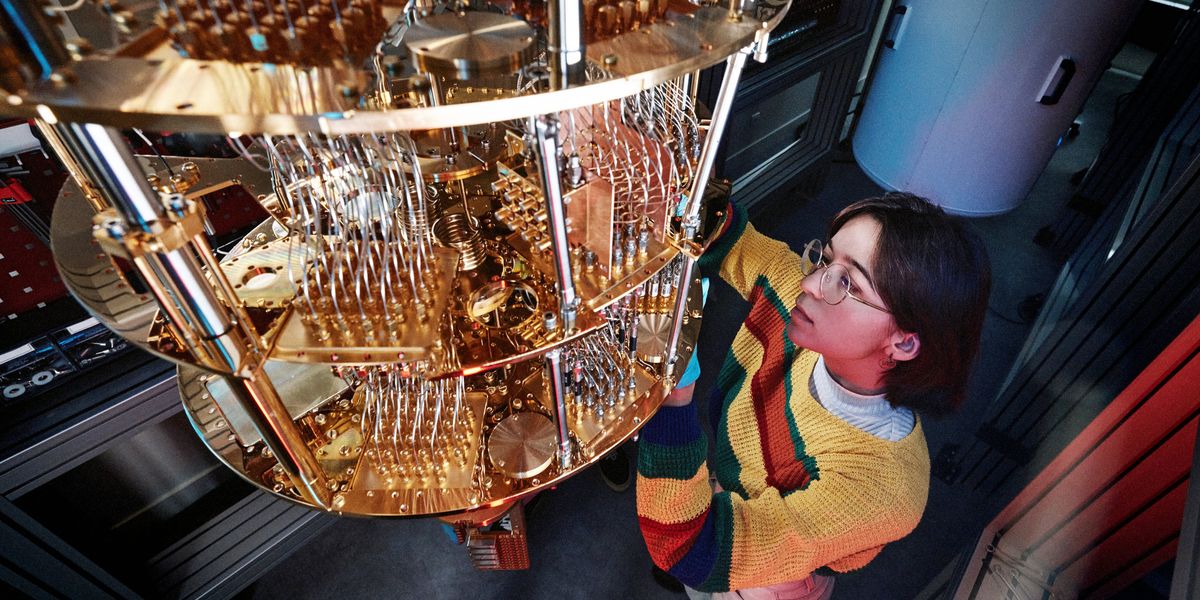
Is the magic bullet for the global magnet supply chain hiding in the bizarre realm of quantum mechanics? It’s a question many might not have considered, yet it’s central to everything from electric vehicles to wind turbines.
For over a decade, the industry has been chasing an elusive prize: a permanent magnet that packs the punch of rare earth elements but avoids the geopolitical headaches and supply chain bottlenecks tied to China’s near-monopoly. The value proposition is immense; an “ideal” magnet would instantly redraw global economic and strategic maps.
And here’s the kicker: no fundamental physics forbid its existence. Yet, despite the best minds and most powerful conventional supercomputers banging their heads against the problem, this super-magnet remains just out of reach.
This is where quantum computing, specifically a project involving Alice & Bob, Los Alamos National Laboratory, and GE Vernova, funded by $3.9 million from the U.S. Department of Energy’s ARPA-E, enters the picture. Their hypothesis? That the very quantum nature of magnetism requires a quantum solution.
The Reign of Neodymium (For Now)
Today, neodymium iron boron (NdFeB) reigns supreme. It’s the undisputed champion in high-power applications, vastly outperforming its more than 67,000 known magnetic compound competitors. Conventional computers have been fed the data, crunched the numbers, and simulated countless possibilities for fifteen years, yielding precisely zero commercially viable alternatives. The problem isn’t a lack of computing power; it’s the sheer, mind-boggling complexity of simulating magnetic properties at the atomic level.
Permanent magnetism, at its core, is about aligning electron spins. Think of it like tiny quantum compasses all pointing in the same direction. Iron and cobalt, with their unpaired 3d electrons, provide a good start. But to get toNdFeB’s elite performance, you need the magic ingredient: rare earth elements like neodymium, praseodymium, and dysprosium. These elements, with their unpaired 4f electrons, dramatically enhance magnetic anisotropy—essentially, they lock those electron spins into their desired orientation, making the magnet stubbornly resistant to demagnetization (that’s coercivity for you).
The challenge for conventional computers isn’t just tracking individual electron spins; it’s simulating the interactions between them. Each electron’s behavior is deeply entangled with its neighbors, creating a cascading effect that explodes the computational space. As Théau Peronnin, CEO of Alice & Bob, puts it:
The emergent global properties [such as magnetism] arise from the local behavior of each electron. But each electron’s behavior is highly, highly correlated with how its neighbors behave. And this is what makes the problem extremely difficult, because you cannot treat each of those electrons individually. You need to treat the whole system with all its possible configurations all at once to predict the global properties. And this is where the computing space explodes.
Peronnin underscores the combinatorial explosion: “You have to consider all the possible superpositions of states of those electrons… It’s 2 to the—I don’t know—40th or 50th power. It’s absolutely tremendous.”
Why Does Quantum Computing Offer Hope?
This is where quantum computers, theoretically, shine. Unlike classical bits (0 or 1), quantum bits (qubits) can exist in superposition (both 0 and 1 simultaneously) and can be entangled, meaning their fates are linked regardless of distance. This allows quantum computers to explore an exponentially larger number of possibilities concurrently. For a problem defined by the correlated behavior of a vast number of quantum states, this parallel processing capability is precisely what’s needed.
Imagine trying to map out every possible arrangement of a massive, interconnected network of dominoes simultaneously falling. A classical computer would have to trace each domino’s fall sequentially, or in limited parallel batches. A quantum computer, in theory, could explore vast swathes of those falling sequences all at once. That’s the promise for simulating the complex electron interactions that govern magnetic properties.
Is This Just Hype or a Genuine Path Forward?
This isn’t the first time quantum computing has been touted as a solution to intractable simulation problems. The field of computational chemistry, for instance, has long looked to quantum machines for breakthroughs in drug discovery and materials science. However, we’re still in the nascent stages of quantum hardware development. Current quantum computers are prone to decoherence (losing their quantum state due to environmental interference) and are limited in the number of stable, interconnected qubits they can reliably manage. Alice & Bob, known for their focus on superconducting qubits and error correction, are certainly at the forefront, but scaling these machines to tackle problems of this magnitude remains a significant engineering hurdle.
The $3.9 million in funding from ARPA-E signals serious interest from government agencies concerned about supply chain security and technological independence. The hope is that by accurately simulating potential rare-earth-free magnet compounds, researchers can bypass the trial-and-error that has thus far proven fruitless with classical methods. If successful, this project could indeed accelerate the discovery of a new generation of magnets, fundamentally altering the landscape for renewable energy technologies, defense systems, and consumer electronics.
However, we must temper our enthusiasm with a dose of reality. The journey from a quantum simulation promising a novel magnet to a commercially viable, mass-produced material is long and arduous. It requires not only theoretical breakthroughs but also significant advancements in materials science and manufacturing processes. We’re talking about a potential paradigm shift, but paradigm shifts rarely happen overnight.
The implications for geostrategy are undeniable. Reducing reliance on a single nation for critical materials is a national security imperative for many countries. A breakthrough here would empower diversification and resilience in global supply chains. It’s a high-stakes game, and quantum computing, for all its current limitations, represents a compelling new gambit.
🧬 Related Insights
- Read more: Intel’s TSNC SDK: 18x Texture Shrinkage, NVIDIA Envy Incoming?
- Read more: HWMonitor and CPU-Z Downloads Serve Up Malware—Official Links Compromised
Frequently Asked Questions
What is the main problem with current rare earth magnets?
The primary issue is that China holds a near-monopoly on the mining and processing of rare earth elements, leading to supply chain vulnerabilities and geopolitical concerns.
How could quantum computers help find new magnets?
Quantum computers can simulate the complex interactions of electrons within materials far more efficiently than classical computers, potentially allowing researchers to predict the magnetic properties of novel, rare-earth-free compounds before synthesizing them.
When will we see rare-earth-free magnets in products?
It’s difficult to say definitively. While quantum computing offers a promising new avenue, significant advancements in both quantum hardware and materials science are still required before a commercially viable rare-earth-free magnet becomes widespread. It could be years, if not a decade or more.