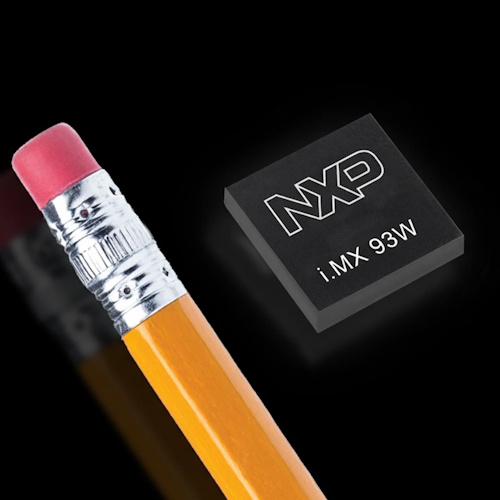
And the pencil. Don’t forget the pencil. Because on the surface, NXP’s new i.MX 93W applications processor, launched with much fanfare and a surprisingly effective visual aid—a humble No. 2 pencil—might seem like just another silicon upgrade. But peel back the layers, and you’re looking at something far more fundamental: the undeniable surge of physical AI. We’re talking intelligence unchained from distant server farms, now actively living and breathing within the devices that surround us.
It’s a platform shift. A seismic event masquerading as a chip announcement. NXP, a name long associated with the nuts and bolts of our connected world, has just put a stake in the ground, declaring that the era of embedded, always-on intelligence is no longer a sci-fi dream but a tangible reality, as graspable as… well, a pencil.
The conversation with Kyle Fox, NXP’s Senior Director, was electric, not just because he was showcasing a marvel of miniaturization, but because he was articulating a vision. He held up that No. 2 pencil, an object so mundane it’s almost invisible, and pointed to the i.MX 93W. The implication? This tiny chip is doing the work of a whole server rack, but it fits in the palm of your hand. It’s the ultimate distillation of computational power.
Kyle described it as a “just add water” experience. And that’s the magic here. Historically, building an intelligent edge device meant a maddening scavenger hunt for components: a chunky applications processor, a separate AI accelerator that felt like a bolted-on afterthought, Wi-Fi modules, Bluetooth modules, 802.15.4 radios, a graveyard of RF support components, and then, the soul-crushing marathon of certifications. It was a developer’s nightmare, a cost nightmare, a deployment nightmare.
NXP’s i.MX 93W throws a Molotov cocktail at that entire convoluted process. It integrates the CPU, a dedicated Neural Processing Unit (NPU) for all your AI heavy lifting, and tri-band radio capabilities into a single, elegant package. Think of it like this: instead of building a car from scratch with separate engine, transmission, and entertainment system components—each requiring its own engineering team and compatibility checks—NXP has built you a high-performance, integrated vehicle ready to hit the road.
This isn’t just about efficiency; it’s about democratizing AI. When the hardware becomes this accessible, the software follows. Developers can finally focus on building amazing experiences rather than wrangling the plumbing. The barriers to entry for creating truly smart devices are crumbling.
And let’s be clear: this isn’t just some glorified microcontroller trying to punch above its weight. As Kyle rightly pointed out, this is a high-end applications processor, capable of running a full Linux environment like Ubuntu. This means it can handle complex tasks, sophisticated algorithms, and strong operating systems, all while making intelligent decisions at the edge.
“We spent hours trying to decide on something that everybody could recognize, trying all sorts of things like coins and paper clips before eventually settling on a number two pencil.”
This quote from Kyle Fox isn’t just about marketing savvy; it’s about understanding the sheer density of innovation packed into this chip. The pencil, a symbol of basic human communication and creation, is now juxtaposed with a device that promises to usher in an age of unprecedented artificial intelligence in our physical world.
What’s truly exciting here is the acceleration of physical AI. We’re not talking about chatbots that live on your phone anymore. We’re talking about robots that can navigate your home with uncanny precision, smart appliances that truly understand your needs, and industrial systems that can predict and prevent failures before they happen. It’s intelligence woven into the fabric of our lives, responding in real-time, understanding context, and acting proactively.
Why Does This Matter for Developers?
For developers, this is Christmas morning. The fragmentation that has plagued edge AI development—the juggling of multiple chips, the constant battle for power efficiency, the endless certification hoops—is dramatically reduced. The i.MX 93W acts as a massive unblocker. Imagine prototyping complex AI applications for robotics or home automation in days, not months. Imagine deploying these devices with confidence, knowing that the core intelligence is integrated, optimized, and ready to go. This chip is a direct pipeline from imagination to deployment. It’s the equivalent of going from hand-cranking an engine to pressing a start button.
Is This Truly “Just Add Water” AI?
While the phrase “just add water” is a brilliant piece of marketing shorthand, it hints at a deeper truth: NXP is aiming for an unprecedented level of integration and ease of use in the physical AI space. By bundling the CPU, NPU, and crucial radio frequencies into a single silicon solution, they are dramatically simplifying the hardware design process. Developers will still need to write software and design the surrounding system, but the foundational complexity of integrating AI and connectivity is significantly abstracted. It’s like buying a high-performance engine for your custom car project instead of sourcing every piston and valve individually.
This shift to physical AI, spearheaded by chips like the i.MX 93W, isn’t just an incremental improvement; it’s the next logical step in how we interact with technology. We’ve moved from mainframes to desktops, from desktops to mobile, and now, we’re moving into an era where intelligence is as pervasive and as essential as the air we breathe. The pencil on the desk is no longer just a tool for writing; it’s becoming a gateway to a smarter, more responsive world.
🧬 Related Insights
- Read more: What is a GPU vs CPU? Understanding the Core of Computing Power
- Read more: Aitech’s U-C860X: Battlefield AI Without the Buzzword Bloat
Frequently Asked Questions
What does the NXP i.MX 93W processor actually do?
The i.MX 93W is an applications processor that combines a central processing unit (CPU), a dedicated AI neural processing unit (NPU), and tri-band radio capabilities on a single chip, enabling intelligent functions directly in edge devices.
Will this chip replace my job as a developer?
No, this chip is designed to empower developers. By integrating complex AI and connectivity hardware, it allows developers to focus on building innovative applications and user experiences rather than managing complex hardware integration.
How does this differ from other AI chips on the market?
The i.MX 93W stands out for its integration of a high-performance CPU, a dedicated NPU, and tri-band radio all in one package, targeting a “just add water” approach for physical AI, simplifying development for a wide range of edge applications.