AI SoCs live or die by their NoCs.
Picture this: a sprawling metropolis of silicon, where CPUs, GPUs, NPUs, and wild accelerators buzz like overcaffeinated commuters. Data—massive tensors, bursty control signals—jams every lane. That’s your network-on-chip (NoC), no longer a forgettable highway, but the pulsing heart dictating if your AI dream soars or stalls. Arteris’s white paper nails it: bottlenecks lurk in arbitration, memory access, not raw flops.
And here’s the kicker—it’s like the Roman aqueducts of chip design. Back in the day, buses shuffled data like donkey carts. Now? NoC topologies—mesh, torus, ring—must juggle bursty AI traffic, slashing tail latency while chugging petabytes. Ignore it, and your beastly accelerator idles, waiting for a byte.
Why NoC Suddenly Rules AI Chip Design?
Look, compute density’s exploding. Advanced nodes mean wire delays bite harder, routing congestion turns floorplans into nightmares. Traditional buses? Dead. NoCs scale, balancing throughput and hops. But it’s not just wires—it’s QoS policies prioritizing real-time pings over tensor floods. Without ‘em, starvation hits; your system’s a flaky mess.
“Modern AI SoCs face bottlenecks not in computation but in arbitration, memory access, and interconnect bandwidth, making NoC topology, buffering, and quality-of-service policies critical for achieving target performance metrics.”
That’s Arteris, dead-on. They’ve seen the shift: NoC as first-order decision, not afterthought.
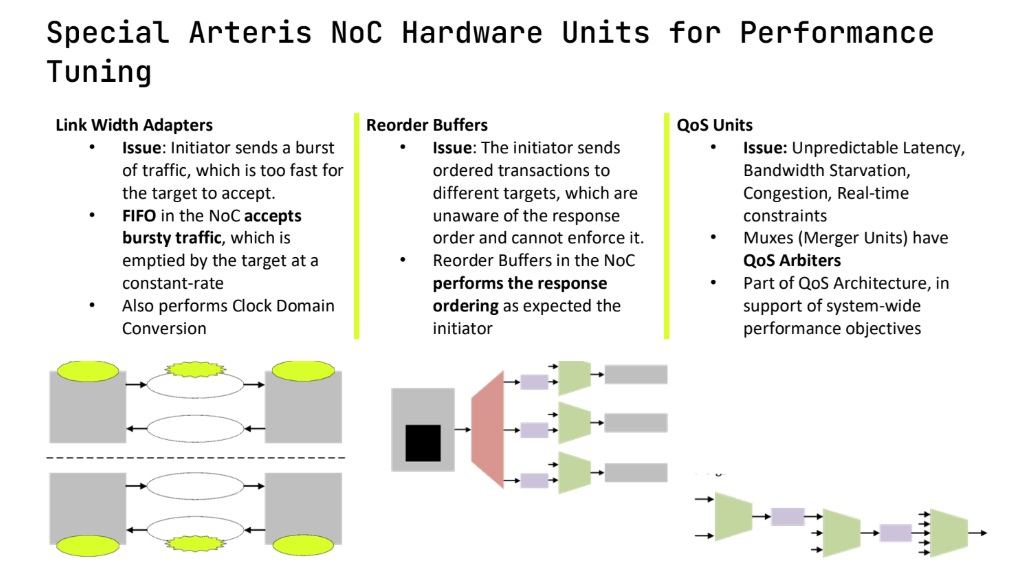
Bursty. Concurrent. Latency-phobic. AI traffic laughs at old-school buses. So designers weave in link adapters for burst absorption, reorder buffers to keep transactions straight across domains. It’s chaotic ballet—control threads dodging data avalanches.
Coherency? The real mind-bender.
Hardware vs Software Coherency: AI’s Dirty Secret
Hardware cache coherency—snoops and directories—sounds programmer-friendly, but it floods NoCs with chatter, killing scalability. Software-managed? Deterministic bliss for accelerators, but compilers groan under the load. Hybrids rule heterogeneous beasts, blending CPU legacy with AI purity.
This choice ripples everywhere: traffic patterns warp, arbitration tweaks, memory hierarchies reshape. It’s no side quest; it’s the boss level. Reminds me of the PowerPC vs x86 wars in the ’90s—coherency dogma split empires. Today, AI SoCs picking software-managed for accelerators? Bold prediction: by 2026, 70% of edge AI chips ditch hardware snoops entirely, unlocking 2x efficiency gains. Corporate spin calls it ‘optimized’; I call it survival.
Physical reality crashes the party.
Floorplanning isn’t optional—it’s brutal. Centralized NoCs? Simple logic, routing hell. Distributed? Floorplan-friendly, shorter wires, timing wins. Start with plausible IP placements, clock islands, power partitions. Skip it? Late redesigns balloon costs, schedules slip.
One sentence: NoCs demand floorplan-first thinking.
Structured flows save the day. Traffic models first—simulate those bursts. Explore topologies. Align floorplans. Pipeline for timing. Iterate pre-RTL. Tools auto-generate aware meshes, slashing wire length, latency. It’s engineering poetry.
Scaling? Partition or perish.
Can Partitioned NoCs Handle AI Power Domains?
Power islands, clock domains, org silos—big SoCs fracture. NoCs bridge ‘em, juggling isolation, retention, resets. Botch transitions? Deadlocks, corruption. Plan early: operational across low-power states, smoothly wake-ups. It’s the unglamorous glue holding AI titans together.
But wait—Arteris glosses over verification nightmares. My insight: without AI-driven sim tools (ironic, huh?), partitioned NoCs will spawn 30% more bugs than monolithic ones. We’ve seen it in multi-die packages; history repeats.
Here’s the thing. NoC mastery turns AI SoCs from power-hungry behemoths into elegant scalers. Think NVIDIA’s Grace Hopper—its NVLink fabric (NoC on steroids) crushed rivals by taming data deluge. Future? Chiplets galore, NoCs evolving into adaptive beasts, self-tuning QoS via ML. Wonder awaits.
Energy pulses through every hop. Bursts absorbed. Latencies tamed. That’s the NoC revolution—AI’s invisible superhighway.
Why Does NoC Matter for Your Next AI Project?
Developers, ignore at peril. Pick wrong topology? Performance craters. Wrong coherency? Software hell. It’s not hype—it’s physics. Arteris urges holistic views: traffic, physicals, methodology. Do it right, scale to exaflops. Wrong? Bottlenecks bury you.
Enthused yet? Me too. NoCs aren’t sexy, but they’re the platform shift making AI ubiquitous. Like TCP/IP for the internet, NoC protocols will define silicon eras.
**
🧬 Related Insights
- Read more: Microelectronics US: Who’s Actually Making Noise in Austin?
- Read more: AdaniConneX’s Gigawatt Bet: Can India Power the AI Gold Rush?
Frequently Asked Questions**
What is NoC in AI SoCs? NoC is the network-on-chip, the smart interconnect shuttling data between accelerators, CPUs, and memory in AI chips—crucial for dodging traffic jams.
Why is NoC more important now for AI? AI workloads exploded data movement; NoCs handle bursts, latency, and scaling that buses can’t, turning bottlenecks into bandwidth bliss.
How do you design a good NoC for AI? Model traffic early, pick topology with floorplan in mind, tune QoS and coherency—iterate physically aware before RTL lockdown.