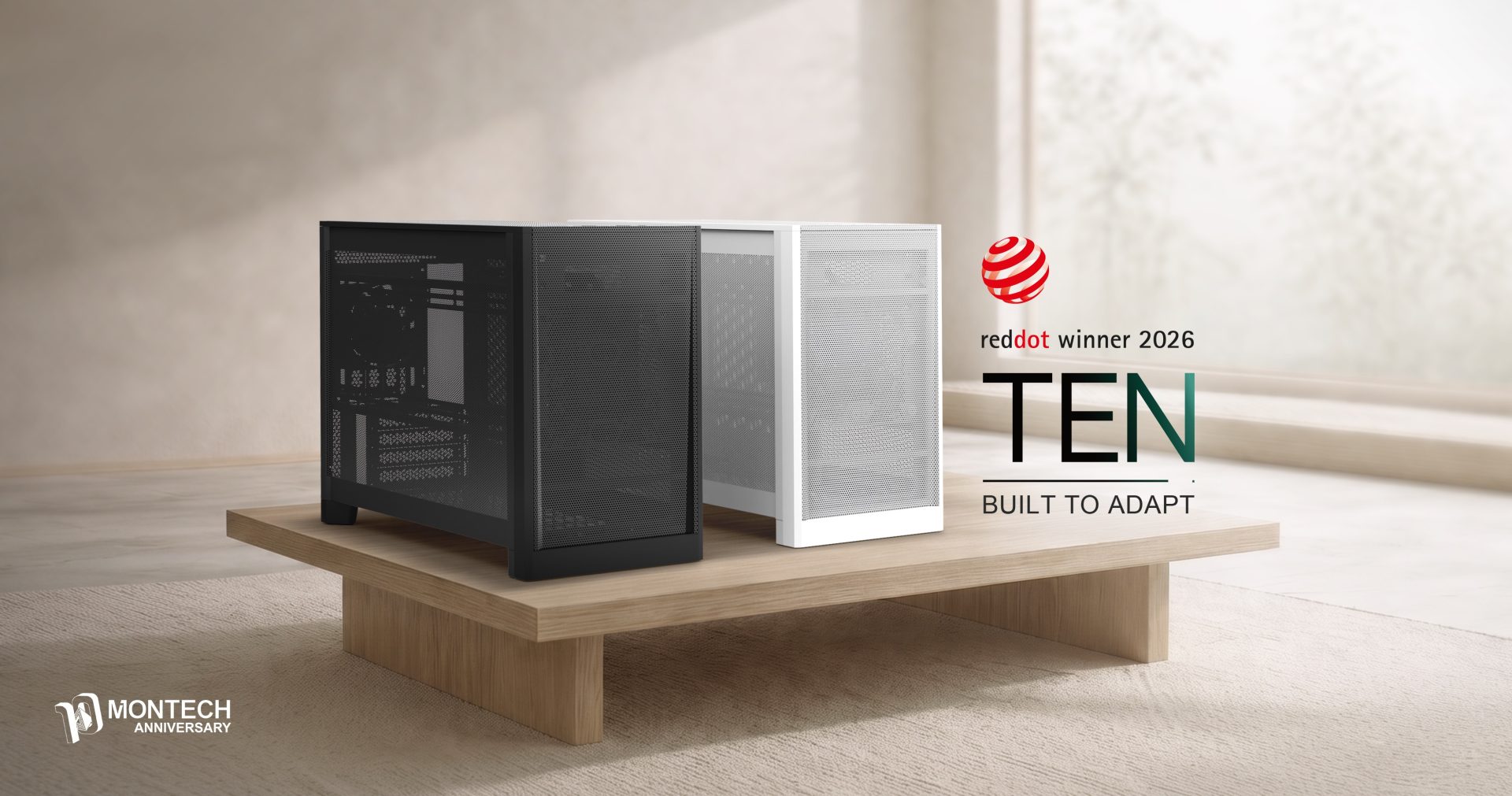
Did you know you could cram seven GPUs into a Micro-ATX case? Neither did I, until Montech decided their 10th anniversary deserved a product that screamed ‘look at us!’ The TEN case. Sixty-nine dollars. Seven GPUs. It’s either a stroke of mad genius or a cry for help from a company with too much time and not enough common sense.
Let’s call it what it is: a puzzle box for tech hoarders. Montech’s press release talks about “Build to Adapt” and three operating modes – M1, M2, and I3. Sounds fancy, doesn’t it? Basically, it means you can reconfigure the thing to either prioritize airflow, liquid cooling, or just sheer, unadulterated hardware stuffing. The “Focus Master” mode (I3, apparently) is where the madness truly lies, offering what Montech claims are nine PSU and three motherboard mounting positions. Nine PSUs. For a Micro-ATX case. My sanity is already starting to fray.
Is This Thing Even Legal?
Seriously, who needs nine power supplies for a Micro-ATX build? Unless you’re planning on powering a small city or mining enough Bitcoin to achieve personal enlightenment, this is pure absurdity. The case manages to squeeze in seven expansion slots – a number usually reserved for full-blown E-ATX behemoths. And it can swallow GPUs up to 425mm long. This isn’t just pushing boundaries; it’s setting them on fire and then hosing them down with high-RPM fans.
But here’s the rub, and where my skepticism really kicks in: the actual usability. While Montech touts “excellent airflow” and “great component compatibility,” I can practically smell the thermal throttling from here. The idea of juggling seven graphics cards, each demanding its own slice of ventilation, within the confines of a relatively small chassis feels… optimistic. Especially when the clearance for these behemoths is mode-dependent. M1 offers the most, but are we talking enough for actual, sustained operation, or just enough to slot them in for a pretty picture?
The case allows several installation positions for hardware, including 7 positions for the power supply, 3 for the motherboard, and 9 for the GPUs.
This quote from their own announcement is the headline that deserves the boldest font. It’s the statistical equivalent of a mic drop. But it also begs the question: why? Why make a Micro-ATX case that caters to a desire for absurd power delivery and GPU density that most users, even enthusiasts, wouldn’t realistically pursue? Are they expecting a sudden surge in users needing to run seven instances of Flight Simulator 2020 simultaneously across separate GPUs?
A Decade of… This?
Ten years in the PC case business. And this is what Montech celebrates with. It’s certainly memorable. It’s also a masterclass in marketing a niche product to the widest possible audience, even if that audience is primarily theoretical. It appeals to that dark corner of the internet where people compare benchmark scores achieved with ludicrous hardware configurations. It’s less about practical PC building and more about setting a Guinness World Record for ‘Most Components in a Small Box.’
My unique insight here? This isn’t about building a practical, everyday gaming rig. This is about bragging rights. It’s about creating a showpiece that says, ‘I can put more into this tiny box than you can into your entire garage.’ The $69 price point is brilliant, mind you. It lowers the barrier to entry for this kind of extreme customization, making it more accessible than, say, a $300 server chassis. But accessibility doesn’t equate to wisdom. It’s like selling a fully automatic weapon at a lemonade stand – technically possible, questionably advisable.
And let’s not forget the “build to adapt” mantra. Adapt to what? Adapting to the growing need for more power than any single component could ever reasonably require? Adapting to a world where people measure their PC’s capability by the number of PSUs it houses? It’s a concept that sounds good on paper but feels utterly divorced from the reality of PC component synergy and thermal management. Expect a lot of custom fan mounts and extensive cable sleeving just to keep things from melting.
The Verdict: A Glorious Dumb Idea?
So, is the Montech TEN a good case? For the average builder, probably not. For the enthusiast who wants to push the absolute limits of what’s physically possible in a Micro-ATX form factor, and can handle the subsequent cooling challenges (and potential electrical fire hazards), it might be a dream. Or a nightmare. At $69, it’s a cheap experiment. A dare. A proof to the fact that when you give engineers enough rope, they’ll eventually build a case capable of housing a small data center.
Montech has certainly made noise with this one. Whether that noise is applause or a warning siren remains to be heard. I, for one, am genuinely curious to see what builds emerge from this thing. Just don’t ask me to be the one troubleshooting the thermal paste degradation after month three.
🧬 Related Insights
- Read more: Syenta’s Chiplet Connect: Tackling AI’s Bandwidth Bottleneck
- Read more: AI Factories: The New Infrastructure of Intelligence
Frequently Asked Questions
What is the Montech TEN case? The Montech TEN is a $69 Micro-ATX PC case designed for extreme component density and modularity, featuring multiple configurations and support for up to seven GPUs and nine power supply units.
How many GPUs can the Montech TEN case support? The Montech TEN case can support up to seven GPUs, depending on the chosen configuration and GPU length.
Is the Montech TEN case good for gaming? It can be, for extreme niche builds. Its primary focus is on cramming in as many components as possible, which requires significant custom cooling solutions and expertise to manage effectively.