The graphics processing unit has evolved far beyond its origins as a display adapter. Today, GPUs are the engines of artificial intelligence, scientific computing, and immersive gaming. NVIDIA, AMD, and Intel each bring distinct architectural philosophies to GPU design, and understanding these differences is essential for anyone evaluating hardware for AI training, inference, or high-performance computing.
NVIDIA: The AI-First Architecture
NVIDIA's dominance in the GPU market, particularly for AI workloads, stems from a combination of architectural innovation, software ecosystem strength, and relentless execution. The company's current data center GPU architecture, Hopper (H100/H200), and its successor Blackwell (B100/B200/GB200), are purpose-built for large-scale AI training and inference.
The Hopper H100 GPU contains 80 billion transistors manufactured on TSMC's 4nm process. Its key innovation is the Transformer Engine, hardware specifically designed to accelerate the attention mechanisms and matrix multiplications that dominate modern AI models. The Transformer Engine dynamically switches between FP8 and FP16 precision during computation, maximizing throughput while maintaining model accuracy.
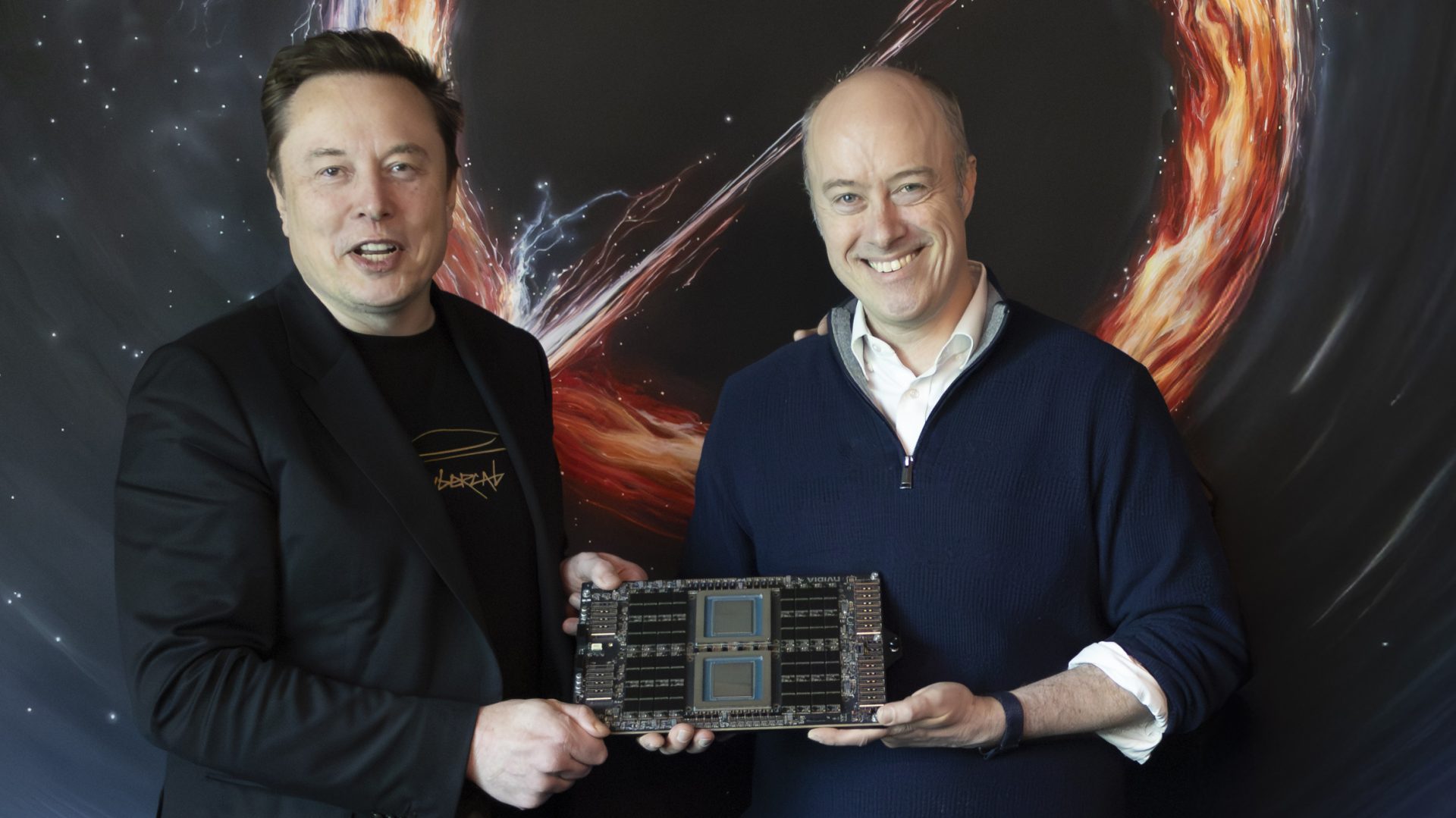
NVIDIA's Blackwell architecture, which powers the B200 and GB200 chips, pushes further with a dual-die design connected by a high-bandwidth chip-to-chip interconnect. The GB200 combines two Blackwell GPUs with a Grace ARM-based CPU in a single module, delivering up to 20 petaflops of FP4 AI performance. This level of integration is specifically designed for training and running trillion-parameter language models.
For gaming, NVIDIA's GeForce RTX series uses a related but distinct architecture optimized for real-time rendering. The Ada Lovelace architecture (RTX 4000 series) features dedicated RT cores for ray tracing, Tensor cores for AI-based upscaling (DLSS), and traditional shader cores. NVIDIA's next-generation Blackwell gaming GPUs (RTX 5000 series) add multi-frame generation, using AI to generate entirely new frames and boost apparent performance.
The CUDA Ecosystem Advantage
Hardware alone does not explain NVIDIA's dominance. CUDA, NVIDIA's proprietary parallel computing platform, has been the standard for GPU programming since 2007. Nearly every major AI framework, including PyTorch, TensorFlow, and JAX, is optimized for CUDA. This software ecosystem creates enormous switching costs: rewriting CUDA-optimized code for alternative platforms requires significant engineering investment.
NVIDIA has layered additional software on top of CUDA, including cuDNN for deep learning primitives, TensorRT for inference optimization, and NeMo for large language model development. This vertically integrated stack means that a researcher can go from model training to optimized production inference entirely within NVIDIA's ecosystem.
AMD: The Value-Performance Challenger
AMD's GPU strategy targets both the data center AI market and consumer gaming, but with a fundamentally different approach than NVIDIA. AMD's Instinct MI300X, based on the CDNA 3 architecture, is the company's flagship data center GPU and its most serious challenge to NVIDIA's AI dominance.
The MI300X stands out for its memory capacity: 192GB of HBM3 memory, compared to 80GB on the H100. For large language model inference, where model weights must fit in GPU memory, this 2.4x memory advantage allows the MI300X to run larger models without splitting them across multiple GPUs. AMD has won significant inference deployments at companies including Microsoft, Meta, and Oracle based partly on this memory advantage.
Architecturally, the MI300X uses a chiplet design, combining multiple compute dies and memory dies in a single package using advanced 2.5D packaging. This approach allows AMD to use proven compute chiplets with cutting-edge HBM memory, potentially improving yields and reducing costs compared to a monolithic design.
For gaming, AMD's RDNA architecture powers the Radeon RX series. RDNA 3 (RX 7000 series) was AMD's first chiplet-based gaming GPU, separating the graphics compute die from the memory cache dies. AMD competes aggressively on price-performance in gaming, often delivering comparable rasterization performance to NVIDIA at lower prices, though NVIDIA maintains advantages in ray tracing and AI upscaling.
The ROCm Software Challenge
AMD's biggest weakness remains its software ecosystem. ROCm, AMD's open-source alternative to CUDA, has improved substantially but still lacks the maturity, optimization depth, and third-party support of NVIDIA's platform. Many AI researchers report that code running on NVIDIA GPUs requires non-trivial modifications to run on AMD hardware, and some libraries simply do not support ROCm.
AMD has invested heavily in closing this gap, hiring CUDA-experienced engineers and contributing to open-source AI frameworks. PyTorch support for ROCm has improved markedly, and AMD has partnered with major cloud providers to ensure its GPUs are available alongside NVIDIA's. But the software gap remains AMD's primary obstacle to winning large-scale AI training deployments.
Intel: The New Entrant
Intel's discrete GPU efforts, under the Arc brand for consumers and Gaudi for data center AI, represent the company's attempt to break NVIDIA and AMD's duopoly. Intel's approach differs from both competitors, particularly in the data center where its Gaudi accelerators use a distinct architecture optimized for AI training efficiency.
The Gaudi 3 accelerator, based on technology Intel acquired with Habana Labs in 2019, takes a different approach than traditional GPUs. Rather than general-purpose shader cores, Gaudi uses dedicated matrix math engines and a flexible, software-programmable tensor processor core. Intel claims Gaudi 3 delivers competitive training performance to the H100 at a significantly lower price point.
Gaudi's architecture includes integrated networking (24 ports of 100GbE per chip), which eliminates the need for separate network adapters in multi-GPU configurations. This can simplify data center design and reduce total system cost, a meaningful advantage for cost-sensitive buyers.
For consumer gaming, Intel's Arc series (Alchemist and Battlemage architectures) targets the mid-range market. Intel's Xe GPU architecture includes hardware ray tracing support and XeSS, Intel's AI-based upscaling technology. While Arc GPUs have improved with better drivers, Intel remains a distant third in gaming GPU market share, competing primarily on value in the sub-$300 segment.
Performance Comparison for AI Workloads
Direct performance comparisons between AI accelerators are complicated by differences in software maturity, precision support, and benchmark methodology. However, some general observations hold.
- Training large models: NVIDIA's H100 and B200 lead in absolute training throughput, particularly for models using mixed-precision (FP8/FP16) training. The mature CUDA software stack and NVLink/NVSwitch interconnects enable efficient multi-GPU scaling that competitors struggle to match.
- Inference: AMD's MI300X is highly competitive for LLM inference due to its large HBM capacity. For inference workloads where the model fits in a single GPU's memory, the MI300X can match or exceed H100 throughput per dollar.
- Cost efficiency: Intel's Gaudi 3 targets the cost-sensitive segment, offering training performance in the same ballpark as H100 at a reported 40-50% lower price. Cloud providers including AWS (with Gaudi-based instances) offer Gaudi as a budget-friendly alternative.
The Competitive Outlook
NVIDIA's position remains dominant, driven by its CUDA ecosystem, consistent execution, and strong relationships with cloud providers and AI labs. However, the AI accelerator market is large enough and growing fast enough to support multiple architectures. AMD's memory advantage and improving software stack make it a credible second source, while Intel's aggressive pricing could carve out a niche among cost-conscious buyers.
The longer-term competitive dynamics may be shaped more by software ecosystem evolution than hardware specifications. If AI frameworks become more hardware-agnostic, reducing the friction of switching between CUDA, ROCm, and other platforms, NVIDIA's software moat would erode. Open standards like SYCL and Triton are steps in this direction, but displacing CUDA's entrenched position will take years.
For buyers evaluating GPU architectures, the right choice depends heavily on the workload. NVIDIA remains the safest choice for large-scale training, AMD offers compelling value for inference, and Intel provides a budget-friendly option for organizations willing to invest in a less mature ecosystem.