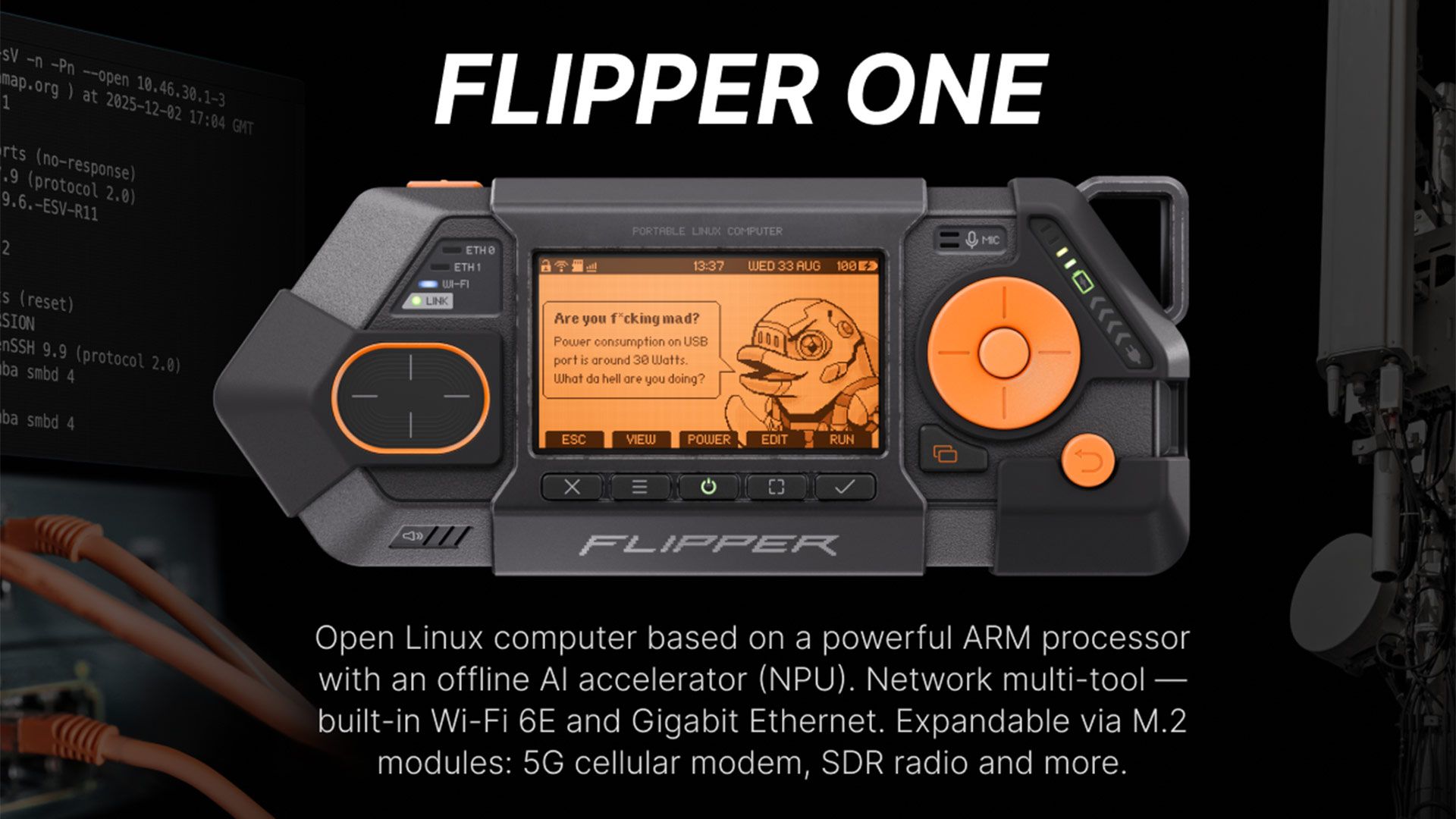
8GB of RAM. An octa-core Rockchip RK3576. A device that’s purportedly as capable as a Raspberry Pi 5, but small enough to jingle in your pocket. This isn’t science fiction; it’s the Flipper One, the latest ambitious — and as-yet-unreleased — offering from the folks who brought you the Flipper Zero. But let’s not get ahead of ourselves. The real story here isn’t just the spec sheet; it’s the architecture, the open development philosophy, and the sheer audacity of building a truly modular, long-lasting Linux computer from the ground up.
Is Flipper One Just a Flipper Zero 2.0?
The team at Flipper Devices is quick to point out that the Flipper One is not an upgrade to the Zero. They’re distinct beasts, built for different tasks. While the Zero is a specialized, tightly scoped multitool, the One is aiming for something far broader: a fully open Arm Linux device that, and this is the kicker, doesn’t become obsolete the moment it ships. That’s a tall order, especially in the perpetually fast-moving world of consumer electronics.
The core of this ambition lies in the hardware. We’re talking about a Rockchip RK3576 SoC, a chip that brings serious compute power to the table, complete with an integrated Mali-G52 GPU and, notably, a Neural Processing Unit (NPU) for AI acceleration. This is paired with a separate, low-power MCU (the RP2350) that can handle basic tasks independently, ensuring some functionality even when the main Linux system isn’t fully engaged. It’s a coprocessor architecture that promises flexibility, allowing for basic operations without booting a full Linux distro, or diving deep into a Debian-based OS for more complex tasks.
“Flipper One is what happens when we apply the same approach to a much bigger problem — building a fully open ARM Linux device that doesn’t go obsolete the moment it ships. To be honest, it’s hard, and we can’t do that alone, which is why we’re opening the development process from day one.”
The M.2 Gamble: Modularity or Mess?
What really sets the Flipper One apart, architecturally, is its embrace of modularity through an M.2 slot. This isn’t just for show; it’s a deliberate design choice to combat planned obsolescence. By offering a standard expansion interface, Flipper Devices is betting that users will be able to swap in new storage, Wi-Fi cards, or even specialized accelerators down the line, extending the device’s lifespan. It’s a concept that echoes the early days of the PC, where upgradability was king. The inclusion of a full-size HDMI port and USB-C with DisplayPort Alt Mode further emphasizes its aspiration to be more than just a handheld gadget; it’s envisioned as a potential media box or even a portable workstation.
But this is where the deep-dive gets interesting, and frankly, a little hairy. Getting an SoC like the RK3576 fully integrated and supported in mainline Linux is a monumental undertaking. Flipper Devices has partnered with Collabora, a respected name in open-source development, to push support for the RK3576 into the Linux kernel. This includes critical work on power management and USB DP Alt-mode. However, many of the SoC’s more advanced features – the NPU, hardware video decoding, and other accelerators – are still not upstream. This means that while the hardware is there, the software ecosystem to fully exploit it is very much a work in progress.
This is precisely why Flipper Devices is opening the development process so early. They’ve launched the Flipper One Developer Portal, a public wiki that acts as a central hub for all development documentation. It’s an ambitious move, essentially outsourcing a significant chunk of the integration and debugging to the community. We’re talking about sub-projects covering Hardware, Mechanics, Linux software, MCU Firmware, User Interface, Documentation, and Testing. Anyone can join, which is both a proof to their commitment to open source and a stark indicator of how much work remains.
Why Does This Matter for Developers?
For developers, the Flipper One represents a fascinating new canvas. The prospect of a portable, fully open Linux device with dedicated AI hardware is tantalizing. Imagine running LLMs locally on a device that fits in your palm, or leveraging the NPU for real-time signal processing. The FlipCTL framework, designed for interacting with the device’s limited screen and buttons, hints at a user experience that’s both accessible and deeply customizable.
However, the reliance on community contributions for critical driver development and upstreaming also presents challenges. Will the community rally enough to tackle the thorny issues of power management and accelerator drivers? Will the M.2 ecosystem mature quickly enough to offer compelling expansion options? These are the questions that will ultimately determine whether the Flipper One becomes a truly revolutionary device or another ambitious project that flickers out.
The AI angle, while present with the on-chip NPU, is also framed realistically. While local LLMs are the goal, there are “wrinkles” to overcome. For now, external AI agents are the more immediate path, leveraging internet connectivity. This suggests a pragmatic approach: build what’s feasible now, and push for the bleeding edge as the underlying software and hardware capabilities mature.
Ultimately, the Flipper One is an experiment in distributed hardware and software development. It’s a bet on the power of community to overcome the immense challenges of building a complex, open, and long-lasting computing device. The hardware is impressive, the vision is bold, but the success hinges entirely on execution and the collective effort of its nascent developer base. We’ll be watching closely.
🧬 Related Insights
- Read more: VSORA’s Jotunn8: Silicon That Starves Never Again for AI Inference
- Read more: How Does TSMC Work?
Frequently Asked Questions
What is Flipper One? Flipper One is a new pocketable device designed to be a fully open Arm Linux computer with modular expansion capabilities, built by the creators of the Flipper Zero.
Will Flipper One replace my Flipper Zero? No, Flipper Devices states that the Flipper Zero and Flipper One are completely different projects built for different tasks.
What kind of processor does Flipper One use? Flipper One uses an octa-core Rockchip RK3576 SoC, which is paired with an RP2350 low-power MCU, and is capable of running Linux.