Yield Cliffs Crossed
The promise of a single, unified model to predict manufacturing yield across vastly different industries—semiconductors, batteries, pharmaceuticals, even quantum systems—sounds like wishful thinking. Yet, that’s precisely what the authors of “Industrial Defectivity Prediction (IDP) V6: A Two-Layer Yield Cliff Framework for Cross-Industry Mass-Production Forecasting” are proposing. This isn’t just another academic exercise; it’s a calculated attempt to move beyond proprietary, process-specific models and offer a generalized architecture that could fundamentally alter how we strategize in high-volume production.
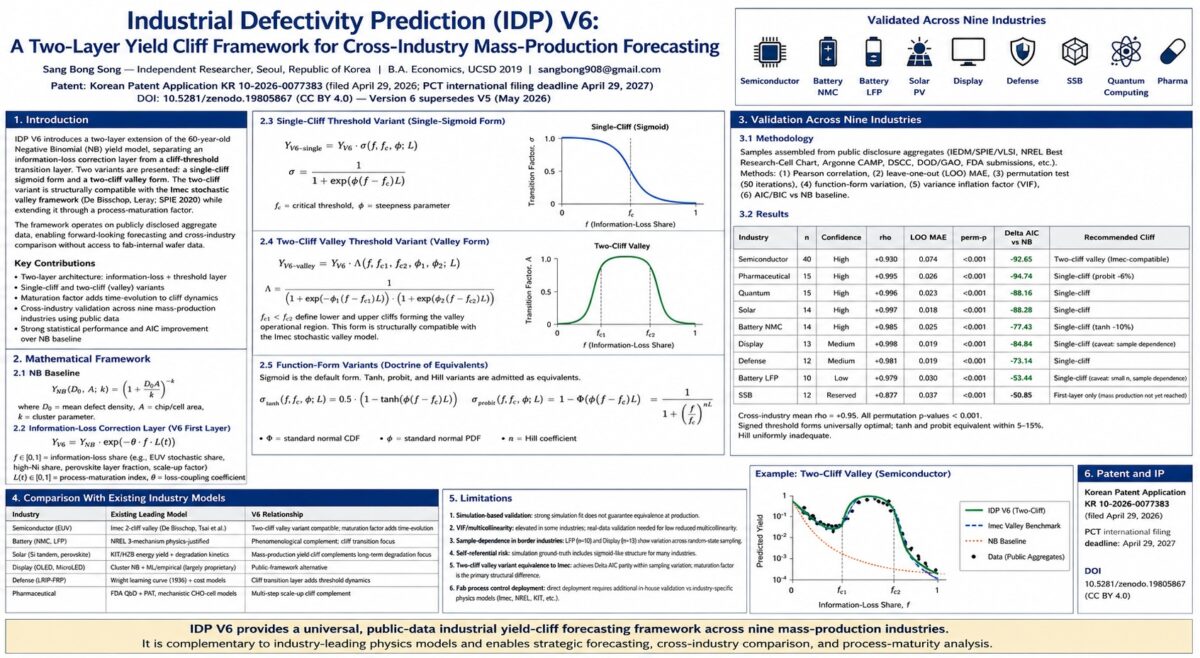
Here’s the core of it: the traditional Negative Binomial (NB) model, a workhorse in semiconductor defect analysis since the 70s, gets a serious facelift. IDP V6 layers on two crucial components. First, an information-loss correction layer accounts for process immaturity and the inherent noise that plagues nascent manufacturing lines. This layer introduces parameters like f (information-loss share) and L(t) (process maturation index), acknowledging that early-stage processes are inherently more unpredictable than mature ones. It’s a smart nod to the reality that new tech rarely hits peak efficiency out of the gate.
Then comes the real innovation: the “yield cliff” layer. This is where the model tackles those dreaded, abrupt drops in manufacturable output that can cripple production schedules. Think of it like a sudden drop-off in a ski slope—a small perturbation at the top can lead to a massive, chaotic descent at the bottom. The framework offers single-cliff and two-cliff variants, the latter being particularly interesting for its compatibility with advanced lithography concepts like Imec’s EUV stochastic valley framework. The key addition here is a time-evolution factor, something that adds a much-needed dynamic element to existing valley-only models.
Is This Just Another Theoretical Model?
One of the paper’s most compelling aspects is its empirical validation strategy. Instead of relying on internal, cherry-picked data, the researchers aggregated publicly available information from a staggering array of sources: government disclosures, conference proceedings, NREL battery datasets, FDA submissions, and defense reports. This broad-brush approach is crucial for demonstrating genuine cross-industry applicability.
They then subjected IDP V6 to six rigorous statistical validation methods. The results? Frankly, impressive. Eight out of nine industries studied achieved Pearson correlations above +0.9. Pharmaceuticals, solar, and quantum computing flirted with perfect correlation (approaching +0.996 to +0.997), while even the notoriously complex semiconductor sector hit +0.93 with significant improvements over standard NB models. The claim of structural compatibility with benchmarks like Imec’s is further bolstered by statistical equivalence within sampling variation.
The reported results indicate strong statistical performance. Eight of nine industries achieved Pearson correlations exceeding +0.9, with pharmaceutical, solar, and quantum-computing categories approaching +0.996 to +0.997 correlation.
This isn’t just about fitting curves; it’s about building a predictive tool that can inform strategic decisions. For companies operating in multiple, diverse manufacturing domains, the ability to forecast yield with a unified framework could unlock significant efficiencies. Imagine a conglomerate that manufactures everything from chip components to advanced drug formulations – having a single lens through which to view potential yield disruptions across their portfolio is a powerful proposition.
Why Does This Matter for the Chip Industry?
While IDP V6 aims for breadth, its semiconductor application is particularly noteworthy. The explicit mention of compatibility with Imec’s stochastic valley framework for EUV lithography isn’t a coincidence. This is where yield cliffs are most acutely felt and where the financial stakes are astronomically high. The ability to model these transitions dynamically and in a unified manner alongside other advanced manufacturing processes—potentially even within the same corporate structure—offers a more holistic view of manufacturing risk and opportunity.
But let’s pump the brakes slightly. While the validation is strong, the paper operates on aggregate, publicly disclosed data. Real-world manufacturing floor data is infinitely more granular and often proprietary for good reason. The leap from aggregate trends to precise, actionable insights on a specific factory line will require significant fine-tuning and likely the integration of more specific process parameters—even if the underlying IDP V6 framework provides the generalized architecture.
Furthermore, the “doctrine of equivalents” approach, allowing for alternative threshold operators like tanh and probit alongside the default sigmoid, acknowledges that a one-size-fits-all mathematical function might be too simplistic. While sigmoid performs best universally, the performance equivalence of other functions suggests that industry-specific nuances might still favor tailored mathematical representations. Hill functions, notably, were deemed inadequate, highlighting that not all statistical models translate well across diverse physical phenomena.
The Bigger Picture: Data Unification in Manufacturing
What IDP V6 hints at is a future where manufacturing data, often siloed and industry-specific, can be brought under a more unified analytical umbrella. This is especially critical in an era of supply chain fragility and the increasing complexity of advanced manufacturing. Companies can’t afford to be myopic; understanding how a disruption in one sector might ripple through another, or how best practices from battery manufacturing might inform pharmaceutical production, requires this kind of generalized modeling capability.
It’s a bold statement, certainly. The true test will be adoption and adaptation. Will fabs, pharma plants, and battery factories embrace a framework that, while rooted in familiar mathematical concepts, presents a new, cross-industry paradigm? The potential for cost savings, improved foresight, and more strategic resource allocation is immense. IDP V6 might just be the Rosetta Stone for manufacturing yield prediction, offering a common language for diverse industrial outputs.
🧬 Related Insights
- Read more: What is EUV Lithography?
- Read more: Switch Hacks 3D Printer: 90 Min to 8 Min!